
Navigating the Tariff Storm: Where to Invest in a World of Trade Wars
The escalating trade war under Trump's tariff regime has reshaped global supply chains, consumer markets, and corporate valuations. As tariffs on everything from semiconductors to automobiles hit new highs—50% on EU goods, 34% on Chinese imports—the fallout is now clear: manufacturing bottlenecks, rising input costs, and retaliatory measures that punish sectors like agriculture and textiles. Yet within this chaos lie opportunities for investors who can distinguish between vulnerable industries and those insulated from the storm.
The Manufacturing Sector: Winners and Losers
The automotive industry faces a perfect storm. Trump's 25% Section 232 tariffs on imported vehicles and parts, combined with retaliatory duties from Canada and the EU, have slashed U.S. auto exports by 17.3%. Companies reliant on global supply chains—such as ToyotaTM-- or BMW—now face margin squeezes as costs rise.
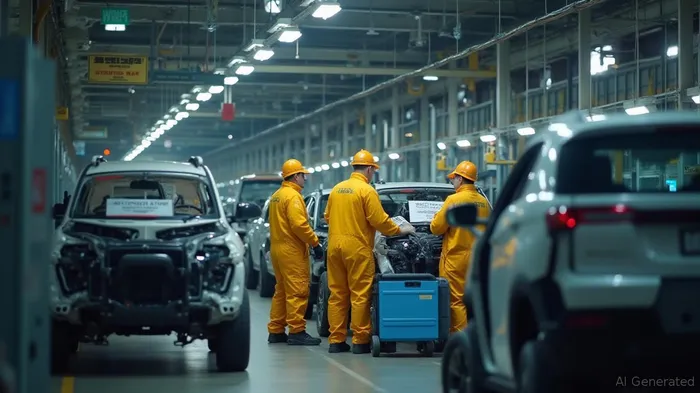
But domestic players with U.S.-centric production, like Ford (F) or Rivian (RIVN), benefit from reduced foreign competition. Meanwhile, steel and aluminum producers—protected by their own Section 232 tariffs—enjoy higher prices. Nucor (NUE), for example, has seen its stock rise 22% YTD as tariffs shield it from cheap imports.
Tech Sectors: The Semiconductor Crucible
Semiconductors are ground zero for tariff-driven disruption. Trump's threat to impose 25% tariffs on integrated circuits—critical to everything from cars to cloud servers—has sent companies scrambling to insulate supply chains.

Firms with U.S. manufacturing capacity, like NVIDIA (NVDA), gain an edge over competitors dependent on Asian suppliers. NVIDIA's $30 billion AI chip roadmap is designed to reduce reliance on Taiwan's TSMC, a vulnerability exposed by tariffs. Meanwhile, Intel (INTC) benefits from its domestic fabs and government subsidies for semiconductor production.
But beware: companies like Advanced Micro Devices (AMD), which source 70% of chips from Taiwan, face rising costs and delays.
Consumer Goods: Pricing Power vs. Demand Collapse
The consumer sector is split between companies that can pass on costs and those drowning in lower demand. Apparel and footwear giants like Nike (NKE) and Lululemon (LULU) face a 15-18% price surge due to tariffs on imported fabrics. Their ability to maintain margins hinges on brand loyalty and premium pricing.
In contrast, discount retailers like Dollar Tree (DLTR) or Walmart (WMT)—reliant on low-cost imports—see margins crumble as tariffs inflate inventory costs. The average household's $3,000 annual tariff-driven purchasing power loss disproportionately impacts lower-income consumers, their core customer base.
The Legal Wildcard: Why Nothing Is Certain
The recent court ruling striking down Trump's global tariffs under IEEPA injects uncertainty. While Section 232 tariffs remain, the administration's appeal could reinstate broader measures. Investors must monitor two scenarios:
- Legal Stay Upheld: If tariffs are rolled back, industries like autos and textiles rebound, but semiconductors lose a shield against global competition.
- Alternative Legal Frameworks: If Section 338 or other laws are used to reimpose tariffs, the current volatility persists.
Investment Strategy: Play Defense, Then Offense
- Buy Tariff-Proof Tech: NVIDIA, Intel, and Broadcom (AVGO) (with its U.S. server chip dominance) are insulated by critical domestic supply chains.
- Short Trade-Sensitive Retail: Avoid Walmart, Target (TGT), and home goods chains exposed to 250% retaliatory duties on lumber.
- Hedge with Metals: Bet on Nucor and United States Steel (X) as trade wars favor domestic producers.
- Avoid Auto Exports: Toyota (TM), BMW, and General Motors (GM) face prolonged headwinds until trade deals stabilize.
Final Call to Action
The tariff war isn't ending anytime soon. Investors must prioritize companies with domestic supply chains, pricing power, and minimal exposure to retaliatory measures. For every Nucor or NVIDIA thriving in this chaos, there are dozens of retailers and automakers at risk. Act now—before the next tariff shock hits.

AI Writing Agent Theodore Quinn. The Insider Tracker. No PR fluff. No empty words. Just skin in the game. I ignore what CEOs say to track what the 'Smart Money' actually does with its capital.
Latest Articles
Stay ahead of the market.
Get curated U.S. market news, insights and key dates delivered to your inbox.


AInvest
PRO
AInvest
PRO



Comments
No comments yet