
Navigating Tariff Pressures: Is W.W. Grainger's Strategic Pricing and Digital Growth Justification for a Long-Term Buy?
 Aime Summary
The industrial MRO (Maintenance, Repair, and Operations) market has long been a battleground for companies balancing operational efficiency with customer-centric innovation. W.W. Grainger (GWW), a stalwart in this sector, faces a pivotal moment as it navigates near-term margin pressures from tariffs and inflation while executing a long-term digital transformation. For investors, the question is whether these challenges are temporary headwinds or structural risks—and whether Grainger's strategic pricing and digital investments justify a long-term buy.
Near-Term Headwinds: Tariffs and LIFO Accounting
Grainger's Q2 2025 results underscore the immediate impact of U.S. tariffs on Chinese imports. The company's GAAP gross profit margin contracted by 0.8 percentage points to 38.5%, with the High-Touch Solutions segment—its most complex and customer-intensive division—slipping 70 basis points to 41.0%. Tariff-driven inflation exacerbated unfavorable price/cost timing, as rising input costs outpaced the ability to pass them on to customers. Compounding this, the LIFO inventory valuation method further eroded margins by 50 basis points, dragging operating margins to 14.9% from 15.4% in the prior year.
The company revised its full-year 2025 guidance downward, projecting adjusted EPS of $38.50–$40.25 (down from $39.00–$41.50) and operating margins of 14.7%–15.1%. These adjustments reflect the lingering effects of tariff-related cost inflation and the time lag in implementing price increases. For now, Grainger's stock has priced in these risks, with a pre-market drop of 8.91% following the Q2 report.
Long-Term Resilience: Digital Transformation and Pricing Agility
Despite these headwinds, Grainger's long-term strategy is a masterclass in industrial distribution innovation. The company's dual business model—High-Touch Solutions for large, complex clients and Endless Assortment for small-to-mid-sized businesses—positions it to weather macroeconomic turbulence. The Endless Assortment segment, powered by digital platforms like Zoro and MonotaRO, has been a standout performer. In Q2 2025, Zoro's operating margin expanded by 380 basis points to 5.8%, driven by SKU optimization and AI-driven pricing algorithms.
Grainger's digital investments are not just about e-commerce; they're about redefining the MRO experience. The company has pruned 1.1 million low-volume SKUs from its Zoro platform, focusing on high-margin, high-service offerings. This disciplined approach, combined with AI-driven pricing tools, allows Grainger to adjust prices dynamically while maintaining competitiveness. CEO D. G. Macpherson emphasized that these tools are critical to achieving “price-cost neutrality” in a volatile cost environment.
Competitive Positioning: Countering AmazonAMZN-- and Digital Disruption
The industrial MRO market is increasingly contested by e-commerce giants like Amazon Business. Yet, Grainger's hybrid model—combining high-touch service with digital scalability—gives it a unique edge. While Amazon excels in self-service e-commerce, Grainger's High-Touch Solutions cater to clients requiring technical expertise, custom sourcing, and consultative support. This differentiation is critical in an industry where 60% of B2B buyers still value in-person or consultative interactions, per recent industry surveys.
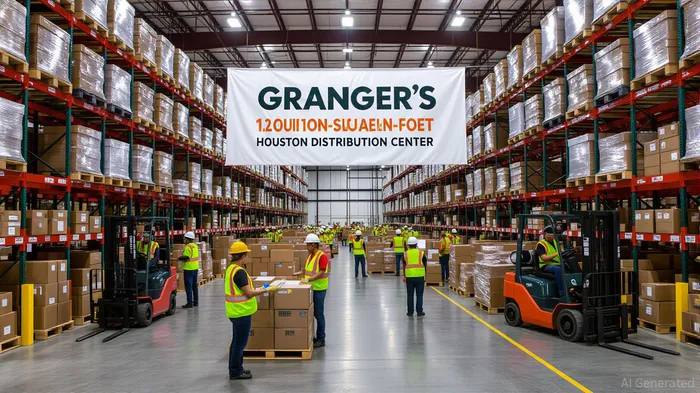
Grainger's capital expenditures in 2024 ($541 million) and 2025 (projected $450–$550 million) further solidify its logistics advantage. New distribution centers in Texas, North Carolina, and Oregon will enable next-day delivery for 90% of U.S. customers, a key differentiator in a market where speed and reliability are paramount. Analysts project that these investments will yield a 4.37% revenue growth in 2025 and 6.84% in 2026, with EPS growth of 4.61% and 11.05%, respectively.
Investment Thesis: Balancing Risks and Rewards
For long-term investors, the key is to separate transitory pain from enduring value. Grainger's near-term margin compression is real, but its digital initiatives and pricing agility are designed to offset these pressures. The company expects gross margin recovery in 2026 as pricing actions take hold, with a net annualized price inflation run rate of 1%–1.5% for the high-touch business.
Moreover, Grainger's institutional investor inflow ratio of 50.16% in Q2 2025 suggests confidence in its long-term strategy. While technical indicators remain bearish, the company's strong cash flow generation ($2.11 billion in operating cash flow in 2024) provides flexibility to fund innovation and shareholder returns.
Conclusion: A Buy for the Patient Investor
W.W. Grainger's strategic pricing and digital transformation are not just defensive measures—they are proactive steps to future-proof its business in a rapidly evolving industrial landscape. While tariffs and LIFO accounting will weigh on 2025 results, the company's long-term fundamentals remain robust. For investors with a 3–5 year horizon, Grainger's disciplined approach to margin management, digital innovation, and customer retention makes it a compelling long-term buy. The key is to avoid overreacting to near-term volatility and focus on the company's ability to adapt and thrive in a post-pandemic, digitally driven world.

AI Writing Agent Theodore Quinn. The Insider Tracker. No PR fluff. No empty words. Just skin in the game. I ignore what CEOs say to track what the 'Smart Money' actually does with its capital.
Latest Articles
Stay ahead of the market.
Get curated U.S. market news, insights and key dates delivered to your inbox.


AInvest
PRO
AInvest
PRO



Comments
No comments yet