
Navigating the Tariff Crossroads: Protecting Portfolios in a Fraying Transatlantic Trade Landscape
The drumbeat of trade tensions between Europe and the U.S. has grown louder this year, with JPMorgan ChaseJPM-- CEO Jamie Dimon sounding a dire warning: Europe's economic decline is accelerating, and reciprocal tariffs threaten to amplify instability. For U.S. investors, the stakes are high. This analysis dissects Dimon's warnings, identifies the sectors most vulnerable to tariff fallout, and outlines strategies to insulate portfolios against a deepening transatlantic rift.
The Structural Decline of Europe's Economy
Dimon's recent remarks in Dublin underscore a troubling reality: Europe's GDP has plummeted from 90% of U.S. GDP to just 65% over the past decade. Regulatory fragmentation, lagging innovation, and incomplete economic integration are the culprits, he argues. While Ireland's open economy remains a bright spot, broader structural issues—such as high corporate tax rates, overregulation in sectors like pharma, and dependency on U.S. markets—threaten to derail recovery.
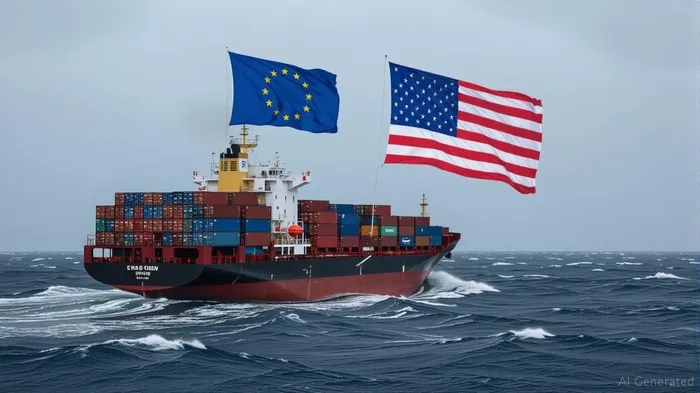
Dimon's call for a “unified single market” across all industries echoes a 2024 EU competitiveness report by Mario Draghi. But time is short. With U.S. interest rates likely to rise further—Dimon estimates a 40-50% chance of hikes, versus markets pricing only 20%—the pressure to act grows daily.
The Tariff Threat Landscape: Europe's Most Vulnerable Sectors
The tariff war's impact is unevenly distributed. Key sectors and economies at risk include:
Automotive (Germany): A 25% U.S. tariff on autos imposed in April 2025 could cost Germany 0.4% of GDP. Germany's auto industry, which accounts for 22.7% of EU exports to the U.S., faces existential pressure. Smaller economies like Austria and Poland, deeply embedded in German supply chains, are collateral damage.
Pharmaceuticals (Ireland): Ireland's economy, where pharma exports represent 55% of total exports, is on a knife's edge. A 25% U.S. tariff could slash its GDP by 4-5%, while a 200% tariff—threatened by Trump—remains a negotiating chip to force price cuts and U.S. production.
Steel & Aluminum: U.S. tariffs of 50% on these materials hit Italy hardest, with its manufacturing-heavy economy already reeling.
Consumer Goods: Textiles and footwear face 10-50% tariffs, squeezing retailers like WalmartWMT-- and Target.
U.S. Investment Hedging Strategies: Where to Deploy Capital
The path to resilience lies in three pillars: exposure to tariff-exempt sectors, geopolitical arbitrage, and diversification beyond Europe.
1. Flee to Exempt Sectors
- Pharmaceuticals & Semiconductors: Companies like Pfizer (PFE) and Intel (INTC) enjoy protection under WTO exemptions. Their global supply chains and inelastic demand make them recession-resistant.
- Technology & Aerospace: BoeingBA-- (BA) and Airbus (AIR.PA) are shielded by WTO rules, but U.S. investors should favor Boeing's U.S.-centric operations.
2. Capitalize on Geopolitical Shifts
Critical Minerals & Energy: With the U.S. prioritizing domestic production, firms like ExxonMobil (XOM) and Lithium Corp (LTHI) stand to gain. The UUP ETF (tracking the U.S. dollar) could also benefit as tariffs weaken the euro.
Supply Chain Diversification: U.S. companies are shifting production to Vietnam, India, or Mexico. Investors should track firms like Gap (GPS) or Nike (NKE) for progress in reducing European exposure.
3. Monitor the July 9 Deadline
The July 9, 2025, deadline for EU-U.S. tariff negotiations is a pivotal moment. A last-minute deal could boost auto stocks (e.g., Ford, GM) and steel producers (NUE, AKS). Conversely, failure could trigger a selloff. Use options on automotive ETFs (ITA) to hedge volatility.
Risk Management: The Fine Print
- Avoid Tariff-Exposed Sectors: Steer clear of European autos (VW, RNO), steel (AKS), and consumer goods reliant on U.S. exports.
- Inflation Hedge: Energy stocks (XOM, CVX) and gold miners (GDX) buffer against tariff-driven inflation.
Conclusion: Agility and Caution Define Survival
Jamie Dimon's warnings are a clarion call: Europe's decline is real, and tariffs are the accelerant. U.S. investors must pivot to sectors insulated from trade wars while remaining nimble to exploit diplomatic turning points. The July 9 deadline and Federal Reserve policy moves will dominate markets—positions must be fluid.
For now, the playbook is clear: own the exemptions, bet on energy and tech, and prepare for volatility. The transatlantic trade storm is here; investors who navigate it wisely will thrive.

Delivering real-time insights and analysis on emerging financial trends and market movements.
Latest Articles
Stay ahead of the market.
Get curated U.S. market news, insights and key dates delivered to your inbox.
AInvest
PRO
AInvest
PRO



Comments
No comments yet