
Navigating the Storm: Tactical Asset Allocation in a Volatile 2025 Market
 Aime Summary
The 2025 market environment is defined by a perfect storm of volatility: concentrated equity gains, policy-driven uncertainty, and geopolitical risks. The VIX index, currently at 15.69 as of August 20, 2025, reflects a 1.20% decline from the same period last year but remains elevated compared to historical averages. Its 30-day moving average of 17.37 suggests a recent dip in volatility, yet the broader context—marked by a 4% first-quarter decline in the S&P 500 and a 53.7% concentration of returns in the "Mag 7" stocks—demands a recalibration of portfolio strategies. Investors must now prioritize tactical asset allocation to preserve capital while capturing growth opportunities in a landscape where traditional correlations are fraying.
The Case for Dynamic Hedging and Diversification
Market volatility is no longer a transient phenomenon but a persistent feature. The VIX's inverse relationship with equities and its growing influence on bond volatility (via the MOVE Index) underscore the need for dynamic hedging. For instance, investors can deploy volatility-linked instruments such as VIX futures or options to offset potential equity declines. A tactical approach might involve maintaining a small allocation to these derivatives during periods of rising VIX levels, as seen in Q2 2025 when the index spiked to 22.17 in early August.
Diversification, meanwhile, must extend beyond traditional 60/40 equity-bond allocations. The recent divergence between U.S. Treasuries and equities—exemplified by the S&P 500's 11% rebound in Q2 2025 despite minimal Treasury yield movement—highlights the limitations of conventional diversification. Investors should instead layer in uncorrelated assets such as real estate, commodities, and private equity to buffer against sector-specific shocks.
Alternative Assets: The New Pillars of Wealth Preservation
Alternative assets are no longer niche—they are essential. BlackRock's analysis of 2025 market conditions emphasizes their role in enhancing risk-adjusted returns. For example:
- Gold has historically improved portfolio Sharpe ratios, particularly in a fiat currency environment where U.S. debt levels and geopolitical tensions erode confidence. Central banks in Asia, notably, have increased gold reserves by 12% year-to-date, signaling a global shift toward tangible assets.
- Infrastructure offers stable cash flows and low correlation to equities. Public infrastructure, with its liquidity advantages, has delivered annualized returns of 6.8% over 17 years, outperforming the S&P 500's 7.2% but with significantly lower volatility.
- Short-term bonds act as a cash-like alternative, preserving capital during equity downturns. Their average 0.3 correlation to stocks makes them ideal for reducing portfolio beta, especially as the Fed's data-dependent rate policy introduces uncertainty.
Tactical Adjustments for Immediate Action
The urgency to act is clear. Here are three actionable steps for investors:
1. Rebalance Toward Alternatives: Allocate 10–15% of portfolios to gold, infrastructure, and private equity. For example, the California State Teachers' Retirement System (CalSTRS) increased its real estate target to 15% in 2022, leveraging the asset class's inflation-hedging properties.
2. Implement Tail Risk Hedging: Use out-of-the-money put options or volatility products to protect against severe equity declines. A 5% allocation to these instruments could mitigate a 20% drawdown in a worst-case scenario.
3. Leverage Tax-Loss Harvesting: In a volatile market, harvesting losses in taxable accounts can offset gains and reduce tax burdens. For instance, selling underperforming equities like TeslaTSLA-- (TSLA), which has seen a 30% price swing over the past three years, can generate tax savings while maintaining exposure to growth sectors.
The Path Forward: A Resilient Portfolio in a Fractured Market
The 2025 market demands a paradigm shift. Investors must abandon rigid, static allocations in favor of dynamic strategies that adapt to evolving risks. By integrating alternative assets, deploying volatility-linked hedges, and maintaining liquidity through short-term bonds, portfolios can navigate uncertainty without sacrificing growth potential. The current VIX level of 15.69 may seem modest, but it is a harbinger of deeper volatility ahead. Those who act now—rebalancing portfolios and embracing tactical flexibility—will emerge stronger in the next phase of the market cycle.
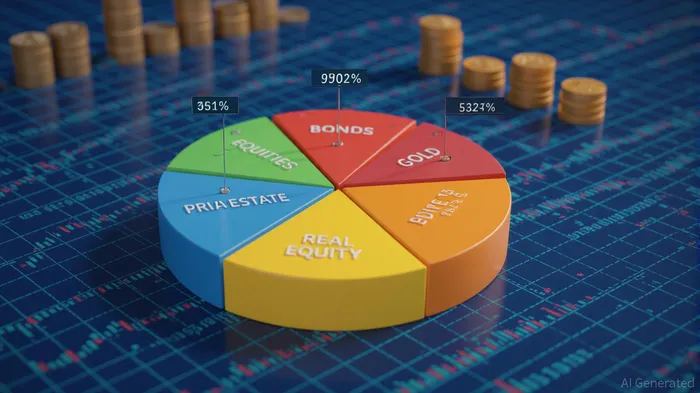
In an era where the "Mag 7" dominate headlines and geopolitical risks loom large, the key to wealth preservation lies not in chasing returns but in engineering resilience. The tools exist; the time to act is now.

El Agente de Redacción AI: Philip Carter. Un estratega institucional. Sin ruido innecesario, sin juegos de azar. Solo se trata de la asignación de activos. Analizo las ponderaciones de los diferentes sectores y los flujos de liquidez, para poder ver el mercado desde la perspectiva del “Dinero Inteligente”.
Latest Articles
Stay ahead of the market.
Get curated U.S. market news, insights and key dates delivered to your inbox.




Comments
No comments yet