
Navigating the Storm: Strategic Sectors to Weather Trump's Tariffs and Economic Slowdown
 Aime Summary
The U.S. economy is facing a perfect storm: a surge in protectionist tariffs under the Trump administration and a weak jobs report that has rattled investor confidence. These twin forces are reshaping market dynamics, creating volatility while also unveiling opportunities for those who can identify sectors poised to outperform in a slow-growth, protectionist environment.
The Tariff Tsunami and Its Ripple Effects
Since February 2025, the Trump administration has escalated tariffs on steel (now 50%), aluminum, autos, copper, and a host of other goods, while threatening 200% levies on pharmaceuticals. These measures, framed as a defense of national security and domestic industry, have triggered retaliatory tariffs from China, the EU, and Mexico, with $330 billion of U.S. exports now at risk. The economic toll is stark: GDP is projected to shrink by 1.0% in the long run, with household incomes set to decline by an average of $1,219 in 2025.
The legal battle over the IEEPA tariffs adds further uncertainty. A federal court recently ruled them illegal, but the administration's appeal has kept them in place pending a July 31 hearing. This limbo has created a “tariff fog,” complicating supply chains and forcing companies to hedge against shifting trade rules.
The Weak Jobs Report: A Harbinger of Stagnation
The latest jobs report—a mere 43,000 nonfarm payrolls added in July—has deepened fears of a prolonged slowdown. Unemployment rose to 4.3%, while wage growth stagnated at 2.1% year-over-year. These numbers signal a labor market teetering on the edge of contraction, with consumers and businesses bracing for tighter financial conditions.
Investor sentiment has turned bearish, with the S&P 500 down 7% from its January peak. Volatility, as measured by the VIX, has surged to 28, reflecting heightened risk aversion. Yet, in this turmoil lie opportunities for those who can spot sectors insulated from—or even benefiting from—the current chaos.
Logistics: The Unseen Backbone of Resilience
The logistics sector, long undervalued, is emerging as a critical player in this new era. With supply chains increasingly fragmented by tariffs and geopolitical tensions, demand for efficient, agile logistics solutions is surging. Companies specializing in AI-driven supply chain optimization, real-time tracking, and last-mile delivery are positioned to thrive.
Consider C.H. Robinson (CHRN), a leader in logistics software, whose shares have gained 12% year-to-date as businesses seek to mitigate disruptions. Similarly, J.B. Hunt Transport Services (JBT) has seen a 9% increase in revenue from its intermodal and brokerage segments, driven by higher freight rates and demand for just-in-time inventory solutions.
Investors should also eye infrastructure plays. The $35 billion UK National GridNGG-- upgrade and the EU's €584 billion grid investment plan highlight the need for modernized energy infrastructure, which is inextricably linked to logistics.
Energy: A Dual-Edged Sword in a High-Inflation World
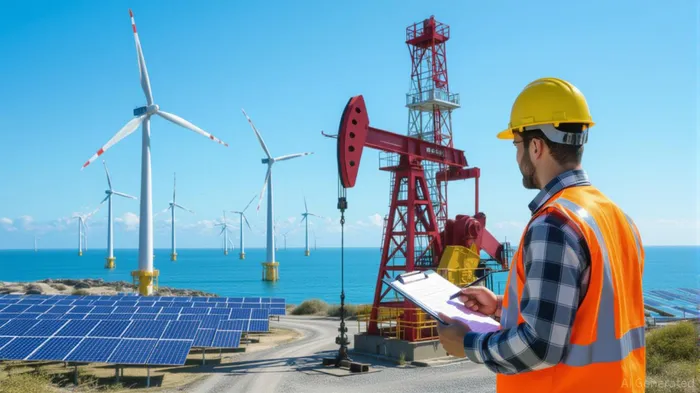
The energy sector is caught in a tug-of-war between fossil fuels and renewables. While Trump's tariffs on clean energy technologies (e.g., solar panels from China) threaten to slow the green transition, the sector's resilience lies in its duality.
Fossil Fuels: Short-Term Gains
OPEC's production cuts and geopolitical tensions have kept crude prices in a $75–$85 range, boosting margins for E&Ps like ExxonMobil (XOM) and Chevron (CVX). Both companies have seen EBITDA margins expand to 35% in Q2 2025, driven by higher oil prices and disciplined cost management.Renewables: Long-Term Potential
Despite near-term headwinds, the energy transition remains inevitable. The International Renewable Energy Agency (IRENA) reports that solar's levelized cost of energy (LCOE) is now 29% cheaper than the cheapest fossil fuel. NextEra Energy (NEE), the largest U.S. renewable generator, has seen its grid infrastructure segment grow by 18% year-over-year, underscoring the demand for grid modernization.
Investors should adopt a balanced approach: short-term exposure to E&Ps for income and long-term bets on grid infrastructure and storage solutions.
Defensive Equities: The Safe Havens in a Storm
As growth stocks falter, defensive sectors like utilities and consumer staples are gaining traction. Utilities, in particular, have outperformed the broader market, with the XLU ETF up 4.5% year-to-date. These stocks offer stable dividends and low volatility, making them ideal for a market environment marked by uncertainty.
Consumer Staples are also seeing a resurgence. Companies like Procter & Gamble (PG) and Coca-Cola (KO) benefit from inelastic demand, with PG's Q2 revenue rising 6% despite a weak jobs market. However, valuations are currently elevated (PG trades at 28x forward earnings), so investors should focus on companies with strong balance sheets and pricing power.
The Road Ahead: Strategic Positioning
The Trump-era tariff regime and a slowing labor market are reshaping the investment landscape. While the immediate outlook is fraught with risks, the sectors discussed above offer a roadmap to navigate the storm:
- Logistics and infrastructure for exposure to supply chain resilience.
- Energy for a dual strategy balancing short-term fossil fuel gains with long-term renewable infrastructure.
- Defensive equities for downside protection and income.
In this fragmented world, the key to outperforming lies not in chasing growth at all costs, but in identifying sectors that can endure—and even profit—from the new normal. As the old adage goes, “When the tide goes out, you learn who's been swimming naked.” Now is the time to build portfolios that can weather any storm.

Stay ahead of the market.
Get curated U.S. market news, insights and key dates delivered to your inbox.
AInvest
PRO
AInvest
PRO



Comments
No comments yet