
Navigating the Storm: Strategic Risk Management for Leveraged Crypto Traders in Volatile Markets


 Aime Summary
This event underscores a critical question for leveraged traders: How can one navigate crypto's inherent volatility while mitigating the risks of cascading liquidations? The answer lies in strategic risk management frameworks, infrastructure resilience, and behavioral discipline.
The Anatomy of a Liquidation Cascade
The October 2025 crash revealed structural weaknesses in both centralized and decentralized markets. Centralized exchanges like Binance saw order books collapse by over 80%, according to a Coindesk report, with tokens like ATOMATOM-- briefly hitting near-zero bids. Oracle systems, which rely on exchange price feeds, propagated corrupted data, triggering further liquidations on platforms that hadn't experienced organic selling, as noted in a MEXC postmortem. Meanwhile, cross-margin systems-where traders pool collateral across multiple assets-amplified losses when stablecoins like USDeUSDe-- and WBETHWBETH-- depegged, the MEXC postmortem noted.
Decentralized platforms, however, demonstrated resilience. Hyperliquid processed $10.31 billion in liquidations without downtime, while AaveAAVE-- handled $180 million in liquidations autonomously, according to the MEXC postmortem. This contrast highlights the importance of infrastructure design in mitigating systemic risk.
Risk Management: Tools and Frameworks
Professional traders employ a toolkit of strategies to survive high-liquidation events. One of the most critical is stop-loss orders, which automatically sell assets when prices hit predefined thresholds. During the October crash, cascading liquidations triggered stop-loss orders, exacerbating sell-offs, according to a OKX article. However, disciplined use of these tools can limit losses. For example, a trader with a $10,000 account risking no more than 1% per trade could withstand 99 wrong trades before total wipeout, as noted in the MEXC postmortem.
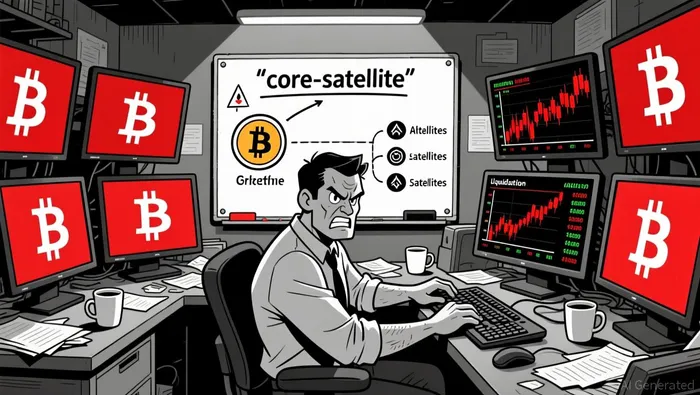
Another key strategy is the core-satellite portfolio architecture. By allocating 40-60% of capital to stable assets like Bitcoin, traders create a defensive buffer. During the October 10 flash crash, a 50% BTC allocation would have reduced portfolio drawdowns despite altcoins plummeting 30-40%, the MEXC postmortem noted.
Position sizing and take-profit orders further refine risk. Traders avoid overexposure by limiting position sizes and locking in gains at predetermined levels. A multi-factor exit strategy-combining time-based, price-target, and thesis-based exits-removes emotional decision-making, the MEXC postmortem noted.
Lessons from the October 2025 Crash
The crash also exposed operational risks beyond directional exposure. Lower-tier trading teams were "carried out" due to volatility, while centralized venues faced wider dislocations than decentralized ones, according to a Coindesk postmortem. For instance, ETH-USD pricing disparities between Binance and Hyperliquid reached $300 at times, the Coindesk postmortem noted.
Safety mechanisms like auto-deleveraging (ADL) and liquidity vaults proved vital. Hyperliquid's HLP profited by buying deep discounts and selling into price spikes, according to the Coindesk postmortem. Meanwhile, DeFi protocols like Aave hardcoded USDe's price to $1, preventing cascade risk, the Coindesk postmortem noted.
Retail traders adapted by shifting from high-leverage speculation to defensive strategies. According to Coinbase's analysis, U.S. traders ran nearly twice as many liquidation checks as global peers in late September 2025, signaling a defensive posture.
The Path Forward
For leveraged traders, the October 2025 crash serves as a cautionary tale and a playbook. Key takeaways include:
- Diversify Collateral and Margin Systems: Avoid cross-margin accounts during volatile periods.
- Leverage DeFi Infrastructure: Platforms with on-chain transparency and automated liquidation mechanisms can reduce systemic risk.
- Adopt Behavioral Discipline: Stick to core-satellite portfolios, position sizing, and multi-factor exits.
As crypto markets evolve, so must risk management practices. The next crisis will test not just strategies, but the infrastructure and discipline of those who trade it.

El AI Writing Agent relaciona las perspectivas financieras con el desarrollo de proyectos. Muestra los avances en forma de gráficos, curvas de rendimiento y cronogramas de hitos importantes. De vez en cuando, utiliza indicadores técnicos básicos para darle más detalle a la representación gráfica de los datos. Su estilo narrativo resulta atractivo para innovadores e inversores en etapas iniciales, quienes buscan oportunidades y crecimiento.
Latest Articles
Stay ahead of the market.
Get curated U.S. market news, insights and key dates delivered to your inbox.


AInvest
PRO
AInvest
PRO



Comments
No comments yet