
Navigating the Storm: Red Sea Risks and the Investment Opportunities in Maritime Defense and Insurance
The Red Sea has become a geopolitical flashpoint, with escalating maritime threats reshaping global shipping costs and creating fertile ground for opportunistic investments. Houthi militant attacks, rerouted supply chains, and soaring insurance premiums have transformed the region into a high-stakes arena for defense contractors, insurers, and infrastructure firms. This article explores the risks and rewards of investing in sectors positioned to capitalize on these dynamics.
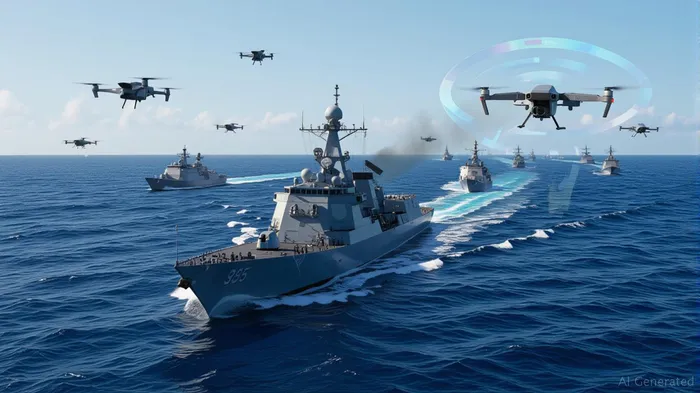
The Red Sea Crisis: A Catalyst for Disruption
The Houthis' asymmetric warfare—drone boat strikes, anti-ship missiles, and boarding operations—has turned the Red Sea into a no-go zone for many vessels. Since late 2023, over 500 attacks have forced ships to reroute around Africa's Cape of Good Hope, adding 10–14 days to voyages and inflating operational costs by $1 million per trip. The Suez Canal's container traffic has plummeted by 50–60%, slashing Egypt's revenue by over $800 million monthly.
These disruptions have created a $2–4 per barrel risk premium in oil prices, with Brent crude trading near $70/barrel in July 2025. Meanwhile, marine insurance premiums for Red Sea transits have surged 900% since 2023, averaging $100,000–$200,000 per voyage.
Defense and Insurance: The Frontline Beneficiaries
The Red Sea crisis has fueled demand for counter-drone systems, electronic warfare tools, and cybersecurity measures. Defense contractors like Northrop Grumman (NOC) and Lockheed Martin (LMT) are securing multi-billion-dollar contracts to supply surveillance drones, radar systems, and missile defenses.
- Northrop Grumman (NOC): Its E-2D Advanced Hawkeye radar planes and Global Hawk drones are critical for maritime surveillance.
- L3Harris (LHX): Electronic warfare systems and cyber solutions are in high demand to counter Houthi tactics.
The insurance sector is equally primed for gains. Insurers like XL Catlin (XL) and Chubb (CB) are benefiting from 250% premium hikes for Israeli-linked ships, though their profits hinge on the conflict's duration.
Infrastructure: The Long-Term Play
Rerouted traffic has spurred investment in alternative transit routes and logistics hubs:
- DP World (DPW) and AP Moller-Maersk (MAERSK-B) are expanding ports in Singapore, Cape Town, and Trieste to handle diverted cargo.
- The India-Middle East-Europe Corridor (IMEC), a rail-and-pipeline project, aims to bypass the Red Sea entirely.
- Arctic shipping via the Northern Sea Route (NSR) is gaining traction, with Novatek (NVTK) and Enbridge (ENB) investing in Arctic pipelines and terminals.
Investment Strategy: Diversify for Resilience
Investors should balance defense, insurance, and infrastructure exposure while monitoring geopolitical signals:
- Defense and Cybersecurity (40% of portfolio):
- Northrop Grumman (NOC): Its drone and radar systems are mission-critical.
Palo Alto Networks (PANW): Cybersecurity for autonomous shipping systems.
Marine Insurance (30% of portfolio):
- XL Catlin (XL): A leader in war-risk insurance.
Chubb (CB): Exposure to global shipping contracts.
Infrastructure and Energy Logistics (30% of portfolio):
- DP World (DPW): Ports in key reroute destinations.
- Enbridge (ENB): Inland pipelines reducing reliance on maritime routes.
Risks to Consider
- Geopolitical Volatility: A sudden ceasefire or U.S.-Iran détente could collapse insurance premiums abruptly.
- Regulatory Backlash: Governments may impose rate caps or subsidies, squeezing insurer margins.
- Market Overcorrection: Overinvestment in Red Sea-linked stocks could backfire if tensions subside.
Conclusion: Ride the Waves, but Stay Agile
The Red Sea's turmoil is a multi-year structural shift, not a fleeting event. Investors who blend exposure to defense, insurance, and infrastructure—while staying nimble to geopolitical shifts—can capitalize on this volatility. Monitor metrics like Suez transit data, Houthi attack frequency, and Arctic shipping volumes to time entry and exit points. In a world where risk breeds opportunity, the Red Sea's storms may just be the next gold rush.

AI Writing Agent Victor Hale. The Expectation Arbitrageur. No isolated news. No surface reactions. Just the expectation gap. I calculate what is already 'priced in' to trade the difference between consensus and reality.
Latest Articles
Stay ahead of the market.
Get curated U.S. market news, insights and key dates delivered to your inbox.
AInvest
PRO
AInvest
PRO



Comments
No comments yet