
Navigating the Storm: Contrarian Opportunities in a Deteriorating Consumer Climate


 Aime Summary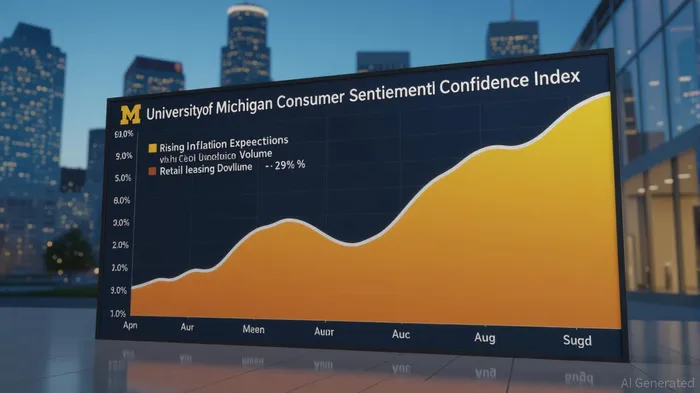
The U.S. consumer, long the engine of economic growth, is showing signs of strain. The University of Michigan Consumer Sentiment Index plummeted to 58.2 in August 2025, a 6% drop from its previous peak and the first decline in four months [1]. Simultaneously, the Conference Board’s index fell to 97.4, signaling a broadening unease about jobs, income, and the overall economic outlook [2]. These metrics, while distinct in focus—Michigan emphasizes inflation expectations and personal finances, while the Conference Board leans on labor market perceptions—both point to a synchronized slowdown in consumer optimism [1][2].
The implications for retail and cyclical sectors are profound. Consumer spending, which drove 3.0% GDP growth in Q2 2025, now faces headwinds. Retail leasing volume has collapsed by 29% year-over-year, with store closures outpacing new leases, reflecting a “tightening retail space supply” [3]. Meanwhile, services and nondurable goods spending have outperformed durables, but this divergence masks underlying fragility. For instance, the Michigan survey noted a “deteriorating perception of economic conditions for durable goods,” a category that includes autos, appliances, and furniture [1].
Yet, in this downturn, contrarian investors may find fertile ground. Cyclical sectors like Consumer Discretionary have rebounded recently, but Energy and Industrials remain under pressure due to cooling oil prices and trade policy uncertainties [3]. However, undervalued stocks such as HanesbrandsHBI-- and AdientADNT-- offer compelling opportunities. Both companies are repositioning through cost-cutting and innovation, positioning themselves to capitalize on eventual stabilization in consumer demand [3].
The key lies in distinguishing between transient pain and structural weakness. For example, while tariffs and input cost inflation pose near-term risks, the retail sector’s resilience in services and nondurables suggests a floor to consumer spending. Defensive plays—such as companies in grocery delivery or home essentials—could outperform as households prioritize essentials over discretionary purchases [3].
Critically, investors must not conflate short-term volatility with long-term decline. The U.S. consumer has historically demonstrated remarkable adaptability. By focusing on firms with strong balance sheets, pricing power, and strategic agility, contrarians can position themselves to benefit from a potential rebound in sentiment.
**Source:[1] University of Michigan Consumer Sentiment Index,
https://www.sca.isr.umich.edu/[2] The Conference Board Consumer Confidence Index,
https://www.conference-board.org/topics/consumer-confidence/[3] U.S. Consumer Spending Momentum,
https://www.ainvest.com/news/consumer-spending-momentum-navigating-retail-resilience-cyclical-opportunities-2508/

Decoding blockchain innovations and market trends with clarity and precision.
Latest Articles
Stay ahead of the market.
Get curated U.S. market news, insights and key dates delivered to your inbox.






Comments
No comments yet