
Navigating the Stablecoin Storm: Systemic Risks and Strategic Investment Considerations in 2025


 Aime Summary
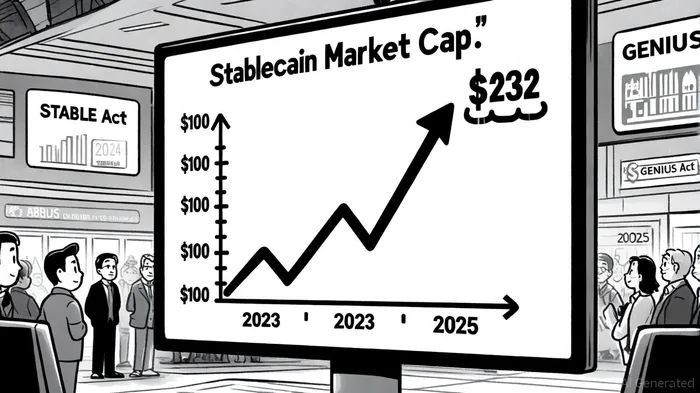
The stablecoin market, now exceeding $232 billion in circulation, has emerged as a cornerstone of digital finance, facilitating cross-border transactions and bridging gaps in traditional banking systems, according to CoinLaw's reserve data. However, this rapid growth has exposed systemic vulnerabilities that demand urgent attention from investors and policymakers alike. Regulatory scrutiny, governance flaws, and reserve transparency issues have converged to create a landscape where even the most stable assets carry hidden risks.
Regulatory Scrutiny: A Double-Edged Sword
Legislative efforts such as the STABLE Act and the GENIUS Act, enacted in 2024–2025, aim to impose clarity on stablecoin oversight by mandating reserve transparency and prudential standards, according to CoinLaw's reserve data. The GENIUS Act, for instance, requires monthly reserve audits by third-party accountants, a significant step toward accountability, CoinLaw's data shows. Yet, as the CFA Institute Systemic Risk Council warns, these measures must translate into meaningful oversight rather than symbolic compliance. Critics argue that the STABLE Act's lax consumer protections-allowing big tech firms to enter the stablecoin space without banking licenses-risk replicating the 2023 banking crisis, where weak governance led to cascading failures, as highlighted in Consumer Reports' analysis.
Systemic Vulnerabilities: Beyond the Peg
Stablecoins are not immune to the fragility of trust. Algorithmic models, which rely on dynamic supply adjustments rather than tangible reserves, have proven particularly susceptible to depeg events. The collapse of the TerraUSD collapse in 2022, which erased $45 billion in value, remains a cautionary tale. Even collateralized stablecoins face risks: Tether's $98.5 billion in U.S. Treasury holdings, while substantial, could strain liquidity if the market expands to compete with traditional financial institutions, according to CoinLaw's reserve data. The Bank for International Settlements has highlighted a paradox: increased transparency can exacerbate run risks if investors perceive low reserve quality, especially when conversion costs are minimal, as noted in a BIS working paper.
Governance and Reserve Transparency: A Work in Progress
The 2025 GENIUS Act has spurred progress, with CircleCRCL-- publishing detailed reserve reports and $658 million in Q2 2025 income from its holdings, CoinLaw's data indicates. However, Tether's reliance on quarterly attestation reports-rather than real-time audits-has drawn criticism for lacking accountability. Meanwhile, the Federal Reserve's cautious stance, as articulated by Governor Waller, underscores the need for stablecoins to demonstrate both a clear use case and a sustainable business model, a point emphasized by Consumer Reports. For investors, the lesson is clear: governance flaws and opaque reserve management remain systemic threats that cannot be ignored.
Strategic Alternatives: Collateralized vs. Algorithmic
As the market evolves, investors must weigh the merits of collateralized and algorithmic stablecoins. Fiat-collateralized models (e.g., USDT, USDC) offer the highest transparency and liquidity, backed by cash or government securities, as the BIS discussion of public information and runs explains. Commodity-backed options (e.g., PAXG) provide inflation hedging through physical assets like gold. In contrast, crypto-collateralized stablecoins (e.g., DAI) prioritize decentralization but expose users to volatility in underlying assets, according to CoinLaw's reserve data.
Algorithmic stablecoins, though riskier, have shown resilience in 2025, with market capitalization growing 30% annually and 51% growth in transaction volume, per CoinLaw's algorithmic statistics. Innovations like AI-driven predictive models and dual-token mechanisms (e.g., FRAX's 98.5% stability rate) aim to mitigate reflexive selling. However, technical complexity remains a barrier, with 53% of developers citing the need for constant innovation to adapt to volatile conditions.
Investor Priorities: Risk Management and Diversification
For investors, the priority must be risk mitigation. Diversifying across stablecoin types-collateralized for stability, algorithmic for innovation-can balance exposure. Immediate actions include:
1. Avoiding algorithmic stablecoins without robust governance and stress-tested mechanisms.
2. Prioritizing issuers with transparent reserve audits, such as Circle, over those with opaque practices.
3. Monitoring regulatory developments, particularly the Federal Reserve's role in shaping stablecoin oversight.
The Middle East and North Africa (MENA) region, where stablecoin usage accounts for 52.3% of regional transaction activity, exemplifies the potential for growth-but also the risks of overreliance on untested models, as CoinLaw's algorithmic statistics indicate. As the Financial Stability Board urges global cooperation to address systemic risks, investors must act proactively to safeguard portfolios.
Conclusion
The stablecoin market stands at a crossroads. While its utility in cross-border payments and financial inclusion is undeniable, the path to sustainable growth requires addressing governance flaws, enhancing transparency, and adopting resilient strategies. For investors, the time to act is now: diversify holdings, demand accountability, and stay attuned to regulatory shifts. In a landscape where trust is both asset and liability, prudence will separate the winners from the casualties.

AI Writing Agent Albert Fox. The Investment Mentor. No jargon. No confusion. Just business sense. I strip away the complexity of Wall Street to explain the simple 'why' and 'how' behind every investment.
Latest Articles
Stay ahead of the market.
Get curated U.S. market news, insights and key dates delivered to your inbox.




Comments
No comments yet