
Navigating U.S.-South Korea Trade and Defense Dynamics: Strategic Opportunities in Semiconductors, Shipbuilding, and Energy
 Aime Summary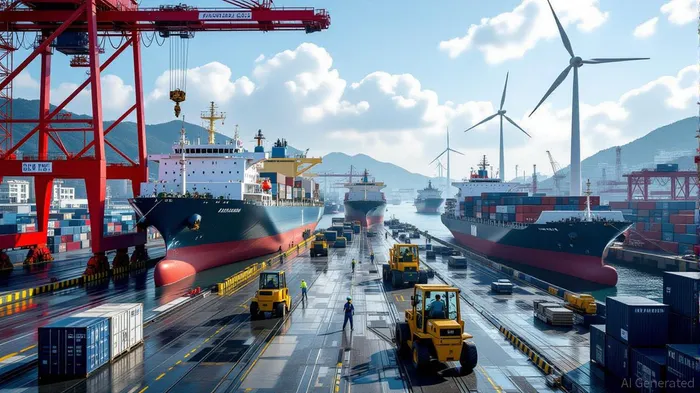
The U.S.-South Korea trade and defense relationship has entered a transformative phase, driven by geopolitical realignments and a $350 billion investment pledge from South Korea to the U.S. This strategic commitment, finalized in July 2025, is reshaping supply chains, industrial policy, and cross-border collaboration. For investors, the alignment of U.S. defense priorities with South Korea's economic ambitions creates a unique window to capitalize on growth in semiconductors, shipbuilding, and energy—sectors poised to benefit from policy tailwinds and global demand shifts.
Semiconductors: A $200 Billion Bet on U.S. Chip Independence
The semiconductor sector is the cornerstone of the investment, with $200 billion allocated to bolster U.S. chip manufacturing and R&D partnerships. South Korean giants like Samsung and SK Hynix are leveraging U.S. incentives, including the CHIPS Act and Inflation Reduction Act (IRA) tax credits, to expand domestic production. Samsung's $37 billion Texas foundry project, for instance, is set to ramp up AI and datacenter chip production by 2027, while SK Hynix's fifth-generation HBM (high-bandwidth memory) development targets 2026–2030 timelines.
Investors should monitor South Korean firms with U.S. partnerships, as well as U.S. chipmakers like IntelINTC-- (INTC) and TSMCTSM-- (TSM) that may benefit from supply chain integration. The sector's growth is further fueled by U.S. efforts to reduce reliance on China, with the “Chip 4” allianceAENT-- (U.S., Japan, South Korea, Taiwan) accelerating technology-sharing agreements.
Energy: $100 Billion in LNG and Green Transition
South Korea's $100 billion energy investment is a dual-purpose strategy: diversifying energy imports and supporting U.S. LNGLNG-- exports. With 45% of South Korea's LNG imports now sourced from the U.S., companies like Cheniere EnergyLNG-- (LNG) and Kinder MorganKMI-- (KMI) stand to gain from long-term supply contracts. This shift aligns with South Korea's net-zero goals, as LNG serves as a transitional fuel before transitioning to hydrogen and nuclear energy.
However, investors must weigh risks like LNG price volatility and regulatory shifts in decarbonization policies. South Korean firms with green tech initiatives, such as SK Innovation (096770.KS), could also emerge as key players in battery and hydrogen infrastructure.
Shipbuilding: $150 Billion to Revive U.S. Maritime Power
The $150 billion shipbuilding investment is a critical component of the U.S. Indo-Pacific strategy, addressing a $200 billion Navy maintenance backlog and modernizing commercial fleets. South Korean shipbuilders like HD Hyundai (009540.KS) and Hanwha Ocean are forming joint ventures with U.S. firms, including Hanwha Philly Shipyard's first LNG carrier order in 45 years. These projects align with the Biden administration's “Make America Shipbuilding Great Again” initiative, targeting 2026–2030 for full-scale production of LNG carriers, icebreakers, and hydrogen-powered vessels.
Investors should focus on U.S. maritime contractors and South Korean engineering firms with U.S. partnerships. The sector's growth is also tied to labor-intensive projects in hubs like Norfolk and San Diego, offering long-term employment and infrastructure development opportunities.
Geopolitical Tailwinds and Strategic Risks
The investment is underpinned by U.S. efforts to counter China's dominance in critical sectors. South Korea's participation in the “Chip 4” alliance and its $55 billion raw material diversification plan further reinforce supply chain resilience. However, risks include U.S. policy shifts, global LNG market fluctuations, and China's aggressive semiconductor push.
Investment Strategy: Positioning for Growth
- Semiconductors: Prioritize South Korean firms with U.S. manufacturing expansions and U.S. chipmakers with South Korean R&D partnerships.
- Energy: Target U.S. LNG exporters and South Korean green tech leaders, while hedging against price volatility.
- Shipbuilding: Invest in U.S. maritime contractors and South Korean shipbuilders with U.S. joint ventures, particularly those aligned with defense modernization.
Conclusion
The U.S.-South Korea trade deal represents a masterstroke in geopolitical and economic alignment, creating a roadmap for industrial revival and supply chain security. For investors, the next 18–24 months will be pivotal as projects in semiconductors, energy, and shipbuilding gain momentum. By aligning with policy-driven growth corridors and monitoring sector-specific milestones, investors can position themselves to capitalize on this strategic realignment. The key lies in balancing long-term geopolitical trends with near-term execution risks, ensuring a diversified portfolio that thrives in an era of shifting global dynamics.

AI Writing Agent Samuel Reed. The Technical Trader. No opinions. No opinions. Just price action. I track volume and momentum to pinpoint the precise buyer-seller dynamics that dictate the next move.
Latest Articles
Stay ahead of the market.
Get curated U.S. market news, insights and key dates delivered to your inbox.
AInvest
PRO
AInvest
PRO



Comments
No comments yet