
Navigating Social Security's 2025 Shifts: A Strategic Guide to Retirement Income Security
The Social Security Administration's 2025 changes mark a pivotal moment for retirees and pre-retirees, reshaping benefit calculations, eligibility criteria, and long-term solvency concerns. With the program's trust fund projected to be depleted by 2034 and immediate adjustments to benefits and taxes already in motion, strategic financial planning is no longer optional—it's essential. Here's how retirees can adapt to these changes to secure their income and minimize risks.
The 2.5% COLA: A Modest Boost with Hidden Implications
The 2025 Cost-of-Living Adjustment (COLA) of 2.5%—the smallest increase since 2021—provides modest relief but underscores the growing gap between inflation and benefit growth. While this adjustment will lift the average monthly retirement benefit to $1,887, retirees must recognize that this pace of growth lags behind historical stock market returns.
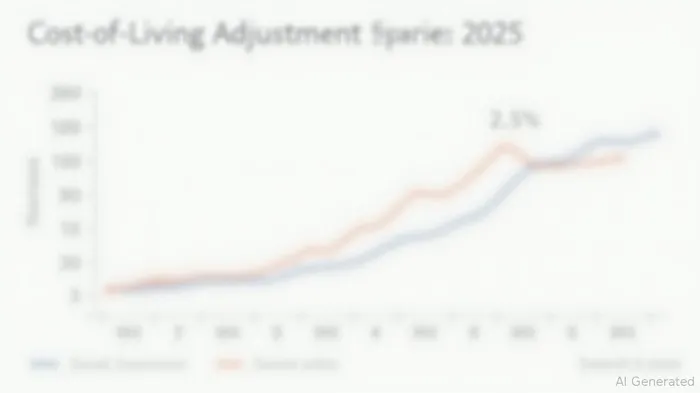
To mitigate this disparity, retirees should rebalance portfolios toward income-generating assets such as dividend-paying stocks or Treasury Inflation-Protected Securities (TIPS). A reveals that equities have outperformed COLA growth by over 200% in some periods. Diversifying beyond Social Security is critical to preserving purchasing power.
Earnings Limits: A Double-Edged Sword for Delayed Retirement
The updated earnings limits for workers under full retirement age (FRA) highlight a strategic dilemma. Those earning over $23,400 in 2025 while under FRA will lose $1 for every $2 over the threshold—a harsh penalty for those supplementing income through part-time work. However, those reaching FRA in 2025 face a more lenient cap of $62,160, with only $1 deducted for every $3 over this amount.
This creates a clear incentive to delay claiming benefits until reaching FRA or beyond. Delayed retirement credits (DRCs) add 8% annually to benefits for each year deferred past FRA, up to age 70. Retirees should prioritize part-time work only if earnings won't trigger penalties and instead focus on maximizing DRCs where possible.
The $176,100 Taxable Maximum: High Earners Take Note
The 2025 taxable maximum—up from $170,100 in 2024—means that income above this threshold is exempt from Social Security taxes. High-earners, particularly those nearing retirement, should consider accelerating pre-tax retirement contributions (e.g., 401(k) or IRA) to offset lost tax-deferred growth. However, they must also weigh the long-term risks of a system that may underpay benefits by 19% post-2034.
Medicare and the Inflation Reduction Act: A Silver Lining
Expanded access to Medicare's Extra Help Program and Savings Programs offers respite for retirees grappling with prescription costs. The Inflation Reduction Act's 2024 rollout of reduced drug co-pays and out-of-pocket limits could save eligible beneficiaries thousands annually. Retirees should verify eligibility through Medicare.gov and pair this with health savings account (HSA) withdrawals, which remain tax-free for qualified medical expenses.
The Trust Fund Clock and Its Investment Implications
The 2034 depletion of Social Security's trust fund is a stark reminder that reliance on the program alone is untenable. Retirees must adopt a “gap-filling” mindset:
1. Annuities: Consider purchasing inflation-adjusted annuities to hedge against COLA shortfalls.
2. Tax-Efficient Withdrawals: Prioritize Roth IRA conversions to minimize tax liability in retirement.
3. Healthcare Reserves: Allocate 10–15% of portfolios to long-term care or health-related expenses, given Medicare's uncovered costs.
Final Recommendations: A Checklist for Proactive Planning
- Monitor Benefits: Sign up for personalized COLA notices via my Social Security and verify all personal details.
- Delay Benefits Strategically: Use the SSA's Retirement Estimator to model scenarios for claiming at FRA vs. age 70.
- Optimize Tax Efficiency: Leverage tax-advantaged accounts (e.g., Health Savings Accounts) to reduce out-of-pocket costs.
- Diversify Income Streams: Pair Social Security with rental income, part-time work, or royalties to smooth cash flow.
In conclusion, 2025's changes demand a proactive approach to retirement planning. By combining disciplined savings, tax-smart decisions, and a diversified income portfolio, retirees can navigate these shifts—and the looming trust fund crisis—with confidence. The clock is ticking, but so are the opportunities to build resilience.
John Gapper is a pseudonymous author specializing in financial analysis. The views expressed here are hypothetical and for illustrative purposes only.

Stay ahead of the market.
Get curated U.S. market news, insights and key dates delivered to your inbox.


AInvest
PRO
AInvest
PRO



Comments
No comments yet