
Navigating the Shifting Tides: How U.S. Consumer Sentiment Shapes Sector Rotation Strategies
 Aime Summary
The U.S. equity market has long been a barometer of consumer psychology. Nowhere is this clearer than in the University of Michigan Consumer Expectations Survey, a dataset that has repeatedly proven its utility in predicting sector rotations. As of December 2025, the index rose to 53.3, a modest improvement from November's 51.0 but still 25% below its 2024 peak. This nuanced shift, coupled with persistent inflation expectations, offers a roadmap for investors seeking to navigate a market increasingly defined by duality: optimism in personal finances coexisting with skepticism about the broader economy.
The Dual Drivers of Consumer Behavior
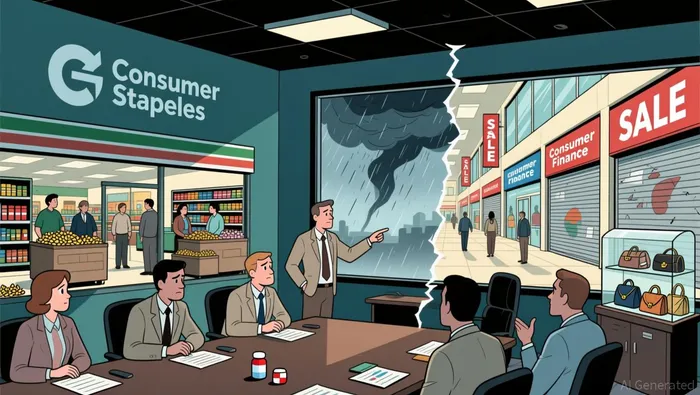
The December data reveals a paradox. While expectations for personal finances surged 13%—driven largely by younger consumers—labor market optimism remains “historically dismal.” This dichotomy suggests a market split between those cautiously optimistic about their own prospects and a broader population wary of macroeconomic headwinds. Such splits often favor sectors with inelastic demand, like Consumer Staples, while underperforming in high-beta discretionary categories.
Historically, when the Consumer Sentiment Index dips below 50, capital flows into defensive sectors. For example, in November 2025, when the index hit 49.0, the Consumer Staples Select Sector SPDR Fund (XLP) outperformed the S&P 500 by 2.1%. Conversely, when the index crosses 50, as it did in December, cyclical sectors like Consumer Finance gain traction. The 3.2% intraday gain in the Consumer Finance ETF (XLF) following a 10.5-point rise in June 2025 underscores this pattern.
Inflation Expectations: The Silent Sector Shifter
While the Consumer Sentiment Index provides a broad directional signal, inflation expectations act as a multiplier. Year-ahead inflation expectations in December 2025 fell to 4.1%, the lowest since January 2025, but still 1.1 percentage points above pre-pandemic levels. This persistent inflationary backdrop has two key implications:
- Discount Retailers Thrive: Elevated inflation disproportionately impacts essential goods, pushing consumers toward budget-friendly options. Walmart (WMT) and Costco (COST) have seen consistent outperformance in recent quarters, with WMT's revenue growing 6.8% year-over-year in Q4 2025.
- Premium Brands Under Pressure: Luxury and discretionary brands face headwinds. Tesla's (TSLA) stock price, for instance, has underperformed the S&P 500 by 12% over the past three years, reflecting waning demand for high-end goods amid inflationary uncertainty.
Strategic Overweights and Underweights
Given the current landscape, investors should consider the following allocations:
- Overweight Consumer Staples: With the Consumer Sentiment Index near 50 and inflation expectations still elevated, defensive positioning in staples is prudent. XLP's 1.2% dividend yield and low volatility make it an attractive proxy.
- Underweight Consumer Finance and Discretionary Sectors: While the index crossed 50 in December, its historical context—36% lower than December 2024—suggests caution. High-beta sectors like automotive and apparel remain vulnerable to sentiment reversals.
- Tactical Bets on Discount Retailers: Walmart and Costco's ability to absorb inflationary costs through scale and pricing power positions them as strong candidates for outperformance in a low-growth environment.
The Fed's Role and Forward-Looking Signals
The Federal Reserve's 25-basis-point rate cut in September 2025 aimed to stimulate spending, but its efficacy hinges on the persistence of inflation and policy clarity. Investors should monitor the interplay between the Current Economic Conditions Index (which hit an all-time low of 51.1 in November 2025) and the Consumer Expectations Index. A sustained divergence—where expectations improve but current conditions remain bleak—could signal a market primed for rotation into cyclical sectors once policy uncertainty abates.
Conclusion: Balancing Growth and Defense
The December 2025 data underscores a market in transition. While consumer optimism about personal finances is rising, it remains fragile against a backdrop of elevated inflation and weak labor market expectations. A balanced approach—overweighting defensive staples, underweighting discretionary sectors, and tactically allocating to discount retailers—offers a resilient strategy. As the Fed's policy trajectory and inflation trends evolve, the Michigan Consumer Expectations Survey will remain an indispensable tool for timing sector rotations in this volatile environment.

Stay ahead of the market.
Get curated U.S. market news, insights and key dates delivered to your inbox.
AInvest
PRO
AInvest
PRO



Comments
No comments yet