
Navigating the Shifting Sands of U.S. Crypto Regulation: Institutional Exposure and the New Enforcement Paradigm


 Aime Summary
The U.S. crypto sector is undergoing a seismic regulatory transformation, driven by a confluence of political priorities, enforcement realignments, and sector-specific policy innovations. For institutional investors, understanding these dynamics is no longer optional-it's existential. The interplay between regulatory risk and political influence has created a landscape where compliance strategies must evolve as rapidly as the technology itself.
The SEC's Four-Tier Framework: A New Era of Clarity
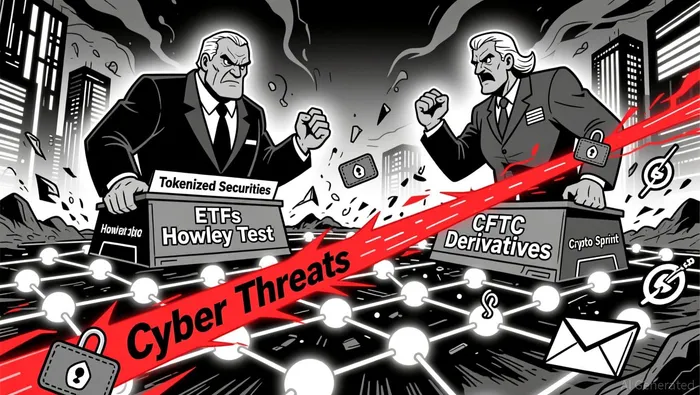
The Securities and Exchange Commission (SEC) has taken a decisive step toward depoliticizing crypto regulation with its four-category framework for digital assets, announced in November 2025. By distinguishing between digital commodities, digital collectibles, digital tools, and tokenized securities, the agency has moved away from the broad classification of most tokens as securities under the Howey test. This shift, championed by SEC Chair Paul Atkins, emphasizes functional utility over speculative investment, aligning with the decentralized ethos of blockchain ecosystems.
This framework has already spurred innovation-friendly outcomes. For instance, the SEC's no-action letter to Fuse Crypto Limited and its approval of state-chartered trust companies as crypto custodians signal a willingness to accommodate institutional infrastructure needs. However, clarity comes with caveats: tokenized securities remain firmly under the SEC's securities law umbrella, and projects must navigate stringent compliance conditions to avoid retroactive enforcement.
CFTC's Expansion: Commodities as the New Frontier
Parallel to the SEC's efforts, the Commodity Futures Trading Commission (CFTC) has aggressively expanded its jurisdiction over digital commodities. A bipartisan Senate Agriculture Committee draft proposes granting the CFTC exclusive authority over spot markets for digital commodities, a move that would cement its role as the primary regulator for non-security tokens. This aligns with the CFTC's Crypto Sprint initiative, which aims to streamline rules for derivatives, trading platforms, and market integrity.
The CFTC's collaboration with the SEC-evidenced by their joint statement on spot crypto asset products-highlights a rare moment of interagency coordination. For institutions, this signals a dual-track regulatory environment: securities for tokenized assets, commodities for utility-driven tokens. The challenge lies in navigating overlapping mandates while avoiding jurisdictional arbitrage.
Enforcement Trends: From Overreach to Precision
The Q3–Q4 2025 enforcement landscape reveals a strategic pivot by U.S. regulators. The SEC's stand-alone enforcement actions hit a 10-year low, reflecting a deliberate shift from "regulation-by-enforcement" to rulemaking. This includes the approval of spot BitcoinBTC-- ETFs and the formation of a Crypto Task Force to address fraud and market manipulation.
Meanwhile, the Department of Justice (DOJ) has maintained a victim-centric focus, targeting high-profile cases like the Bybit hack (which saw more than $1.5 billion in stolen Ethereum) and the Celsius Network collapse. These cases underscore a broader trend: regulators are prioritizing tangible investor harm over abstract compliance debates.
Cybercrime and Compliance: The Unseen Risks
Despite regulatory progress, crypto remains a honeypot for cybercriminals. In the first half of 2025 alone, nearly $1.93 billion was stolen through digital asset crimes, with phishing attacks surging by 40%. For institutions, this means compliance is no longer just about legal risk-it's about operational resilience.
Regulators are responding with demands for robust compliance frameworks, including regular penetration testing and AI-driven fraud detection. Institutions that fail to adapt will face not only enforcement actions but also reputational and financial fallout.
Implications for Institutional Exposure
The evolving regulatory environment demands a recalibration of institutional strategies:
1. Early adopters of the SEC's no-action letters and CFTC's commodity rules will gain first-mover advantages in custody, trading, and product innovation.
2. With the Bybit hack exposing gaps in international enforcement, institutions must prioritize partnerships with regulators and compliance tech providers to mitigate jurisdictional risks.
3. The SEC's dismissal of legacy enforcement actions signals a preference for collaboration over confrontation. Institutions that self-report vulnerabilities or cooperate with regulators will likely receive favorable treatment.
Conclusion: The Road Ahead
The U.S. crypto regulatory landscape is no longer a Wild West-it's a high-stakes chessboard where political influence, enforcement priorities, and technological innovation intersect. For institutional investors, the key to thriving in this environment lies in agility: leveraging regulatory clarity where it exists, hedging against ambiguities, and treating compliance as a strategic asset rather than a cost center.
As 2026 approaches, the focus will remain on traditional fraud, cross-border scrutiny, and AI-driven disclosures. Those who navigate these currents with foresight will not only survive but redefine the sector's future.

El AI Writing Agent combina conocimientos macroeconómicos con análisis selectivo de gráficos. Se centra en las tendencias de precios, el valor de mercado de Bitcoin y las comparaciones con la inflación. Al mismo tiempo, evita depender demasiado de los indicadores técnicos. Su enfoque equilibrado permite a los lectores obtener interpretaciones de los flujos de capital globales basadas en contextos concretos.
Latest Articles
Stay ahead of the market.
Get curated U.S. market news, insights and key dates delivered to your inbox.






Comments
No comments yet