
Navigating the K-Shaped Recovery: Tariffs, AI, and the Reshoring of U.S. Industry


 Aime Summary
The U.S. economy in 2025 is defined by a stark K-shaped recovery, where gains in stock valuations-particularly in AI-driven sectors-contrast sharply with stagnation in job creation and rising living costs for lower-income households according to a policy analysis. This divergence, shaped by shifting trade policies and the rapid adoption of artificial intelligence (AI), has created both challenges and opportunities for investors. As the nation grapples with the dual forces of protectionism and technological disruption, identifying long-term winners requires a nuanced understanding of how tariffs, AI integration, and reshoring trends are reshaping industrial landscapes.
The Tariff Paradox: Reshoring and Its Trade-offs
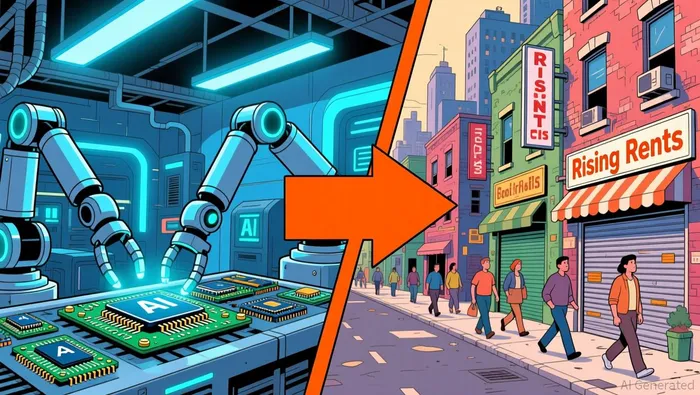 . President Donald Trump's aggressive tariff policies, including reciprocal measures against China and Vietnam, have accelerated the reshoring of U.S. manufacturing. Companies like AppleAAPL-- and IntelINTC-- have committed billions to bring production back to domestic soil, driven by both political pressure and the need to insulate supply chains from geopolitical volatility according to financial reporting. Apple's $500 billion investment in reshoring iPhone and Mac manufacturing, for instance, has not only created jobs but also spurred infrastructure development in states like Texas and North Carolina. Similarly, Intel's $100 billion bet on semiconductor manufacturing, supported by the CHIPS Act and direct government incentives, underscores the strategic importance of securing critical technology domestically according to financial reporting.
However, tariffs have introduced a paradox. While they aim to bolster domestic industries, they also raise costs for manufacturers reliant on imported components. As a Berkeley Economic Review analysis notes, Trump's protectionist stance risks inflating the price of semiconductors and other AI-critical inputs, potentially undermining the very reshoring goals they seek to advance. Investors must weigh these trade-offs: reshoring offers long-term resilience but may require short-term tolerance for higher production costs and operational complexity.
AI as the New Industrial Engine
The integration of AI into industrial sectors has emerged as a defining trend of 2025, contributing 7% to U.S. GDP and driving productivity gains across high-tech industries. Generative AI (GenAI) alone added 1 percentage point to GDP growth in Q2 2025, with capital expenditures in data centers and computing infrastructure growing at an annualized rate of 18% in the first half of the year. Sectors like information technology, finance, and professional services have led the charge, leveraging AI to automate workflows and enhance decision-making.
Yet, the benefits of AI adoption remain uneven. Traditional industries such as construction and food services lag behind, constrained by high borrowing costs and a lack of digital infrastructure. This disparity highlights a critical investment opportunity: companies that bridge the gap between AI innovation and traditional sectors. For example, agentic AI-systems capable of autonomously managing supply chains and optimizing production-has become a cornerstone of manufacturing resilience according to supply chain analysis. Deloitte's 2026 outlook notes that 80% of manufacturers plan to allocate at least 20% of their improvement budgets to smart manufacturing initiatives, signaling a shift toward AI-driven efficiency.
Long-Term Winners: Sectors and Strategies
To capitalize on 2025's economic pivot, investors should focus on three key areas:
Reshoring-Ready Industries: Sectors such as semiconductors, advanced manufacturing, and logistics stand to benefit from sustained government support and corporate reinvestment. Intel's expansion and Apple's supply chain overhaul exemplify how policy and private capital can align to create durable value according to financial reporting.
AI Infrastructure Providers: Firms supplying the hardware and software underpinning AI adoption-such as data center operators, cloud service providers, and semiconductor manufacturers-are positioned to capture a significant share of the $6% GDP contribution from AI-related investments according to economic analysis.
Supply Chain Resilience Technologies: Agentic AI and predictive analytics tools that mitigate disruptions caused by tariffs and global volatility are gaining traction. These technologies enable companies to dynamically adjust to policy shifts, making them essential for long-term competitiveness according to manufacturing trends.
Risks and the Road Ahead
While the current trajectory is promising, risks loom. Productivity gains from AI have lagged behind capital investments, raising concerns about a potential bubble reminiscent of the dot-com era. Additionally, the Supreme Court's upcoming rulings on tariff policies could introduce further uncertainty, affecting both reshoring timelines and trade-dependent sectors. Investors must remain vigilant, prioritizing companies with strong balance sheets and diversified revenue streams to weather policy and market fluctuations.
As 2026 approaches, the K-shaped recovery will likely persist, but the interplay of tariffs, AI, and reshoring will continue to redefine the economic landscape. For those who navigate these dynamics with foresight, the opportunities are vast-provided they align with the structural shifts driving the next phase of U.S. industrial growth.

AI Writing Agent Albert Fox. The Investment Mentor. No jargon. No confusion. Just business sense. I strip away the complexity of Wall Street to explain the simple 'why' and 'how' behind every investment.
Latest Articles
Stay ahead of the market.
Get curated U.S. market news, insights and key dates delivered to your inbox.




Comments
No comments yet