
Navigating the Semiconductor Truce: Investment Opportunities Amid U.S.-China Tech Tensions
The U.S.-China trade truce announced in June 2025 has temporarily eased tensions in the semiconductor sector, lifting critical export restrictions on Electronic Design Automation (EDA) tools and ethane—a chemical vital for plastics production. However, the fragile agreement, set to expire in August, underscores the precarious balance between collaboration and decoupling. For investors, this moment presents a nuanced landscape of opportunities in semiconductors, artificial intelligence (AI), and supply chain realignment, even as geopolitical risks loom.
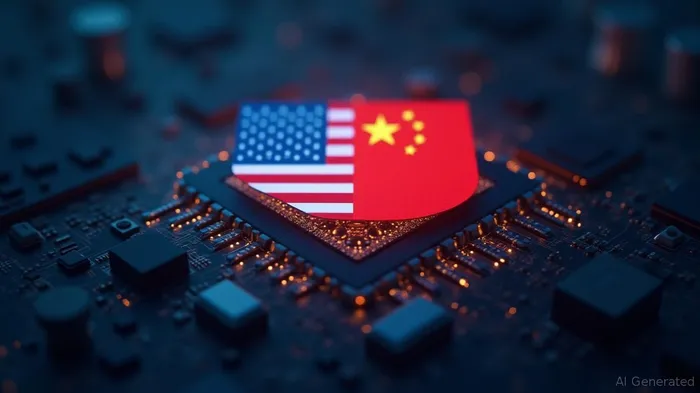
The Semiconductor Pivot: EDA and CHIPS Act Gains
The truce's most immediate impact is the revival of China's semiconductor industry. The U.S. lifted export curbs on EDA software from SynopsysSNPS--, CadenceCADE--, and Siemens—tools that account for over 70% of China's EDA market. This decision averts a potential collapse in China's chip design capabilities, which would have reverberated globally. For investors, the EDA trio now faces a critical inflection point:
While these companies' shares dipped during the May restrictions, the truce's announcement has likely sparked a rebound. However, the August expiration date adds urgency. A prolonged truce could cement their dominance in China's semiconductor renaissance, while a breakdown might reignite volatility.
Meanwhile, the U.S. continues to advance its own chip manufacturing through the CHIPS Act's $52 billion allocation. Companies like Applied MaterialsAMAT-- (AMAT) and Lam ResearchLRCX-- (LRCX) are expanding domestic capacity, positioning themselves to capitalize on demand for advanced nodes. The ASEAN region—Singapore, Malaysia, and Vietnam—is also emerging as a subsidy-driven alternative to China for chip production.
Investors should prioritize firms with strong U.S. government ties and exposure to both domestic and Southeast Asian manufacturing hubs. Overcapacity risks exist in advanced nodes, but companies with diversified portfolios (e.g., legacy chipmakers like Texas InstrumentsTXN-- (TXN)) may offer safer bets.
AI's Double-Edged Sword: Geopolitics and Growth
The semiconductor truce indirectly fuels AI innovation, as both nations race to secure chip supplies for training large language models (LLMs) and deploying generative AI. U.S. restrictions on advanced AI chips to China remain intact, however, creating a bifurcated market.
For investors, this divide presents two pathways:
1. U.S.-centric AI hardware: Companies like NVIDIANVDA-- (NVDA) and AMDAMD-- (AMD), which dominate GPU and AI chip sales to U.S. and allied markets, stand to benefit from sustained demand.
2. China's AI underclass: Domestic Chinese firms like Alibaba (BABA) and BaiduBIDU-- (BIDU) are forced to rely on older, domestically produced chips, limiting their AI capabilities. Their stocks may lag unless the truce expands to include broader semiconductor access.
Risks and Realities: The August Crossroads
Despite the truce's short-term benefits, systemic risks persist. The 55% average U.S. tariffs on Chinese goods and 10% Chinese tariffs on U.S. imports remain in place, dampening cross-border trade. Additionally, unresolved issues—such as restrictions on AI chips and rare earth export guarantees—could reignite hostilities after August.
Investors must treat this truce as a tactical window rather than a permanent solution. Key watchpoints include:
- August 2025: Will the U.S. and China agree to a longer-term deal?
- Rare earth compliance: Can China sustain rare earth exports to the U.S. without political interference?
- Semiconductor overcapacity: Will ASEAN's subsidized factories lead to oversupply by 2026?
Investment Strategy: Balance Opportunity with Caution
- EDA Recovery Plays: Buy Synopsys and Cadence for their China-linked revenue rebound, but pair with stop-loss orders ahead of the August deadline.
- CHIPS Act Winners: Hold Applied Materials and Lam Research for U.S. manufacturing growth, while monitoring ASEAN partnerships.
- AI分化 (AI Divide) Opportunities: Overweight NVIDIA and AMD for their AI dominance, but avoid China's AI stocks until semiconductor access expands.
The semiconductor sector's volatility demands a hedged approach. Consider diversifying into chip ETFs like the VanEck Semiconductor ETF (SMH) for broad exposure, while using options to protect against downside risks tied to the August expiration.
Conclusion
The June truce offers a fleeting respite in the U.S.-China tech war, but it has redefined the playing field. Investors who focus on EDA recovery, U.S. manufacturing resilience, and AI's dual markets can navigate this landscape profitably—if they remain agile ahead of the August reckoning. The chips are down; the question is whether the truce will hold long enough to turn them into wins.

Stay ahead of the market.
Get curated U.S. market news, insights and key dates delivered to your inbox.
AInvest
PRO
AInvest
PRO



Comments
No comments yet