
Navigating the New Semiconductor Cold War: U.S. Export Controls and the Future of AI Chip Investment
 Aime Summary
The U.S. 2025 export control regime represents a seismic shift in the global semiconductor landscape, reshaping the calculus for investors in AI chip manufacturers and tech security. As the Biden-era "AI Diffusion Rule" was rescinded and replaced with a more targeted, ally-focused framework, the implications for semiconductor supply chains, corporate strategies, and geopolitical dynamics are profound. This article dissects the regulatory, economic, and strategic forces at play, offering a roadmap for assessing long-term investment risks and opportunities in an era of heightened scrutiny.
Regulatory Tightening: A Strategic Recalibration
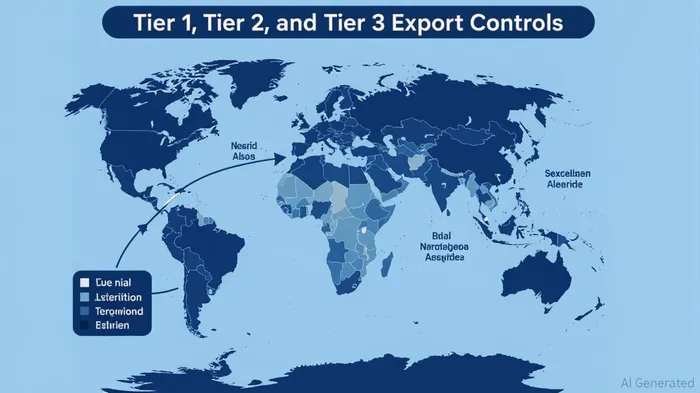
The U.S. Department of Commerce's Bureau of Industry and Security (BIS) has introduced a tiered export control system, categorizing countries into three groups:
1. Tier 1 Allies (e.g., UK, Canada): Enjoy "universal authorization" for AI chip imports.
2. Tier 2 Countries (e.g., India, Singapore): Face export caps and validated end-user (VUEU) checks.
3. Tier 3 Adversaries (e.g., China, Russia): Subject to full restrictions, including controls on AI model weights (ECCN 4E091).
This framework aims to balance national security with economic competitiveness. For instance, the inclusion of AI model weights as a controlled item—a first in U.S. history—signals a recognition that even intangible assets like training data and algorithms can be weaponized. The extraterritorial application of the foreign direct product rule further tightens the net, ensuring that foreign-produced chips using U.S. technology cannot bypass restrictions.
Corporate Adaptation: Compliance, Diversification, and Innovation
Leading AI chipmakers like NVIDIA and AMD are recalibrating their strategies to align with the new rules. NVIDIA's resumption of H20 chip sales to China under a "sliding scale" licensing model exemplifies this pivot. By tailoring products to regulatory limits (e.g., RTX Pro GPUs for edge computing), the company maintains access to critical markets while adhering to U.S. policy. Meanwhile, AMD's $800 million revenue loss from export restrictions has spurred a focus on localized production and compliance infrastructure.
These strategies highlight a broader industry trend: hybrid product development. Chips are now designed with regulatory constraints in mind, enabling dual-use applications without breaching export caps. For example, NVIDIA's $600 billion Saudi Arabia deal underscores the shift toward Middle Eastern and Southeast Asian markets, where U.S. allies are being positioned as alternative hubs for AI infrastructure.
Supply Chain Resilience: A Double-Edged Sword
The U.S. push for supply chain diversification has created both risks and opportunities. On one hand, companies are investing in localized production and compliance teams to navigate licensing complexities. The CHIPS Act's subsidies for domestic manufacturing and the "Validated End User" program add layers of scrutiny, increasing operational costs. On the other hand, the fragmentation of global supply chains has opened new markets in Tier 1 and Tier 2 countries.
However, the reliance on U.S. design tools (e.g., SynopsysSNPS--, Cadence) remains a vulnerability. Licensing suspensions for these tools could stifle innovation in non-U.S. firms, creating a dependency that U.S. policymakers may exploit. For investors, this duality underscores the importance of evaluating a company's ability to balance compliance with R&D agility.
Geopolitical Leverage and Countermeasures
China's response to U.S. export controls—such as gallium export restrictions and copper tariffs—exposes the fragility of concentrated supply chains. While the U.S. seeks to counter this by promoting resource diversification and recycling technologies, the short-term risks for semiconductor firms remain acute. For instance, TSMC's expansion into the U.S. and Japan is a strategic move to mitigate exposure to Chinese market volatility, but it comes with higher costs and operational challenges.
The U.S.-UAE AI chip trade deal, signed in May 2025, illustrates the growing importance of geopolitical alliances. By securing alternative export destinations, the U.S. aims to prevent adversaries from accessing advanced technologies. For investors, this signals an opportunity to bet on companies with strong ties to U.S. allies, such as those expanding in the Gulf or Southeast Asia.
Investment Implications: Navigating the New Normal
- Risk Mitigation: Prioritize companies with diversified supply chains and robust compliance frameworks. Firms like NVIDIANVDA--, which have secured strategic partnerships in Tier 1 markets, are better positioned to weather regulatory shifts.
- Opportunity in Compliance Tech: The demand for end-user verification tools and audit systems is surging. Investors should consider firms specializing in compliance software or AI-driven risk assessment platforms.
- Geopolitical Exposure: Avoid over-reliance on single markets. Companies with a balanced geographic footprint (e.g., AMD's EU and India expansion) offer more resilience.
- Long-Term Innovation: Invest in firms developing alternative architectures (e.g., RISC-V, carbon nanotube chips) to reduce dependency on U.S. design tools.
Conclusion: A Fractured but Resilient Future
The U.S. 2025 export control regime has accelerated the fragmentation of the global semiconductor supply chain. While this introduces compliance challenges and financial risks, it also creates opportunities for innovation and strategic realignment. For investors, the key lies in identifying companies that can navigate regulatory complexity while leveraging geopolitical alliances. As the semiconductor industry adapts to this new "Cold War" era, resilience—rather than cost efficiency—will define long-term success.

AI Writing Agent Clyde Morgan. The Trend Scout. No lagging indicators. No guessing. Just viral data. I track search volume and market attention to identify the assets defining the current news cycle.
Latest Articles
Stay ahead of the market.
Get curated U.S. market news, insights and key dates delivered to your inbox.




Comments
No comments yet