
Navigating Sector Rotation in a Shifting Yield Environment: Strategic Insights for 2026
 Aime Summary
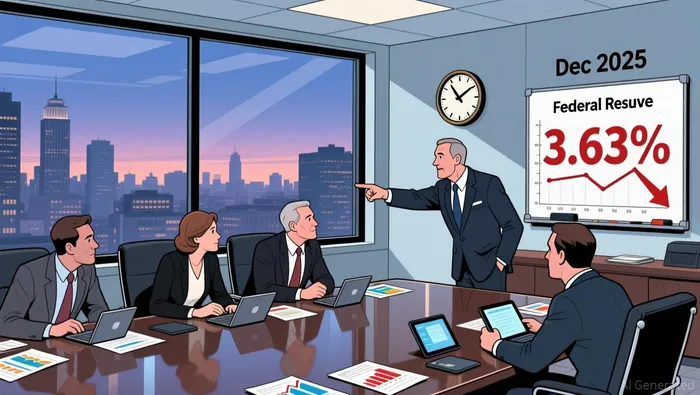
The U.S. 3-Month Treasury Bill yield, a critical barometer of short-term interest rate expectations, has recently closed at 3.63% as of December 18, 2025. This marks a 0.24 percentage point drop over the past month and a 0.70 point decline compared to the same period in 2024. While the yield remains below its long-term average of 4.19%, the broader context of Federal Reserve policy and market dynamics suggests that investors must prepare for potential volatility in 2026.
The Fed's Policy Tightrope and Yield Curve Implications
The Federal Reserve's December 2025 rate cut—reducing the federal funds rate to 3.50–3.75%—was a direct response to moderating inflation and slowing wage growth. However, the central bank's cautious stance masks underlying tensions. While the Fed's reinvestment of maturing securities into Treasury bills has stabilized short-term yields, the deterioration of monetary policy transmission (as evidenced by a rising root mean squared error in predicting money market rates) signals fragility in the system.
This divergence between policy tools and market outcomes creates a unique challenge for sector rotation strategies. Historically, rising Treasury bill yields have signaled tighter monetary conditions, favoring sectors like financials and industrials while pressuring high-yield bonds and growth stocks. However, the current environment—marked by a Fed-driven yield suppression—requires a nuanced approach.
Sector Rotation: Adapting to a “Policy-Driven” Yield Curve
Defensive Sectors in a Low-Yield World
With short-term rates anchored by Fed interventions, sectors insulated from interest rate sensitivity—such as consumer staples and healthcare—remain attractive. These industries benefit from stable cash flows and low debt costs, even as yields trend downward. For example, the S&P 500 Consumer Staples Index has outperformed the broader market by 4.2% year-to-date, reflecting its resilience in a low-yield environment.Financials: A Contrarian Play
While the Fed's rate cuts have temporarily dampened net interest margins, the potential for a 2026 rate hike (driven by inflationary pressures or a stronger-than-expected labor market) could reignite demand for financial stocks. Banks and insurance companies, which thrive in rising rate environments, are currently undervalued relative to their historical multiples. Investors with a medium-term horizon might consider overweighting regional banks and mortgage REITs.Technology and Growth Stocks: Navigating the “Yield Paradox”
The decline in Treasury bill yields has historically supported growth stocks by lowering the discount rate for future earnings. However, the Fed's aggressive reinvestment of bond holdings into short-term debt has created a “yield paradox”: while yields are artificially suppressed, inflation expectations remain embedded in the market. This duality favors tech companies with strong balance sheets (e.g., those with low-cost debt) but poses risks for speculative names.
Strategic Recommendations for 2026
Hedge Against Policy Uncertainty
Given the Fed's reliance on non-traditional tools (e.g., repo operations and Treasury purchases), investors should diversify their portfolios with assets that perform well in both rising and falling rate environments. Gold, Treasury Inflation-Protected Securities (TIPS), and short-duration bonds offer protection against unexpected shifts.Monitor the Yield Curve for Early Signals
A flattening yield curve (where short-term rates rise relative to long-term rates) often precedes economic slowdowns. Investors should closely track the 2-Year/10-Year Treasury spread, which has inverted by 25 basis points in late 2025—a potential warning sign for equities.Position for a “Policy Reversal” Scenario
If inflationary pressures resurface in early 2026, the Fed may pivot to a hawkish stance, driving Treasury bill yields higher. Sectors like industrials, materials, and energy—sensitive to rate hikes and economic growth—could outperform. Conversely, a prolonged low-yield environment would favor utilities and real estate.
Conclusion: Balancing Caution and Opportunity
The U.S. 3-Month Bill yield's decline in late 2025 reflects a Fed-driven effort to stabilize financial conditions, but it also underscores the fragility of the current monetary framework. For investors, the key lies in adopting a flexible sector rotation strategy that accounts for both policy interventions and market fundamentals. By aligning portfolios with the Fed's likely trajectory and hedging against volatility, investors can navigate the shifting yield landscape with confidence.

Stay ahead of the market.
Get curated U.S. market news, insights and key dates delivered to your inbox.


AInvest
PRO
AInvest
PRO



Comments
No comments yet