
Navigating Sector Divergence in a Wage-Driven Economy
 Aime Summary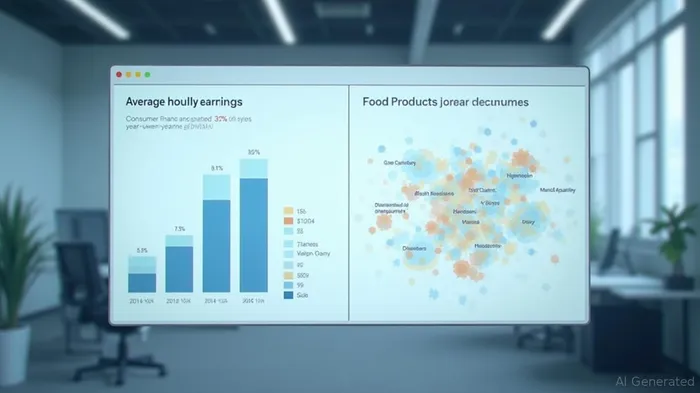
The U.S. labor market in July 2025 presents a paradox: wages are rising, yet the broader economy remains mired in a tug-of-war between inflationary pressures and tepid productivity. The latest Average Hourly Earnings (AHE) report—a cornerstone of macroeconomic analysis—reveals a 0.3% monthly increase, pushing the 12-month growth rate to 3.9%. While this figure may seem modest, its implications are far from uniform. For investors, the key lies in dissecting sector-specific impacts, particularly in industries like Consumer Finance and Food Products, where divergent wage dynamics are reshaping competitive landscapes and valuation metrics.
The Consumer Finance Sector: A Tale of Diverging Demand
The Consumer Finance industry, with an average hourly wage of $26 in July 2025, has long been a barometer of household financial health. A stronger-than-expected AHE report initially seems bullish for this sector, as higher wages typically correlate with increased consumer spending and credit demand. However, the data tells a nuanced story.
For instance, the 3.9% annual wage growth outpaces the 2.7% CPI inflation rate, suggesting a modest real income expansion. This should, in theory, bolster demand for consumer credit and personal loans. Yet, the sector's performance is being tempered by two critical factors:
1. Moderating High-Wage Growth: While high-paying jobs (e.g., legal, engineering) led wage growth in 2021–2022, their pace has cooled to 2.9% in June 2025, lagging behind the 3.0% growth for middle-wage roles. This flattening of the wage distribution reduces the urgency for high-income earners to seek financial products.
2. Regulatory and Cost Pressures: The Consumer Financial Protection Bureau's scrutiny of earned wage access products (e.g., fee-heavy liquidity tools) has curtailed profit margins. With 90% of users paying transaction fees averaging $3.18 in 2022, the sector's growth is increasingly reliant on volume rather than pricing power.
The Food Products Industry: Subsector Nuances and Cyclical Risks
In contrast, the Food Products industry exhibits a more fragmented response to wage growth. The sector's average hourly earnings of $27.72 in July 2025 mask stark subcategory disparities. For example:
- Dairy and Confectionery: These subcategories thrive on wage growth, with dairy manufacturing reporting $33.46 per hour—3.9% above the sector average. This aligns with historical trends where higher wages drive demand for premium and perishable goods.
- Frozen Food and Poultry Processing: These segments lag, with hourly earnings at $24.99 and $25.17, respectively. The disconnect reflects structural challenges: frozen food demand is often income-inelastic, while poultry processing faces labor shortages and input cost pressures.
The sector's mixed performance underscores the importance of granular analysis. A 0.3% increase in average work hours (to 34.3 hours) has limited the impact of wage growth on total income, particularly in labor-intensive subcategories. For investors, this means overexposure to broad food indices could dilute returns. Instead, a focus on high-growth subcategories—such as dairy and premium confectionery—offers better alignment with wage-driven consumption patterns.
Investment Strategies: Balancing Exposure and Hedging Risks
Given these dynamics, a two-pronged approach is warranted:
1. Sector Diversification with a Wage Lens:
- Consumer Finance: Allocate to companies with fee-light models or those leveraging AI-driven credit scoring to reduce default risks. Avoid firms reliant on high-fee earned wage products, as regulatory headwinds persist.
- Food Products: Overweight subcategories with strong wage elasticity (e.g., dairy, premium snacks) and underweight those facing supply-side constraints (e.g., frozen food, poultry). ETFs like the Consumer Staples Select Sector SPDR (XLP) can provide broad exposure, but active stock picking is essential to capture subsector premiums.
- Macro Hedges Against Wage-Inflation Divergence:
- Short-Term Interest Rate Bets: A 3.9% wage growth rate, combined with a 2.7% CPI, suggests a modest rise in core inflation. Investors should consider hedging with Treasury Inflation-Protected Securities (TIPS) or short-duration bonds.
- Commodity Exposure: The dairy and confectionery subcategories benefit from agricultural commodity inputs (e.g., milk, sugar). A long position in futures contracts for these commodities could enhance returns if wage-driven demand outpaces supply.
Conclusion: Wage Growth as a Strategic Filter
The July 2025 AHE report is not merely a data point—it is a lens through which investors can dissect sector-specific opportunities. While the Consumer Finance industry faces headwinds from moderating wage growth and regulatory scrutiny, the Food Products sector's subcategory divergence offers fertile ground for selective investments. By aligning portfolios with wage-driven demand patterns and hedging against inflationary risks, investors can navigate the current economic landscape with both precision and resilience.
In an era of divergent wage trends, the key to outperformance lies not in chasing headline figures but in understanding the microeconomic forces that shape sector performance. As the labor market continues to evolve, those who adapt their strategies to the nuances of wage dynamics will be best positioned to capitalize on the opportunities ahead.

Stay ahead of the market.
Get curated U.S. market news, insights and key dates delivered to your inbox.






Comments
No comments yet