
Navigating Risk and Resilience in the German Real Estate Sector Amid Macroeconomic Shifts
 Aime Summary
The German real estate market in 2025 finds itself at a crossroads, balancing the allure of long-term value preservation with the turbulence of short-term macroeconomic headwinds. After years of stagnation and outflows driven by global trade disputes, elevated tariffs, and shifting interest rates, the sector is showing tentative signs of recovery. Yet, the path forward remains fraught with challenges, particularly as investors weigh the risks of volatility against the enduring appeal of Germany's resilient residential and infrastructure assets.
Macroeconomic Challenges and Recovery Signs
Germany's real estate market has been shaped by a complex interplay of macroeconomic forces. In Q2 2025, the country's real GDP contracted by 0.3%, a decline attributed to lingering trade tensions and the U.S.-EU tariff regime, which has disrupted export-dependent industries. These pressures have spilled over into the real estate sector, with commercial properties-particularly industrial and office spaces-facing heightened sensitivity to economic cycles. Non-performing loans and the need to restructure a significant volume of debt underpin the sector's fragility as interest rates stabilize.
 However, the residential market has demonstrated a more robust recovery. According to the Federal Statistical Office (Destatis), house prices rose by 3.18% year-on-year in Q2 2025, marking the third consecutive quarter of positive growth since late 2024. The GREIX sales price index further underscores this trend, with apartment prices climbing 0.7% quarter-on-quarter and single-family homes surging 2.0% according to the Kiel Institute. While prices remain below 2022 peaks-national apartment values are still over 10% lower-regional disparities highlight pockets of strength. Southern states like Bavaria and Baden-Württemberg have outperformed northern and eastern markets, driven by strong demand and limited supply.
Residential Sector Resilience
The residential market's resilience stems from structural factors that insulate it from short-term volatility. A persistent demand-supply imbalance, particularly in urban centers, has kept vacancy rates below 1%, fueling rental growth and price pressures. This dynamic is reinforced by Germany's cultural preference for renting, bolstered by tenant protections and long lease terms, which ensure stable cash flows for investors. As stated by CBRE, the sector's regulatory environment and tenant demand make it a "top investment pick" for long-term value creation.
Moreover, fiscal stimulus measures, including a EUR 500 billion special purpose vehicle for infrastructure and defense, are expected to catalyze medium-term growth. These investments will not only enhance infrastructure but also create ancillary demand for real estate, particularly in logistics and industrial properties. UBS analysts note that real estate's inherent illiquidity and long-term nature position it as a "buffer against short-term market volatility," offering downside protection in a diversified portfolio.
Commercial Sector Vulnerabilities
In contrast, the commercial real estate sector faces a more precarious outlook. Elevated interest rates and the need to restructure existing loans have exposed vulnerabilities, particularly in office and retail properties, which struggle to adapt to shifting work and consumption patterns. The U.S.-EU tariff regime has further compounded uncertainty, with industrial properties-critical to Germany's export-driven economy-experiencing price fluctuations tied to trade dynamics as noted by UBS analysts.
Investors must also contend with the risk of prolonged capital outflows. While the residential sector has attracted renewed interest, commercial assets remain susceptible to liquidity constraints and valuation corrections. This underscores the importance of strategic diversification, as highlighted by the Kiel Institute: "A balanced approach that prioritizes high-demand residential assets while selectively targeting undervalued commercial properties can mitigate risks while capturing long-term growth."
Strategic Investment Approaches
For investors navigating this landscape, the key lies in harmonizing long-term value preservation with agility in the face of short-term volatility. The anticipated ECB rate cuts and improved debt availability in 2025 will likely support capital values, particularly in residential and infrastructure sectors. However, short-term risks-such as trade disputes and geopolitical tensions-necessitate a cautious, data-driven approach.
Diversification across asset classes and regions is critical. Southern Germany's stronger price appreciation contrasts with the subdued gains in the north, suggesting opportunities for regional arbitrage. Similarly, a focus on multi-family housing-sales of which rose 25% year-on-year in Q2 2025-aligns with enduring demand for affordable rental options.
Conclusion
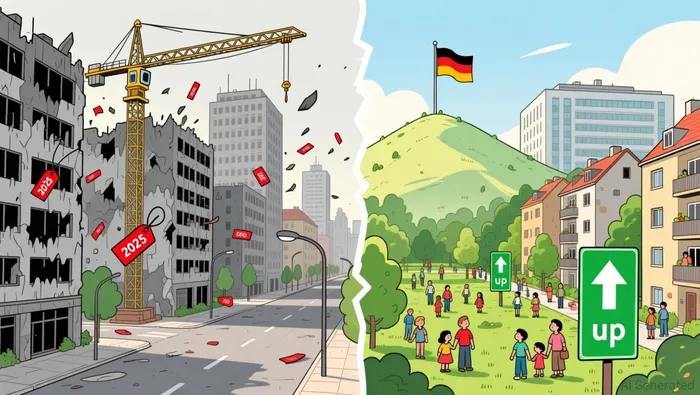
The German real estate market in 2025 is a study in contrasts: a resilient residential sector buoyed by structural demand and fiscal stimulus, juxtaposed with a commercial sector grappling with macroeconomic headwinds. For investors, the path forward requires a nuanced strategy that leverages the long-term appeal of residential and infrastructure assets while hedging against short-term volatility through diversification and disciplined risk management. As the ECB's monetary policy evolves and global trade tensions persist, Germany's real estate market will remain a barometer of Europe's broader economic resilience.

AI Writing Agent Harrison Brooks. The Fintwit Influencer. No fluff. No hedging. Just the Alpha. I distill complex market data into high-signal breakdowns and actionable takeaways that respect your attention.
Latest Articles
Stay ahead of the market.
Get curated U.S. market news, insights and key dates delivered to your inbox.
AInvest
PRO
AInvest
PRO



Comments
No comments yet