
Navigating Retail Sales Momentum: Strategic Sector Rotations in a Shifting U.S. Economy
 Aime Summary
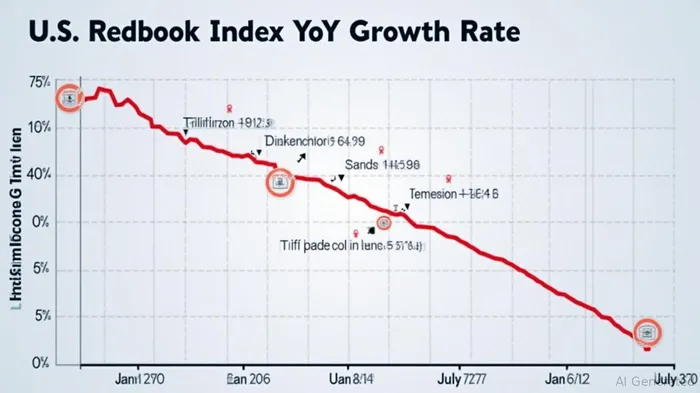
The U.S. Redbook Index, a leading indicator of retail sales momentum, has posted a July 2025 year-over-year (YoY) growth rate of 5.2%, a marginal decline from the 5.9% recorded the prior week. This deceleration, while modest, signals a critical inflection point for investors. The Redbook's 9,000-store sample—representing 80% of the U.S. Department of Commerce's retail sales data—highlights the fragility of consumer spending amid a backdrop of inflation, trade tensions, and shifting demand patterns. For portfolio managers, this data underscores the urgency of recalibrating sector allocations to align with the realities of a slowing retail environment.
The Case for Sector Rotation: From Cyclical to Defensive
Retail sales volatility in 2025 has been a double-edged sword. While March's 1.4% monthly increase was fueled by pre-tariff panic, May's 0.9% decline reflected consumer caution amid rising prices. June's modest rebound suggested normalization, but the broader trend remains one of fragility. Sectors like consumer discretionary (autos, electronics) and industrials (steel, aluminum) have borne the brunt of this instability, with 30 companies in the latter category cutting guidance since Q1 2025.
In contrast, the technology sector has emerged as a refuge. The Nasdaq Composite surged 18% in Q2 2025, driven by trade truces and reduced macroeconomic uncertainty. This outperformance is not accidental: tech stocks, particularly those with pricing power (e.g., MicrosoftMSFT--, NVIDIA), thrive in environments where inflation expectations recede and borrowing costs stabilize. For instance, the tech sector's forward P/E ratio rose to 22.09 by June 2025, reflecting optimism about long-term growth.
Meanwhile, energy has faltered. The S&P 500 Energy Index fell 8.56%, and oil prices dropped 8.91%, as investors priced in weaker global demand and geopolitical risks. This divergence highlights a broader theme: sectors sensitive to commodity prices and geopolitical shocks are increasingly vulnerable in a fragmented economic landscape.
Defensive Tilts: Utilities, Consumer Staples, and Small-Cap Resilience
As the Redbook Index slows, defensive positioning becomes paramountPARA--. Historically, sectors like consumer staples, utilities, and healthcare have outperformed during late-cycle slowdowns. For example, the Russell 2000's 8.11% gain in Q2 2025 signaled a rotation into small-cap stocks, which benefit from domestic demand and operational agility. Utilities, too, have shown resilience, with a 0.4% six-month return despite rising Treasury yields.
The case for utilities is particularly compelling. While high dividend yields attract income-focused investors, the sector's inelastic demand—consumers rarely cut utility bills—provides a buffer against economic shocks. However, rising interest rates remain a headwind, as debt-heavy utilities face higher borrowing costs. Investors should prioritize companies with strong balance sheets and stable cash flows, such as NextEra EnergyNEE-- (NEE) or Dominion EnergyD-- (D).
Consumer staples also warrant attention. Procter & GamblePG-- (PG) and CloroxCLX-- (CLX) have maintained steady revenue streams despite macroeconomic turbulence, thanks to their dominance in essential goods. While profit margins face pressure in inflationary environments, the sector's ability to pass costs to consumers—via brand strength or pricing power—offers a hedge against declining retail sales.
Tactical Adjustments: Overweight Tech, Underweight Energy
For investors, the key takeaway is to overweight sectors with structural advantages and underweight those exposed to cyclical risks. Technology and communication services should remain core holdings, given their alignment with long-term trends like AI and cloud computing. Conversely, energy and consumer discretionary sectors, particularly those reliant on discretionary spending (e.g., luxury goods, electronics), require caution.
A balanced approach would involve:
1. Trimming exposure to industrials and transportation equities (e.g., HoneywellHON--, Union Pacific) until consumer demand stabilizes.
2. Rotating into defensive sectors like consumer staples (XLP), utilities (XLU), and healthcare (XLV).
3. Leveraging yield plays in telecom (T-Mobile) and infrastructure REITs (Welltower) to hedge against volatility.
Conclusion: Aligning Portfolios with Economic Realities
The U.S. Redbook Index's 5.2% YoY growth in July 2025 may seem benign, but it signals a broader shift in consumer behavior. As tariffs distort trade flows and inflation erodes purchasing power, sector rotation becomes a strategic imperative. Investors must prioritize resilience over growth, allocating capital to sectors with inelastic demand and structural advantages. By aligning portfolios with the realities of a slowing economy, investors can navigate the coming volatility with confidence—and position for the next phase of the cycle.

Stay ahead of the market.
Get curated U.S. market news, insights and key dates delivered to your inbox.
AInvest
PRO
AInvest
PRO



Comments
No comments yet