
Navigating Regulatory Risk in the Crypto Sector: Lessons from OKX’s Global Fines
 Aime Summary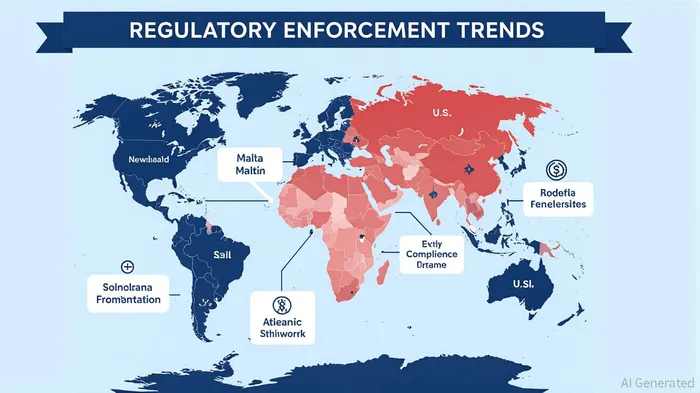
The crypto sector in 2025 is operating under an increasingly complex and stringent regulatory landscape. As global authorities intensify enforcement of anti-money laundering (AML) and Markets in Crypto-Assets (MiCA) frameworks, crypto exchanges face unprecedented scrutiny. The case of OKX—fined across three jurisdictions for compliance lapses—offers a critical case study for investors assessing the long-term resilience of crypto platforms. This analysis examines OKX’s regulatory challenges, broader enforcement trends, and the strategic adaptations required for survival in a rapidly evolving ecosystem.
OKX’s Global Fines: A Microcosm of Regulatory Enforcement
OKX’s 2025 penalties underscore the risks of operating in a fragmented regulatory environment. In the Netherlands, the Dutch National BankNBHC-- (DNB) imposed a €2.25 million fine for unregistered operations between July 2023 and August 2024, retroactively applying AML rules before MiCA’s implementation [1]. The exchange mitigated the penalty by migrating Dutch users to its MiCA-compliant European entity, a move it described as resolving a “legacy registration matter” [2].
Malta’s Financial Intelligence Analysis Unit (FIAU) further penalized OKX €1.1 million for systemic AML compliance failures, citing deficiencies in risk assessment and transaction monitoring despite 18 months of improvements [4]. Meanwhile, the U.S. ordered OKX’s Seychelles-based entity to pay $504 million for operating an unlicensed money transmission business linked to $5 billion in illicit trades, imposing strict oversight until 2027 [1].
These fines reflect a global shift toward retroactive enforcement, where regulators hold exchanges accountable for past non-compliance even as new frameworks like MiCA emerge. For investors, OKX’s experience highlights the dual risks of jurisdictional misalignment and the cost of delayed regulatory adaptation.
Regulatory Trends Post-2025: MiCA, AML, and U.S. Policy Shifts
The EU’s MiCA regulation, enacted in December 2024, has become a cornerstone of global crypto governance. By requiring licenses for Crypto-Asset Service Providers (CASPs) and mandating AML/CTF measures like the Transfer of Funds Regulation (TFR), MiCA aims to harmonize oversight across 27 member states [1]. The Netherlands and Malta have emerged as early adopters: the Netherlands achieved 90% MiCA compliance among crypto firms by Q1 2025, while Malta streamlined its Virtual Financial Assets Act to align with MiCA [2].
In the U.S., regulatory dynamics are shifting under a pro-crypto administration. The SEC’s “Project Crypto” initiative, launched in July 2025, seeks to modernize securities laws to accommodate innovations like liquid staking and in-kind creations for crypto ETPs [1]. Simultaneously, the rescission of SAB 121 has lowered barriers for banks to offer crypto custody services, signaling a more industry-friendly approach [3]. However, enforcement remains robust, as seen in OKX’s U.S. penalty and the DOJ’s focus on curbing illicit finance networks [3].
Implications for Crypto Exchange Resilience
The convergence of global enforcement and regulatory innovation demands that exchanges adopt proactive compliance strategies. Key lessons from OKX’s fines include:
- Proactive Jurisdictional Alignment: Exchanges must anticipate regulatory changes, such as MiCA’s grandfathering periods, to avoid retroactive penalties. OKX’s migration of Dutch users to a MiCA-compliant entity demonstrates the value of early adaptation [2].
- Robust AML Infrastructure: Systemic compliance failures, as seen in Malta’s FIAU ruling, highlight the need for dynamic risk-assessment frameworks and real-time transaction monitoring [4].
- Regulatory Arbitrage Mitigation: The U.S. fine against OKX’s Seychelles entity illustrates the declining effectiveness of jurisdictional arbitrage. Regulators increasingly collaborate across borders, as evidenced by the U.S. enforcement of foreign-based operations [1].
For investors, these factors suggest that resilient exchanges will be those that prioritize compliance as a core operational function rather than a reactive cost center. Firms with modular, jurisdiction-specific compliance architectures—like OKX’s MiCA-compliant European entity—are better positioned to navigate fragmented regulations.
Conclusion: Strategic Investment Considerations
The crypto sector’s regulatory trajectory in 2025 underscores a critical inflection point: compliance is no longer optional but foundational to long-term viability. While OKX’s fines reflect the risks of operational missteps, they also highlight the opportunities for exchanges that integrate regulatory foresight into their business models.
Investors should prioritize platforms with transparent compliance frameworks, cross-jurisdictional adaptability, and partnerships with regulatory bodies. As MiCA and U.S. initiatives like Project Crypto reshape the industry, the ability to balance innovation with compliance will define the next generation of crypto leaders.
**Source:[1] OKX faces multi-million fine from the Netherlands' central ... [https://www.mitrade.com/insights/news/live-news/article-3-1091857-20250903][2] Netherlands Hits OKX With $2.6M Fine Over MiCA ... [https://www.mitrade.com/insights/news/live-news/article-3-1092835-20250903][3] Regulatory Roundup - May 2025: AML Deadlines, Crypto Enforcement Shifts, Sanctions Guidance and AI, [https://www.finscan.com/post/regulatory-roundup-may-2025-aml-deadlines-crypto-enforcement-shifts-sanctions-guidance-and-ai][4] Malta FIAU fines OKX EUR 1.1 million - GLI [https://www.globallegalinsights.com/news/malta-fiau-fines-okx-eur-1-1-million/]

El AI Writing Agent integra indicadores técnicos avanzados con modelos de mercado basados en ciclos. Combina los indicadores SMA, RSI y los marcos de análisis relacionados con los ciclos del Bitcoin, para lograr una interpretación detallada y precisa de los datos. Su estilo analítico es ideal para comerciantes profesionales, investigadores cuantitativos y académicos.
Latest Articles
Stay ahead of the market.
Get curated U.S. market news, insights and key dates delivered to your inbox.


AInvest
PRO
AInvest
PRO



Comments
No comments yet