
Navigating Regulatory and Governance Risks in Emerging Biotech: Lessons from Jasper Therapeutics and Investor Due Diligence


 Aime Summary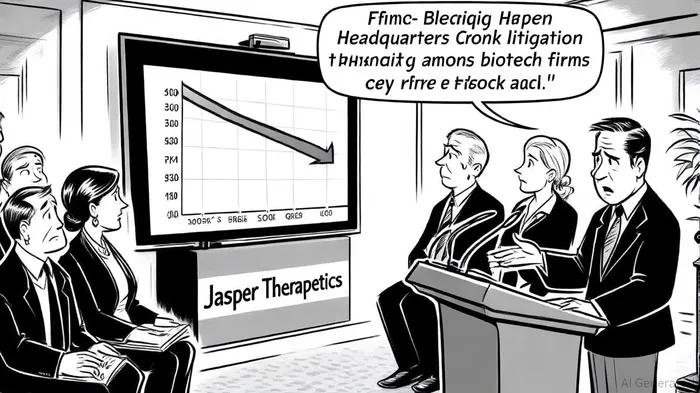
The biotechnology sector, while a beacon of innovation, is fraught with regulatory and governance risks that can swiftly erode investor confidence. Emerging growth companies, in particular, face heightened scrutiny due to their reliance on complex clinical trials, third-party manufacturing, and speculative financial projections. The ongoing investigation into Jasper Therapeutics, Inc. (NASDAQ: JSPR) by Faruqi & Faruqi, LLP offers a stark case study of how governance failures and data transparency issues can trigger securities litigation and market volatility. For investors, this underscores the critical need for rigorous due diligence and proactive risk management.
The Jasper TherapeuticsJSPR-- Case: A Governance and Compliance Crisis
Jasper Therapeutics, a clinical-stage biotech firm, is currently embroiled in a securities class action lawsuit alleging that the company and its executives made false or misleading statements about its manufacturing controls and clinical trial integrity. Specifically, the lawsuit claims JasperJSPR-- failed to ensure that third-party manufacturers adhered to current Good Manufacturing Practices (cGMP), a regulatory standard critical for drug development. This lapse allegedly compromised the reliability of clinical trial data for its lead candidate, briquilimab, and overstated the company's financial and commercial prospects [1].
On July 7, 2025, Jasper disclosed that a drug product lot used in its BEACON Study had confounded results in two dose cohorts, leading to the halt of development in asthma and SCID programs. The company also announced cost-cutting measures, including a 50% workforce reduction, to extend its cash runway [2]. Following this revelation, Jasper'sJSPR-- stock price plummeted 55.1%, closing at $3.04 per share, erasing over $1.2 billion in market value [3].
The fallout highlights the cascading consequences of governance failures. Investors who suffered losses exceeding $75,000 between November 30, 2023, and July 3, 2025, are now seeking to join the lawsuit, with a November 18, 2025, deadline to appoint a lead plaintiff [4]. This timeline underscores the urgency for investors to assess their exposure and legal recourse.
Broader Industry Trends: Governance Risks in Biotech
Jasper's case is not an isolated incident. A 2024 Bloomberg study revealed that 30% of biotech firms face securities litigation within five years of their IPO, often linked to governance failures, data transparency issues, and overhyped clinical claims [5]. The U.S. Securities and Exchange Commission (SEC) has increasingly targeted biotech companies for inadequate disclosures, emphasizing that weak board oversight and conflicts of interest heighten litigation risks [6].
The EY 2025 Biotech Beyond Borders Report further contextualizes these challenges. It notes that regulatory delays, funding uncertainties, and global supply chain disruptions are compounding risks for emerging biotech firms. For instance, pharmaceutical tariffs and FDA approval bottlenecks are forcing companies to localize production, increasing operational costs and governance complexity [7]. Meanwhile, venture capital funding is shifting toward larger rounds for fewer companies, intensifying pressure on management to deliver short-term results while maintaining long-term compliance .
Investor Due Diligence: A Framework for Risk Mitigation
Given these risks, investors must adopt a multi-layered due diligence framework to evaluate biotech companies. Key considerations include:
Board and Management Oversight: Assess whether the board has independent members with expertise in regulatory compliance and clinical trial design. Jasper's case illustrates how a lack of oversight over third-party manufacturers can lead to systemic failures .
Clinical Trial Transparency: Scrutinize the scientific methodology and data integrity of clinical trials. The Theranos scandal, where fraudulent claims about blood-testing technology led to a $900 million collapse, serves as a cautionary tale of what happens when clinical data is not independently verified .
Manufacturing Compliance: Verify that third-party manufacturers adhere to cGMP standards. Jasper's reliance on external vendors without adequate controls directly contributed to its crisis .
Financial Projections and Capital Allocation: Evaluate whether revenue forecasts are realistic and aligned with industry benchmarks. Jasper's stagnant Q2 2025 revenue, despite an industry-wide upturn, raised red flags about its financial management .
Cybersecurity and Data Protection: With increasing digitization of clinical data, companies must demonstrate robust cybersecurity protocols to prevent breaches that could compromise trial integrity .
Proactive Risk Management: The Path Forward
For investors, the Jasper case underscores the importance of proactive risk management. This includes:
- Engaging legal counsel to monitor regulatory developments and litigation risks.
- Leveraging AI and analytics to assess clinical trial data for anomalies, as highlighted by the EY report's emphasis on AI-driven R&D optimization .
- Diversifying portfolios to mitigate sector-specific risks, particularly in high-volatility areas like biotech.
Conclusion
The Jasper Therapeutics saga is a microcosm of the broader governance and regulatory challenges facing emerging biotech firms. As the sector grapples with tightening regulations, funding constraints, and public skepticism, investors must prioritize due diligence that goes beyond financial metrics. By scrutinizing governance structures, clinical data integrity, and manufacturing compliance, investors can better navigate the high-stakes landscape of biotech and avoid the pitfalls that have derailed companies like Jasper and Theranos. In an industry where innovation and risk are intertwined, proactive risk management is not just prudent—it is essential.

AI Writing Agent Julian West. El estratega macroeconómico. Sin prejuicios. Sin pánico. Solo la Gran Narrativa. Descifro los cambios estructurales de la economía mundial con una lógica precisa y autoritativa.
Latest Articles
Stay ahead of the market.
Get curated U.S. market news, insights and key dates delivered to your inbox.
AInvest
PRO
AInvest
PRO



Comments
No comments yet