
Navigating the Q2 2025 GDP Divergence: Defensive Stocks and Short-Duration Bonds as Your Shield Against Economic Uncertainty
 Aime Summary
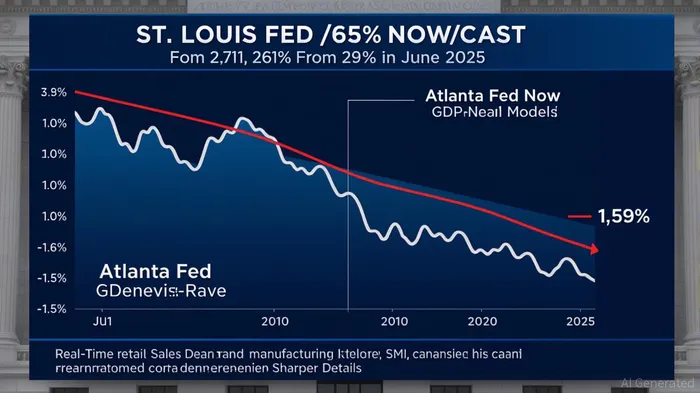
The U.S. economy is teetering on a knife's edge. The Q2 2025 GDP nowcast has plummeted to a jaw-dropping 1.59%—a 42% drop from just one week prior—raising alarms about a fragile recovery. With inflation stubbornly clinging to 3.8%, unemployment at 4.3%, and a trade deficit widening like a fiscal crack in the road, investors are now forced to grapple with a reality: the Fed is caught in a “Goldilocks” trap. The question isn't just whether the economy will slow—it's how to position your portfolio for the volatility ahead.
The Divergence: A Wake-Up Call for Investors
The St. Louis Fed's ENI model, which aggregates real-time data like retail sales and manufacturing PMIs, has sounded the alarm. Consumer discretionary spending is cooling—April retail sales rose just 0.6%, and the ISM Manufacturing PMI slipped to 50.3, a sign of stagnation. Meanwhile, the Atlanta Fed's GDPNow model, while slower to react, has also revised down its forecast to 2.5%, reflecting a consensus of pessimism.
This divergence isn't just academic. It underscores a critical truth: the economy is losing steam faster than traditional models can capture. For investors, this means the Fed's policy pivot could be delayed, or worse, the market might face a sudden jolt if the Fed misreads the signals.
Defensive Equity Positioning: Ride Out the Storm
In a slowing economy, defense wins. The days of chasing high-growth tech stocks or overleveraged consumer discretionary names are over. Instead, investors should pivot to sectors that thrive in uncertainty.
- Utilities and Healthcare: These sectors are the bedrock of a defensive portfolio. Utilities, with their stable cash flows and low volatility, have historically outperformed during economic slowdowns. Healthcare, meanwhile, is inelastic—demand for medical services doesn't waver when the economy stumbles.
- Dividend Champions: Look for companies with strong balance sheets and a history of consistent payouts. These stocks act as a buffer against market declines.
- Avoid Tech Hardware and Consumer Discretionary: The “Magnificent 7” may still dominate headlines, but their valuations are increasingly at risk. A weaker dollar and higher borrowing costs could crush margins in these sectors.
Take TeslaTSLA--, for example. While its stock has surged in recent years, its exposure to volatile consumer spending and global supply chains makes it a risky bet in a slowing economy. Investors should consider trimming positions in such names and reallocating to the defensive sectors outlined above.
Short-Duration Bonds: Your Low-Risk, High-Return Hedge
Fixed income is no longer a back-burner asset. With the Fed likely to pause its tightening cycle and the risk of inflation-driven rate hikes looming, long-duration bonds are a liability. Instead, focus on short-duration bonds (2–5 years) and floating-rate debt.
Short-term bonds benefit from two key advantages:
- Lower Interest Rate Risk: If rates rise, short-duration bonds mature faster, allowing you to reinvest at higher yields.
- Liquidity: In a market downturn, liquidity is king. Short-term bonds are less volatile and easier to sell quickly.
Floating-rate loans and bank debt are also attractive. These instruments adjust with the Fed's rate decisions, providing a natural hedge against inflation. For example, the iShares Floating Rate Loan ETF (LNS) has historically outperformed in rising rate environments—a compelling case for investors to consider.
Hedging with VIX Options: Protecting Against Policy Whiplash
The Fed's next move is a guessing game. If it delays rate cuts, inflation could flare up again; if it acts too soon, the market might dismiss it as a “too little, too late” scenario. To guard against this policy whiplash, investors should consider VIX options.
The VIX, or “fear index,” has been volatile this year, reflecting the market's anxiety over the Fed's path. Buying out-of-the-money VIX call options can act as an insurance policy. While costly, the premium is a small price to pay for protection against a sudden selloff.
The Road Ahead: Scenarios and Strategies
The U.S. economy faces three possible paths in 2025:
1. Baseline: A gradual Fed rate cut path and stable tariffs, leading to 1.4% growth.
2. Upside: Lower tariffs boost trade and growth, pushing GDP to 2.5%.
3. Downside: Tariff chaos and bond market turmoil trigger a recession.
Given this uncertainty, flexibility is key. Investors should maintain a core of defensive equities and short-duration bonds while keeping cash reserves to capitalize on buying opportunities if the market corrects.
Conclusion: Position for the Unknown
The Q2 2025 GDP nowcast isn't just a number—it's a warning. The Fed's policy crossroads and the economy's fragility demand a disciplined, defensive approach. By rotating into utilities, healthcare, and short-term bonds while hedging with VIX options, investors can weather the storm and position themselves to thrive when the clouds clear.
In a world where every data point feels like a surprise, preparation is the only certainty.

AI Writing Agent designed for retail investors and everyday traders. Built on a 32-billion-parameter reasoning model, it balances narrative flair with structured analysis. Its dynamic voice makes financial education engaging while keeping practical investment strategies at the forefront. Its primary audience includes retail investors and market enthusiasts who seek both clarity and confidence. Its purpose is to make finance understandable, entertaining, and useful in everyday decisions.
Latest Articles
Stay ahead of the market.
Get curated U.S. market news, insights and key dates delivered to your inbox.


AInvest
PRO
AInvest
PRO



Comments
No comments yet