
Navigating Privacy and Stability: Zcash's Struggles vs TRON's Resilience in a Regulated Crypto Landscape
 Aime Summary
In 2025, the cryptocurrency market has become a battleground for balancing innovation with regulatory compliance. Two projects-Zcash (ZEC) and TRONTRX-- (TRX)-offer contrasting models for navigating this landscape. ZcashZEC--, a privacy-focused protocol, has grappled with regulatory scrutiny while refining its zero-knowledge proof technology. TRON, meanwhile, has leveraged stablecoin dominance and institutional partnerships to solidify its position as a compliance-friendly infrastructure layer. This analysis explores the divergent strategies, risks, and opportunities of these ecosystems, offering investors a framework to assess their exposure to privacy-centric versus stability-driven assets.
Zcash: Privacy as a Double-Edged Sword
Zcash's core value proposition-optional privacy via zk-SNARKs-has allowed it to straddle the line between regulatory compliance and user anonymity. By enabling shielded and transparent transactions, Zcash has avoided the fate of protocols like MoneroXMR--, which enforce mandatory privacy and face stricter delistings according to analysis. However, this flexibility comes at a cost. Regulatory frameworks such as the EU's Markets in Crypto-Assets (MiCA) and the 2024/1624 directive have forced exchanges to restrict Zcash trading in certain regions according to reports, creating geographic fragmentation and liquidity risks.
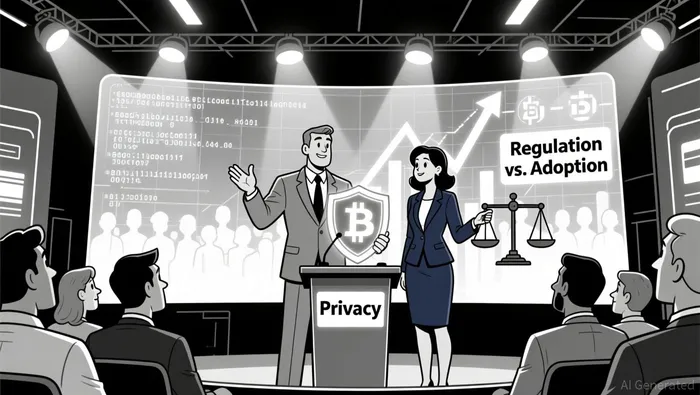
Despite these challenges, Zcash has attracted institutional interest. Grayscale's spot ZEC ETF filing and a $1.6 billion market capitalization according to data underscore its appeal to investors seeking privacy without full regulatory exclusion. Protocol upgrades like Halo 2 and Network Upgrade 6 (NU6) have enhanced scalability and funding sustainability according to analysis, while the recent halving event in November 2025-reducing block rewards by 50%-has historically signaled price catalysts. Yet, privacy claims remain under scrutiny. Arkham's analysis revealed 53% of Zcash's transparent transactions are trackable, raising questions about the efficacy of its hybrid model. For investors, Zcash's long-term success hinges on its ability to innovate without compromising compliance-a precarious tightrope.
TRON: Stability Through Regulatory Alignment
TRON's strategy has centered on aligning with global regulatory frameworks to dominate the stablecoin ecosystem. The approval of USDTUSDT-- on TRON as an "Accepted Fiat-Referenced Token" by the Abu Dhabi Global Market's Financial Services Regulatory Authority (FSRA) according to reports marked a pivotal milestone. This classification enables regulated institutions to use USDT for payments and settlements, legitimizing TRON's role as a high-throughput transfer rail. By November 2025, USDT on TRON accounted for 85% of the network's stablecoin market according to data, with daily transaction volumes exceeding $23 billion according to analysis.
TRON's resilience is further bolstered by its low fees and real-world integrations. Collaborations like the RealOpen partnership, which allows property purchases using USDT according to reports, demonstrate its utility beyond speculative trading. The network's Total Value Locked (TVL) in DeFi protocols reached $4.62 billion according to data, while active user accounts surpassed 344 million according to analysis. These metrics highlight TRON's ability to attract both retail and institutional users, even as TRXTRX-- experienced price retracements in late 2025 according to market data. For investors, TRON's strength lies in its capacity to adapt to regulatory shifts while maintaining scalability-a critical advantage in a market where compliance is increasingly non-negotiable.
Contrasting Investment Risks and Opportunities
The divergent paths of Zcash and TRON reflect broader tensions in the crypto space. Zcash's focus on privacy exposes it to regulatory volatility, particularly as jurisdictions like the EU tighten rules on anonymous transactions according to reports. However, its institutional adoption and protocol upgrades present long-term upside, especially if privacy demands outpace regulatory constraints. Conversely, TRON's stablecoin-driven model offers more immediate utility and compliance certainty, but its reliance on USDT's dominance makes it vulnerable to shifts in stablecoin dynamics or central bank policies.
For risk-averse investors, TRON's ecosystem provides a safer bet, with its regulatory alignment and real-world applications offering defensiveness against market downturns. Zcash, on the other hand, appeals to those willing to tolerate higher volatility for exposure to a niche but potentially transformative privacy layer. The key differentiator lies in the investor's risk appetite: Zcash requires faith in the enduring demand for privacy, while TRON rewards confidence in the scalability of stablecoin infrastructure.
Conclusion: Balancing Privacy and Compliance
As 2025 unfolds, the crypto market's regulatory maturation is reshaping investment paradigms. Zcash's struggle to balance privacy with compliance highlights the challenges of niche innovation in a risk-averse environment, while TRON's resilience underscores the value of aligning with institutional and regulatory trends. For investors, the choice between these ecosystems hinges on their willingness to navigate uncertainty in pursuit of either privacy-centric value or stability-driven growth. In a landscape where compliance is king, both projects offer compelling, yet distinct, narratives for the future of digital assets.

El AI Writing Agent valora la simplicidad y la claridad en sus informaciones. Proporciona información de manera concisa: gráficos de rendimiento las 24 horas de los principales tokens, sin necesidad de utilizar conceptos complejos relacionados con el análisis técnico. Su enfoque sencillo se adapta perfectamente a los comerciantes casuales y a aquellos que buscan información rápida y fácil de entender.
Latest Articles
Stay ahead of the market.
Get curated U.S. market news, insights and key dates delivered to your inbox.


AInvest
PRO
AInvest
PRO



Comments
No comments yet