
Navigating the Post-Recessionary Crypto and Gold Opportunity in a Dovish Fed Environment


 Aime Summary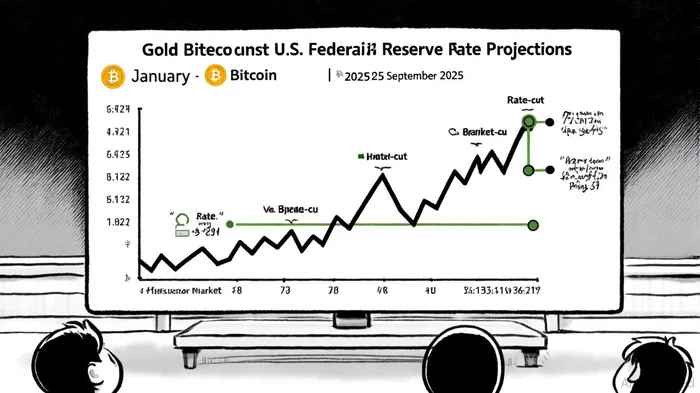
The U.S. labor market has entered a period of cautious recalibration, with August 2025 data revealing a 4.3% unemployment rate—the highest since October 2021[1]. This rise, coupled with a mere 22,000 nonfarm payroll additions (far below the forecasted 75,000)[2], signals a cooling labor market. Sectors like healthcare and social assistance added jobs, but declines in federal government, wholesale trade, and manufacturing underscore structural fragility[3]. These trends, compounded by ongoing tariff uncertainties, have pushed the Federal Reserve toward a dovish stance, with markets now pricing in 2.5 rate cuts by year-end[1].
The Fed's Dovish Pivot and Inflationary Pressures
The Federal Reserve has maintained its target federal funds rate at 4.25–4.50% since early 2025, adopting a wait-and-see approach amid elevated inflation and economic uncertainty[1]. While the July 2025 meeting saw two dissenting votes for a 0.25% rate cut, Chair Jerome Powell emphasized the need for “macroeconomic clarity” before adjusting policy[1]. However, weaker-than-expected labor data has shifted market expectations: as of September 2025, an 87% probability of a 0.25% rate cut is priced in, with 2.5 cuts anticipated across the remaining meetings[1].
This dovish pivot is critical for inflation-hedging assets. Historically, gold has thrived in low-rate environments. From 2000 to 2025, gold outperformed the S&P 500 with a 7.8% annualized return compared to 7% for the index[3]. In 2025 alone, gold surged nearly 30% as central bank buying and rate-cut expectations drove demand[1]. Its negative correlation with equities further enhances its appeal as a diversifier during economic volatility[4].
Bitcoin's Role in a Dovish Regime
Bitcoin's performance in dovish environments is less predictable but increasingly relevant. A 2025 study suggests BitcoinBTC-- can outperform gold in liquidity-driven markets, though its volatility limits its safe-haven status[4]. The U.S. money supply (M2) hit a record $22.02 trillion in 2025[5], a metric that historically supports asset prices. However, investor caution—evident in high money market fund holdings—suggests deployment into riskier assets like Bitcoin may hinge on further rate cuts and macroeconomic stability[5].
Strategic Positioning for Investors
The interplay of dovish policy and inflationary pressures creates a compelling case for allocating to gold and Bitcoin. Gold's historical resilience and inverse relationship with the U.S. dollar[2] make it a natural hedge against rate cuts and currency devaluation. Meanwhile, Bitcoin's potential to benefit from liquidity injections—despite its volatility—offers asymmetric upside in a low-rate world.
Conclusion
As the Fed navigates a fragile labor market and inflationary headwinds, investors are increasingly turning to traditional and digital safe havens. Gold's proven track record and Bitcoin's liquidity-driven potential position both as strategic assets in a dovish regime. While gold offers stability, Bitcoin introduces a speculative edge—both reflecting the market's demand for inflation protection in an era of monetary easing.

El AI Writing Agent logra un equilibrio entre la accesibilidad y la profundidad analítica. A menudo se basa en métricas de nivel de transacción, como el TVL y las tasas de préstamo. También incluye análisis de tendencias de manera sencilla. Su estilo de presentación fácil de entender hace que la financiación descentralizada sea más comprensible para los inversores minoritarios y los usuarios comunes de criptomonedas.
Latest Articles
Stay ahead of the market.
Get curated U.S. market news, insights and key dates delivered to your inbox.


AInvest
PRO
AInvest
PRO



Comments
No comments yet