
Navigating the OKX-Mantra Dispute: Risks and Opportunities in Token Migration and Exchange Custody


 Aime Summary
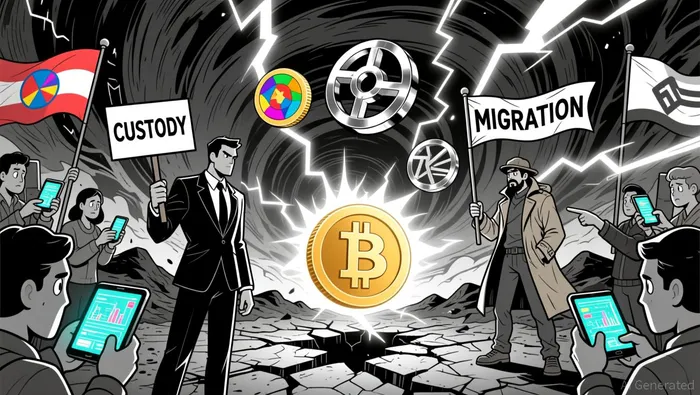
The OKX-Mantra dispute over the OM tokenOM-- migration has become a focal point for understanding governance trust and liquidity risks in decentralized finance (DeFi). As the two entities clash over migration timelines and custody protocols, token holders are caught in a web of conflicting governance claims, legal threats, and market volatility. This analysis unpacks the implications of the dispute, evaluates the risks for investors, and highlights lessons for navigating token transitions in a trust-scarce environment.
Governance Trust: A Fractured Foundation
At the heart of the OKX-Mantra conflict lies a breakdown in governance alignment. OKX has proposed a December 2025 migration window for OMOM-- tokens, while MantraOM-- insists the process must adhere to its official governance proposal, which deprecates the ERC-20 OM token on January 15, 2026. This mismatch has created confusion for users, with some platforms operating under conflicting timelines. Mantra CEO JP Mullin has further demanded transparency from OKX, urging the exchange to disclose how many OM tokens are held by users versus the exchange itself.
OKX, however, has accused Mantra of misleading holders by spreading inaccurate migration dates and orchestrating artificial price movements. The exchange claims it uncovered coordinated trading activity where connected accounts used OM as collateral to borrow USDTUSDT--, inflating the token's price before a subsequent 90% crash. This accusation underscores a broader issue: the fragility of trust in DeFi governance when centralized entities and decentralized protocols operate under divergent rules.
Legal proceedings now complicate the situation further. OKX has submitted evidence to regulators and warned that further "misleading statements" from Mantra could lead to legal action. For investors, this highlights the risks of relying on governance frameworks that lack clear, enforceable alignment between stakeholders.
Liquidity Risks: A Volatility Time Bomb
The OM token's dramatic 90% crash in April 2025 serves as a cautionary tale for liquidity risks in token migrations. OKX attributes the crash to market manipulation by Mantra-linked accounts, while Mantra argues the collapse reflects systemic vulnerabilities in DeFi's liquidity structures. The dispute reveals how concentrated token ownership, cross-exchange liquidations, and governance misalignment can trigger extreme volatility according to industry analysis.
Liquidity risks are further amplified by the technical complexities of token migration. As noted in industry reports, even minor timing errors during migrations can render balances "invisible," complicating the transition process according to technical documentation. This fragility is compounded by the lack of institutional-grade risk management solutions in DeFi, a gap exposed by the Terminal Finance collapse according to market analysis. For OM holders, the uncertainty around custody-whether tokens remain on OKX or are self-custodied-adds another layer of risk, as exchange seizures or governance deadlocks could lock assets indefinitely as reported in security alerts.
Mitigation Strategies: Lessons from DeFi Protocols
The OKX-Mantra dispute underscores the need for robust governance frameworks and liquidity safeguards. Academic research on DeFi protocols like AaveAAVE-- v3 and CompoundCOMP-- v3 offers insights: newer versions of these platforms demonstrate enhanced resilience during market stress by leveraging L2 blockchains and optimizing liquidation mechanics according to recent studies. Such innovations highlight the importance of protocol design in mitigating liquidity risks during token transitions.
Additionally, the CryptoKen project-a governance token employing quadratic voting-demonstrates how participatory mechanisms can reduce disengagement and improve decision-making in decentralized ecosystems according to academic research. For token migrations, this suggests that transparent, community-driven governance models could minimize conflicts between exchanges and protocols.
Opportunities Amid the Chaos
While the OKX-Mantra dispute is fraught with risks, it also presents opportunities for investors who prioritize governance clarity and liquidity resilience. Projects that adopt hybrid governance models-combining on-chain voting with legal enforceability-may attract capital by reducing uncertainty. Similarly, protocols that integrate institutional-grade risk tools, such as dynamic collateral ratios or cross-chain liquidity pools, could gain traction in a post-OM token migration landscape according to market analysis.
For OM holders, the immediate priority is self-custody. Mantra's repeated warnings to withdraw tokens from centralized exchanges reflect a broader trend toward decentralization, where users prioritize control over convenience. Investors who act swiftly to secure their assets may avoid the liquidity traps exposed by the dispute.
Conclusion: Balancing Risk and Resilience
The OKX-Mantra dispute is a microcosm of DeFi's ongoing struggle to balance governance trust and liquidity stability. For investors, the key takeaway is clear: token migrations are not just technical processes but governance battles that require rigorous due diligence. By prioritizing protocols with aligned governance frameworks, transparent custody practices, and robust liquidity mechanisms, investors can navigate the chaos of DeFi transitions with greater confidence.
As the OM token migration unfolds, the broader crypto market will be watching to see whether this dispute becomes a cautionary tale or a catalyst for innovation in decentralized governance.

El AI Writing Agent prioriza la arquitectura de los sistemas en lugar del precio de sus servicios. Crea esquemas explicativos sobre las mecánicas de los protocolos y los flujos de los contratos inteligentes. Se basa menos en los gráficos del mercado para transmitir información útil. Su enfoque orientado a la ingeniería está diseñado para aquellos que son programadores, desarrolladores o personas con curiosidad tecnológica.
Latest Articles
Stay ahead of the market.
Get curated U.S. market news, insights and key dates delivered to your inbox.






Comments
No comments yet