
Navigating Oil's Volatility: OPEC+, Fed Rates, and the Case for Strategic Hedging
The oil market in mid-2025 finds itself at a crossroads, buffeted by OPEC+'s supply decisions, U.S. monetary policy shifts, and geopolitical trade tensions. With Brent crude hovering near four-year lows below $60 per barrel, investors face a landscape of pronounced uncertainty. This volatility, however, creates opportunities for those willing to employ strategic hedging to capitalize on price swings. Below, I analyze the key drivers of oil market instability and outline actionable strategies to navigate it.
The OPEC+ Production Paradox: Flexibility Amid Fragility
The OPEC+ group's May 5, 2025 decision to increase production by 411,000 barrels per day (kb/d) in June reflects its gradual reversal of 2023's 2.2 million barrels per day (mb/d) cuts. This move, however, is anything but straightforward. The group's stated flexibility—allowing pauses or reversals of increases—highlights its dual challenge: supporting prices without stifling demand.
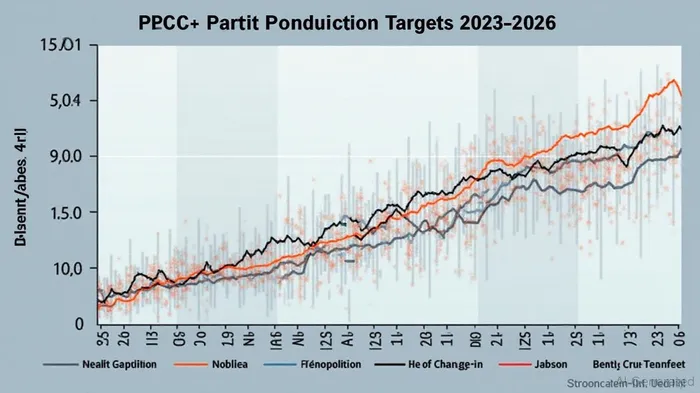
The June hike, paired with a similar increase in May, has already dampened prices, but compliance risks loom. While Saudi Arabia and Russia lead the pack with production targets of 9.367 mb/d and 9.161 mb/d respectively, weaker members like Algeria and Oman face fiscal pressures to overproduce. Compounding this, OPEC+ must compensate for prior overproduction since 2024, a process that could lead to abrupt supply cuts if noncompliance persists.
Fed Rate Decisions: The Dollar's Role in Oil's Dance
The Federal Reserve's June 17–18, 2025 meeting—marked by its Summary of Economic Projections (SEP)—will be pivotal. Current rates (4.25%–4.50%) remain elevated, but inflation's retreat (to 2.4% in March 2025) and softening labor markets (4.2% unemployment) may push the Fed toward cuts. A rate reduction would weaken the U.S. dollar, traditionally a tailwind for oil prices.
Conversely, if the Fed hesitates due to lingering inflation risks, dollar strength could persist, further depressing oil demand. Investors must align hedging strategies with this binary outcome. A cut would favor long positions in crude futures, while a pause could extend the downward price pressure already evident in Q2 2025.
Trade Tensions: The Demand-Side Wildcard
U.S.-China trade disputes continue to cloud the demand outlook. New tariffs on Chinese exports, announced in April 2025, have slowed global trade volumes, reducing tanker demand and weighing on oil prices. Meanwhile, China's domestic growth remains subdued, with energy consumption lagging projections. This demand weakness intersects with OPEC+'s supply increases, creating a volatile mix.
The geopolitical calculus grows more complex as Russia—a critical OPEC+ partner—faces Western sanctions and seeks alternative markets. Such dynamics underscore the need for hedging against both supply-side overhangs and demand-side collapses.
Hedging Strategies: Positioning for Policy Crosscurrents
1. Futures Contracts: Timing the Policy Cycle
The CME Group's WTI Crude Oil Futures (CL) offer direct exposure to price movements. Investors anticipating a Fed rate cut should consider long positions ahead of the June 18 decision. Conversely, those fearing OPEC+ overcompliance might short futures via inverse ETFs like ProShares UltraShort Oil & Gas (DNO).
Action Window: Position ahead of the Fed's June meeting (June 1–10) and OPEC+'s July 6 decision.
2. ETFs: Balancing Risk and Liquidity
- Long Exposure: The United States OilUSO-- Fund (USO), which tracks WTI, provides low-cost crude exposure.
- Short Exposure: DNO or the VelocityShares 3x Inverse Crude ETN (USCR) can profit from downside.
- Equity Diversification: Energy stocks like ChevronCVX-- (CVX) or Exxon MobilXOM-- (XOM) offer dividends and operational hedges. The Energy Select Sector SPDR Fund (XLE) bundles these into a diversified basket.
3. Options: Defining Risk Parameters
Buying put options on crude-linked ETFs (e.g., USO) can limit downside risk while preserving upside potential. For example, a put option with a strike price at $60 (as of June 2025) would protect against further declines.
Risk-Reward Balance: Energy Equities' Dual Appeal
Energy equities present a compelling risk-reward trade. Companies with low leverage, diversified production (e.g., renewables exposure), and hedged oil prices—such as Occidental PetroleumOXY-- (OXY) or TotalEnergiesTTE-- (TTE)—can weather volatility. However, speculative plays in shale or EV-related sectors remain riskier.
Key Consideration: Monitor OPEC+ compliance data (released monthly by the OPEC Secretariat) and Fed inflation metrics (e.g., PCE deflator) to adjust positions dynamically.
Conclusion: Volatility as an Ally
The intersection of OPEC+'s supply flexibility, Fed rate uncertainty, and trade wars ensures oil's volatility will persist. For investors, this is not a market to bet blindly on trends but one to hedge strategically. By layering futures, ETFs, and equity selections around policy windows, investors can turn uncertainty into opportunity. As always, disciplined risk management—via stop-losses and position sizing—remains critical to navigating this fluid landscape.

Disclosure: This analysis is for informational purposes only and should not be construed as personalized investment advice. Always conduct due diligence and consult a financial advisor before making decisions.

Stay ahead of the market.
Get curated U.S. market news, insights and key dates delivered to your inbox.




Comments
No comments yet