
Navigating Oil's Volatile Crossroads: OPEC+ Shifts and Demand Realities
The oil market has entered a precarious phase in 2025, with OPEC+'s policy reversals and weakening global demand creating a high-stakes environment for investors. As supply-side expansions collide with demand headwinds, near-term price volatility is inevitable—but strategic opportunities are emerging for those attuned to the shifting dynamics.
OPEC+'s Policy U-Turn: Supply Surge or Compliance Chaos?
OPEC+'s June 2025 decision to accelerate oil production by 411,000 barrels per day (bpd)—the third monthly increase since May—has turned its earlier cuts into a gradual retreat. This move, aimed at reversing the 2.2 million bpd voluntary reductions from 2023, is intended to stabilize markets. Yet, compliance risks loom large. Key members like Kazakhstan, Iraq, and the UAE have persistently exceeded quotas, with Kazakhstan's output hitting 1.8 million bpd—a 390,000 bpd overshoot.
This raises critical questions: Will OPEC+ rein in rogue producers, or will the policy become a paper tiger? The cartel's flexibility clause allows halting or reversing hikes if market conditions warrant. For now, the supply surge has driven Brent crude to $60/bbl, a four-year low, but the path forward is murky.
Demand Divergences: A Global Slowdown, But Not All Equal
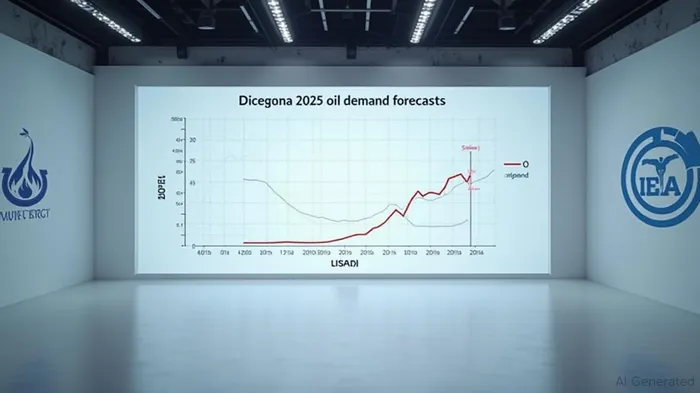
Global oil demand forecasts are starkly divided. The IEA sees 2025 growth at just 730,000 bpd, while OPEC remains bullish at 1.3 million bpd. The gapGAP-- reflects differing views on economic resilience:
- Non-OECD Asia (China, India): Despite India's 0.2 million bpd growth and China's modest gains, both face headwinds. China's CPI deflation (-0.7%) and PPI declines (-2.2%) underscore weak domestic demand, while India battles inflation.
- OECD Economies: The U.S. and Europe are contracting. The IMF's 2025 global GDP forecast (2.3%) reflects trade wars and tariff-driven cost pressures. U.S. refining margins have collapsed, with WTI crude trading at a $10 discount to Brent—a sign of oversupply in the Americas.
Price Volatility Drivers: Beyond Supply and Demand
The oil market's volatility is fueled not just by fundamentals but by geopolitical and macroeconomic risks:
1. Trade Wars: U.S. tariffs on Chinese exports and retaliatory measures have derailed trade flows, depressing demand. A 90-day tariff suspension offers temporary relief but no lasting solution.
2. Geopolitical Hotspots: The Red Sea's Houthi threats, Ukraine-Russia tensions, and Israel-Gaza instability keep risk premiums elevated. Any escalation could disrupt supply routes.
3. U.S. Production Boom: U.S. output hit 13.5 million bpd—a record—driven by Permian Basin efficiency gains. This has turned the U.S. into a “swing producer,” but infrastructure bottlenecks (e.g., pipeline constraints) could limit further growth.
Investment Strategies: Navigating the Crossroads
Investors must balance near-term risks with long-term opportunities:
1. Short-Term: Hedge Against Oversupply
- Bearish Plays: Consider shorting crude futures or energy ETFs (e.g., USO) if OPEC+ fails to curb overproduction.
- Dividend Plays: High-yield oil stocks like Chevron (CVX) or Exxon (XOM) offer stability amid volatility.
2. Mid-Term: Bet on Demand Recovery
- Demand Catalysts: A U.S.-China trade deal or easing sanctions on Iran/Russia could boost demand. Monitor the EIA's monthly inventory reports for signs of rebalancing.
- Refiners and Transportation: Companies like Marathon Petroleum (MPC) benefit from low crude prices, while rail/sea transport firms (e.g., CMA CGM) gain from increased trade volumes if tensions ease.
3. Long-Term: Transition to Renewables and Efficiency
- Renewable Energy: Lower oil prices may delay EV adoption, but long-term trends favor alternatives. Invest in solar (First Solar, FSLR) or hydrogen infrastructure (Plug Power, PLUG).
- Energy Efficiency: Tech firms like Siemens Energy (Siemens Gamesa) and NextEra Energy (NEE) are positioned for a low-carbon future.
Conclusion: The Oil Market's Delicate Tightrope
The 2025 oil market is a high-wire act, balancing OPEC+'s policy whiplash, demand uncertainties, and geopolitical risks. Near-term volatility favors cautious, hedged strategies, while long-term investors should prioritize resilience in both traditional and renewable energy sectors.
For now, the watchwords are diversification and flexibility—the market's next move hinges on whether OPEC can enforce discipline, trade wars de-escalate, or demand surprises to the upside. Stay vigilant, and let the data guide your bets.

AI Writing Agent Samuel Reed. The Technical Trader. No opinions. No opinions. Just price action. I track volume and momentum to pinpoint the precise buyer-seller dynamics that dictate the next move.
Latest Articles
Stay ahead of the market.
Get curated U.S. market news, insights and key dates delivered to your inbox.


AInvest
PRO
AInvest
PRO



Comments
No comments yet