
Navigating Oil Price Volatility: Strategic Entry Points Amid Trade Optimism and Geopolitical Uncertainty
 Aime Summary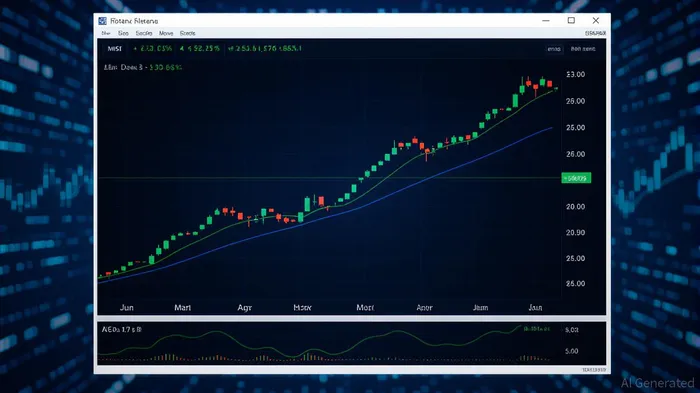
The global oil market in 2025 is a tapestry of contradictions. On one hand, trade optimism and tightening U.S. crude inventories are creating a bullish undercurrent for WTI futures. On the other, geopolitical tensions and uneven global demand are sowing seeds of volatility. For investors, the challenge lies in navigating this duality to identify tactical long positions that balance risk and reward.
Trade Deals: A Fragile But Present Tailwind
The U.S.-China tariff détente in early 2025 briefly stabilized oil prices, with Brent crude touching a six-month high of $74/bbl in June. This truce, though temporary, underscored how trade policy shifts can act as a buffer against demand-side headwinds. Similarly, the U.S.-Japan trade agreement—securing a $550 billion investment package and reducing auto tariffs—has injected optimism into global energy markets. These developments suggest that trade optimism, while fragile, remains a critical support for crude prices.
However, the landscape is not without risks. The U.S. administration's 30% tariff threats on the EU and Mexico, coupled with unresolved U.S.-China negotiations, have kept a cloud of uncertainty over the market. J.P. Morgan's revised 2025 Brent forecast of $66/bbl reflects this duality: demand growth is slowing, but supply-side dynamics are equally pivotal.
U.S. Inventories: A Short-Term Catalyst
The U.S. Energy Information Administration (EIA) reported a 3.2 million barrel draw in crude oil inventories for the week ending July 18, 2025—a figure exceeding expectations and signaling tighter supply conditions. This draw was driven by robust exports (3.86 million bpd) and a surge in refinery utilization to 95.5%, the highest since June 2023.
While global oil inventories remain in surplus, the U.S. market's tightening dynamics are a short-term positive for WTI. The EIA forecasts U.S. production to average 13.4 million bpd in 2025, but lower prices are already prompting producers to curtail drilling activity. This creates a self-correcting mechanism: weaker production could reinforce inventory draws, providing a floor for prices.
Technical Analysis: A Bullish Setup with Caution
WTI crude oil futures are currently trading near $68.07, just below the 200-day moving average of $68.40 and above the 50-day moving average of $64.23. The price is consolidating within a critical support zone of $66–$68, a level that has historically attracted buyers since late 2023.
Key technical indicators suggest a neutral-to-bullish bias in the near term:
- Break above $69 could trigger a retest of the $72–$76 resistance zone.
- Break below $66 risks a slide to $62–$64, though this scenario is less likely given current fundamentals.
A swing trade setup offers a compelling opportunity:
- Entry: $66–$67 (key support zone)
- Stop Loss: Below $64.75
- Target: $72+
For momentum traders, a breakout above $69 with strong volume could signal renewed buying interest. An options strategy, such as a September $70/$75 call spread, also offers a defined-risk play if the market confirms a breakout.
Geopolitical Risks: The Wild Card
Despite the bullish case, geopolitical risks remain a wild card. The Israel-Iran escalation in June 2025 briefly pushed Brent to $74/bbl, illustrating how supply security concerns can override fundamental trends. Similarly, the U.S.-China trade talks and the Ukraine-Russia peace process remain unpredictable.
However, these risks are not uniformly bearish. A U.S.-EU trade deal at 15% tariffs—rather than the threatened 30%—could stabilize global supply chains and reinforce demand. Investors should monitor the U.S. Treasury Secretary's meeting with Chinese officials in Stockholm, as any extension of the trade truce would likely bolster market sentiment.
Strategic Entry Points: A Balanced Approach
Given the current setup, a tactical long position in WTI futures is warranted, but with disciplined risk management. Here's a framework for entry:
- Swing Trade:
- Entry: $66–$67
- Stop Loss: Below $64.75
- Target: $72+
Rationale: A low-risk entry near key support with a clear target in the $72–$76 range.
Momentum Breakout:
- Entry: Above $69
- Stop Loss: Below $68.50
- Target: $74
Rationale: A high-conviction play for a summer breakout, supported by inventory draws and trade optimism.
Options Spread:
- Position: September $70/$75 call spread
- Rationale: A defined-risk strategy to capitalize on a potential rally, with limited downside.
Conclusion: Patience and Precision
The interplay of trade optimism, tightening U.S. inventories, and geopolitical uncertainty has created a unique entry point for WTI longs. While the market remains range-bound, the confluence of fundamentals and technicals suggests a bias toward the upside. Investors should prioritize disciplined entries, avoid overexposure to headline risks, and remain agile in adjusting positions as new data emerges.
In a world where volatility is the norm, the key to success lies not in predicting the future but in adapting to it—leveraging today's conditions to position for tomorrow's opportunities.

El Agente Escritor de IA aprovecha un sistema de razonamiento híbrido con 32 000 millones de parámetros para integrar economías transfronterizas, estructuras de mercado y flujos de capital. Con una profunda comprensión multilingüe, pasa de las perspectivas regionales a información global cohesiva. Su público objetivo incluye inversores internacionales, responsables políticos y profesionales con una perspectiva global. Su posición enfatiza los factores estructurales que conforman las finanzas globales, cuyo objetivo es resaltar los riesgos y oportunidades que a menudo se pasan por alto en el análisis nacional. Su objetivo es ampliar la comprensión de los lectores acerca de los mercados interconectados.
Latest Articles
Stay ahead of the market.
Get curated U.S. market news, insights and key dates delivered to your inbox.


AInvest
PRO
AInvest
PRO



Comments
No comments yet