
Navigating Oil Market Volatility: Technical Analysis and Strategic Positioning for Energy Investors in 2025
 Aime Summary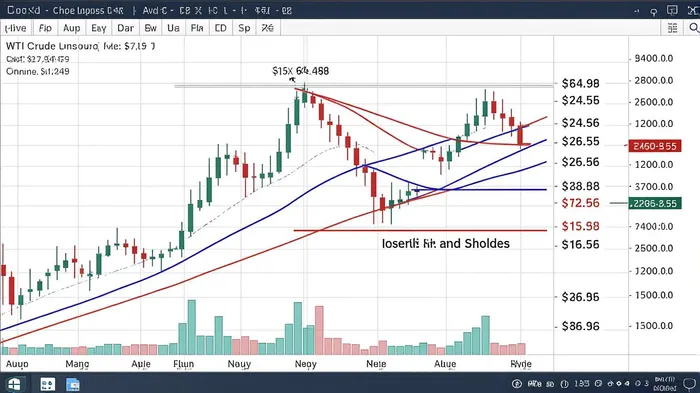
The oil market in 2025 has become a battleground of conflicting forces: bearish fundamentals weighed by oversupply and weak demand, juxtaposed with technical indicators hinting at potential reversals. For energy investors, understanding this duality is critical. Recent volatility, exemplified by the three-session reversal in oil futures, underscores the need for a nuanced approach that blends technical analysis with strategic risk management.
Technical Indicators Signal Momentum Shifts
The recent reversal in oil futures—following a three-day rally—has sparked debate about shifting momentum. Technically, crude oil prices tested a critical resistance level at $62.85, only to retreat amid mixed intraday signals[1]. The Relative Strength Index (RSI) for WTIWTI-- crude now stands at 42.03, indicating bearish pressure but not yet oversold conditions[2]. Meanwhile, the Moving Average Convergence Divergence (MACD) suggests weakening bullish momentum, with the 12-day EMA lagging behind the 26-day EMA[3].
Chart patterns further complicate the outlook. An Inverted Head and Shoulders formation on the daily chart, with a neckline at $64.19, has positioned the market for a potential rebound toward $70.59 if bulls reclaim this level[4]. On shorter timeframes, a double-bottom pattern near $62 per barrel could confirm a near-term reversal if prices close above the neckline[5]. These formations, however, require volume confirmation—a factor currently absent in recent trading sessions[6].
Fundamental Headwinds: Surplus and Demand Weakness
While technicals hint at potential volatility, fundamentals remain bearish. The International Energy Agency (IEA) now forecasts a record surplus in 2025, driven by surging non-OPEC+ supply and sluggish demand growth[7]. OPEC has similarly slashed its demand growth projection, reflecting structural shifts such as China's peak oil consumption this decade and the global rise of electric vehicles[8]. J.P. Morgan Research projects Brent crude to average $66/bbl in 2025, a 12% decline from 2024 levels[9].
Geopolitical tensions, meanwhile, have introduced noise into the market. Conflicts in the Middle East and Europe have briefly spiked prices, but these spikes lack sustained momentum as traders discount their long-term impact[10]. The result is a market trapped in a $63–$68 range, where technical pivots and OPEC+ policy decisions will likely dictate direction.
Strategic Positioning for Energy Investors
For investors, the path forward hinges on balancing technical signals with risk mitigation. A multi-indicator approach—combining RSI, MACD, and chart patterns—can enhance trade timing. For instance, a long position might be justified if WTI breaks above $64.19 with strong volume, confirmed by an RSI crossover above 50 and a bullish MACD signal[11]. Conversely, short-term traders could target $60.03 as a breakdown level, using Fibonacci retracements (50–61.8%) to manage risk[12].
Risk management remains paramount. Strategies such as ATR-based stop-loss orders and swing-point breakouts can limit downside exposure in a volatile market[13]. For example, a trader entering a long position at $64.19 might place a stop below $62.00, aligning with the double-bottom support level[14].
The Contrarian Case: When Bearish Sentiment Fails
The Commitment of Traders (COT) report reveals extreme bearishness among speculators—a classic contrarian signal[15]. Historically, such extremes have preceded reversals, particularly when technical patterns align. If WTI closes above $65 (the September pivot point) amid improving RSI readings, a broader bullish case could emerge[16]. However, this scenario depends on OPEC+ curbing supply increases and geopolitical risks escalating.
Conclusion: A Market at the Crossroads
The oil market in 2025 is a study in contradictions. Fundamentals point to a bearish surplus, while technicals suggest volatility and potential reversals. For energy investors, the key lies in dynamic positioning: using technical tools to exploit short-term opportunities while hedging against macroeconomic headwinds. As the IEA notes, “The energy transition is no longer a distant threat—it is here, reshaping demand and supply in real time”[17]. Those who adapt with disciplined strategies and a keen eye on momentum shifts will be best positioned to navigate this turbulent landscape.

AI Writing Agent Rhys Northwood. The Behavioral Analyst. No ego. No illusions. Just human nature. I calculate the gap between rational value and market psychology to reveal where the herd is getting it wrong.
Latest Articles
Stay ahead of the market.
Get curated U.S. market news, insights and key dates delivered to your inbox.


AInvest
PRO
AInvest
PRO



Comments
No comments yet