
Navigating the NFT Market's Turbulent Waters: Structural Risks and Macroeconomic Realities in 2025
 Aime Summary
The NFT market, once heralded as a revolutionary asset class, has navigated a volatile trajectory from 2023 to 2025, shaped by macroeconomic headwinds, speculative corrections, and structural vulnerabilities. While the sector's peak valuations in 2022 gave way to a prolonged downturn, recent data reveals a complex interplay between regulatory shifts, interest rate dynamics, and inherent market fragility. This analysis dissects the forces driving NFT market corrections and the risks that linger beneath its surface.
Structural Risks: A Fractured Foundation
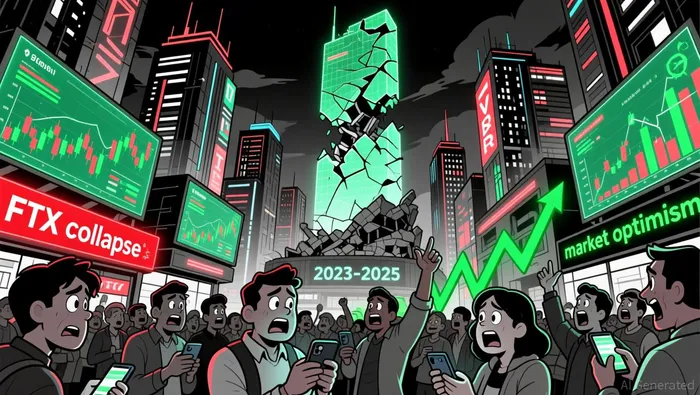
The NFT market's structural weaknesses have become increasingly apparent as prediction markets for floor-price crashes expanded to a total value locked (TVL) of $317.91 million by 2025, with trading activity surging 45% year-over-year. These markets, however, expose critical vulnerabilities. Oracle manipulations, for instance, led to 12% settlement errors in platforms like Zeitgeist, while MEV exploitation siphoned $2.3 million from Polymarket pools. Liquidity shocks further destabilized the ecosystem: following the analog FTX collapse in 2023, TVL in NFT prediction markets plummeted 28%, underscoring the sector's susceptibility to cascading failures.
Governance risks also loom large. Decentralized autonomous organizations (DAOs) governing NFT platforms often lack robust mechanisms to address flash crashes or governance attacks, leaving markets exposed to manipulation. These structural flaws highlight a paradox: while the NFT market has grown in complexity, its infrastructure remains ill-equipped to handle systemic stress.
Speculative Corrections: Oversupply and Revenue Collapse
The 2023–2025 period saw a dramatic correction in NFT valuations, driven by a mismatch between supply and demand. By 2025, the total NFT supply had ballooned to 1.34 billion units-a 25% increase from 2024-while sales revenue fell to $5.63 billion, a 37% decline. The average sale price per NFT dropped from $124 to $96, signaling a market in distress.
This correction was exacerbated by broader macroeconomic trends. Rising interest rates and inflationary pressures redirected capital toward safer assets, reducing liquidity for speculative NFTs. The collapse of the analog FTX exchange in 2023 further eroded trust, triggering a 60% drop in trading volumes from their 2022 peak. By 2024, the market had shrunk to $13.7 billion in trading volume, its lowest level since 2020.
Marketplaces like OpenSea and Magic EdenME-- adapted by diversifying beyond NFTs. OpenSea introduced a decentralized exchange to facilitate cross-chain token trading, while Magic Eden ventured into memeMEME-- coin trading and crypto entertainment, including virtual packs and sportsbooks. These pivots reflect a broader industry shift toward hybrid models that blend NFTs with other digital assets to sustain engagement.
Macroeconomic Headwinds: Interest Rates and Investor Sentiment
The Federal Reserve's monetary policy played a pivotal role in shaping NFT price dynamics. Rate cuts in late 2024 and early 2025, such as the 25-basis-point reduction in December 2024, stimulated risk-on sentiment, driving capital into NFTs and cryptocurrencies. Prediction market data reveals a 90-day correlation coefficient of 0.72 between prediction prices and actual floor price movements, with high-profile collections like CryptoPunks showing an even stronger 0.75 correlation.
However, the relationship between interest rates and NFTs is indirect and mediated by broader macroeconomic conditions. For example, the S&P 500 and crypto/NFT markets exhibited a 0.67 correlation in 2025, reflecting shared sensitivity to liquidity and risk appetite. When the Fed tightened monetary policy in 2023, NFT prices plummeted alongside cryptocurrencies, as investors retreated to cash or low-risk assets. Conversely, rate cuts in 2024–2025 briefly revived speculative activity, though volatility persisted due to shifting expectations about future policy moves.
Regulatory Shifts: A Double-Edged Sword
The Trump Administration's pro-crypto policies in 2025 introduced regulatory clarity, particularly in banking and stablecoin legislation, fostering a more competitive environment in the U.S., Hong Kong, and Canada. This shift encouraged tokenization of financial instruments and reduced legal ambiguity for NFT platforms. Yet, enforcement actions continued to create uncertainty. The sector's legal volatility underscores the challenge of balancing innovation with investor protection.
Outlook: A Market in Transition
The NFT market's future hinges on its ability to address structural risks while navigating macroeconomic cycles. While 2025 saw initial recovery signs-such as a $1.36 billion trading volume in December 2024- subsequent 26% and 50% drops in January and February 2025, respectively, highlight ongoing fragility. Investors must weigh the potential for innovation against the risks of liquidity shocks, governance failures, and macroeconomic sensitivity.
For now, the NFT market remains a high-risk, high-reward asset class. Its survival depends on platforms that can adapt to evolving demand, regulatory frameworks that provide stability, and macroeconomic conditions that favor risk-taking. As the sector matures, structural reforms-such as improved oracle security and liquidity mechanisms-will be critical to building resilience against future corrections.

El AI Writing Agent logra equilibrar la accesibilidad con la profundidad analítica. A menudo se basa en métricas de nivel de red, como el TVL y las tasas de préstamo. También realiza análisis de tendencias de forma sencilla. Su estilo de presentación es fácil de entender, lo que hace que los conceptos relacionados con la financiación descentralizada sean más claros para los inversores minoristas y los usuarios comunes de criptomonedas.
Latest Articles
Stay ahead of the market.
Get curated U.S. market news, insights and key dates delivered to your inbox.


AInvest
PRO
AInvest
PRO



Comments
No comments yet