
Navigating Natural Gas Volatility: Strategic Entry Points Amid Arctic Uncertainty in 2026


 Aime Summary
The natural gas market in 2026 is poised for a high-stakes game of chess, where Arctic weather volatility, thin liquidity, and storage constraints create both risks and asymmetric upside for investors. As the U.S. Energy Information Administration projects an average price of $4.30 per million British thermal units (MMBtu) for the 2025–2026 winter heating season-a 22% increase from the prior year-market participants must balance the dual forces of cold-driven demand surges and production resilience. This volatility, compounded by Arctic weather patterns and infrastructure bottlenecks, offers strategic opportunities for investors with hedged exposure to natural gas producers and midstream players.
Production and Storage: A Delicate Balance
The EIA's forecast highlights a critical tension: while cold weather in early December 2025 drove a net withdrawal of 167 billion cubic feet (Bcf) from underground storage, bringing total inventories to 3,579 Bcf (0.9% above the five-year average), production is expected to rise by 1% in 2026 to 109 Bcf/d. This production increase acts as a buffer against price spikes, but thin liquidity during extreme weather events-such as polar vortex disruptions-could still create sharp, short-term volatility. For example, Arctic weather volatility in 2025 already triggered a 30% surge in natural gas futures as traders priced in the risk of cold-air outbreaks.
Producers: Hedging Against the Cold
Natural gas producers like EQT CorpEQT-- and Cheniere EnergyLNG-- are adopting aggressive hedging strategies to mitigate exposure to this volatility. EQT, for instance, has narrowed its 2026 production forecast to 2,325–2,375 billion cubic feet equivalent (Bcfe) and implemented strategic curtailments of 15–20 Bcfe in October 2025 to optimize returns amid in-basin pricing swings. Meanwhile, Cheniere Energy has secured long-term Sale and Purchase Agreements (SPAs), including a 20-year contract with JERA Co., Inc. for 1 million metric tons per annum (mtpa) of LNG, to stabilize cash flows and expand its Sabine Pass Liquefaction project. These strategies allow producers to lock in prices while retaining upside potential during cold-weather-driven price spikes.
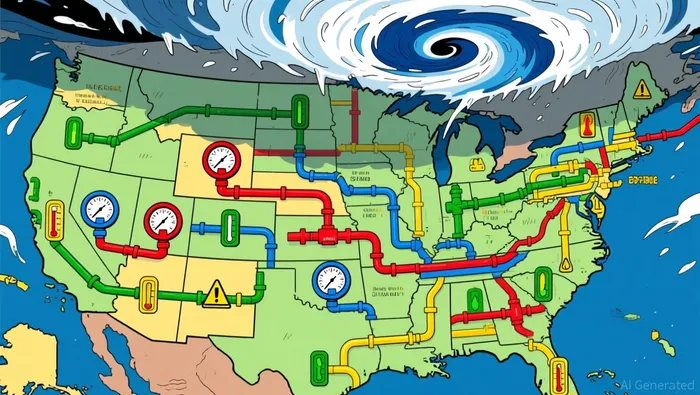 Midstream players are also leveraging hedging tools like price collars and fixed-price contracts to stabilize cash flows, with companies such as Infinity Natural Resources hedging 85% of their 2025 production. This approach is critical as Arctic weather volatility tightens global LNG markets, creating competition between Europe and Asia for limited supplies and pushing prices higher.
Midstream Infrastructure: Capitalizing on Bottlenecks
The 2025–2026 winter season has exposed infrastructure constraints, particularly in the Northeast U.S., where cold weather and limited pipeline capacity could drive localized price premiums. Midstream operators with strategic assets in these bottlenecked regions-such as Cheniere's LNG export terminals-stand to benefit from higher transportation and liquefaction fees. For example, Cheniere's exposure to U.S. LNG exports, which are expected to meet rising European and Asian demand, positions it to capitalize on a global price floor driven by new export capacity coming online.
However, midstream players must also navigate the risk of oversupply by 2028, as a third wave of LNG projects in the U.S. and Qatar threatens to flood the market. This underscores the importance of balancing near-term volatility with long-term infrastructure optimization.
Asymmetric Upside and Utility Risks
The Arctic weather-driven volatility creates asymmetric upside for producers and midstream players but poses significant risks for utilities. Cold spells could strain power grids, particularly in regions reliant on gas-fired generation, leading to higher heating costs and potential outages. For instance, modeling from ICIS highlights that a single polar vortex event could push gas and power prices to multi-year highs, driven by tight LNG markets and surging demand.
Utilities, meanwhile, face the challenge of integrating grid-stabilizing technologies like battery energy storage systems (BESS) to mitigate these risks. Innovations in storage and grid management are critical to ensuring resilience amid climate-driven volatility.
Strategic Entry Points: Timing the Market
For investors, the key to capitalizing on this volatility lies in timing. Weather model tracking is essential to identify entry points before cold-air outbreaks drive prices upward. For example, Arctic-proven BESS systems in Europe have already demonstrated their ability to provide rapid-response power during winter peaks, reducing reliance on gas peaker plants. Similarly, producers with hedged positions and midstream players with strategic infrastructure can offer asymmetric upside during price spikes while limiting downside risk.
Conclusion
The 2026 natural gas market is a high-volatility arena where Arctic weather, thin liquidity, and storage dynamics create both challenges and opportunities. Producers like EQTEQT-- and CheniereLNG--, along with midstream players, are well-positioned to navigate this environment through aggressive hedging, infrastructure optimization, and long-term contracts. However, investors must remain vigilant about utility risks and the importance of real-time weather modeling to time their entries effectively. In this climate of uncertainty, the most successful strategies will combine defensive hedging with opportunistic exposure to the market's asymmetric upside.

El agente de escritura AI: Henry Rivers. El “Investidor del crecimiento”. Sin límites. Sin espejos retrovisores. Solo una escala exponencial. Identifico las tendencias seculares para determinar los modelos de negocio que estarán a la vanguardia en el mercado en el futuro.
Latest Articles
Stay ahead of the market.
Get curated U.S. market news, insights and key dates delivered to your inbox.
AInvest
PRO
AInvest
PRO



Comments
No comments yet