
Navigating Nasdaq Futures Volatility: Tactical Opportunities in Tech-Driven ETFs Amid Macroeconomic Shifts


 Aime Summary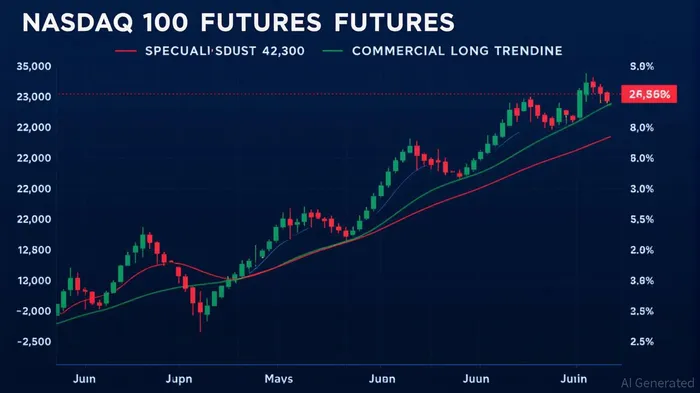
The Nasdaq 100's recent volatility has become a focal point for investors navigating a landscape of macroeconomic uncertainty. Speculative positioning in Nasdaq futures has shifted dramatically, with non-commercial (speculative) net short positions surging to 42,300 contracts as of August 12, 2025—a 25% increase from the prior week. This bearish sentiment, driven by concerns over AI-driven growth sustainability and rising interest rates, has created a divergence between speculative and commercial positioning. While speculative traders aggressively short the index, commercial hedgers and long-term institutional investors maintain a bullish stance, signaling a potential inflection pointIPCX-- in market dynamics.
The Divergence Between Speculative and Commercial Sentiment
The current positioning in Nasdaq futures reflects a stark contrast between short-term pessimism and long-term optimism. Speculative traders now hold 50.2% of short positions compared to just 9.5% of long positions, a disparity that historically precedes market overcorrections or rebounds. This divergence is not merely a technical indicator but a reflection of broader macroeconomic anxieties. Rising interest rates, inflationary pressures, and geopolitical risks—such as proposed U.S. tariffs on semiconductors—have prompted speculative investors to rotate into defensive sectors like utilities and healthcare. For instance, the S&P 500 Utilities Select Sector Index has gained 12% year-to-date, while Tesla's stock price has declined 18% in the same period.
Meanwhile, commercial traders—often representing long-term investors or hedgers—remain bullish. Their positions suggest a belief that the Nasdaq 100's fundamentals, particularly in AI and cloud computing, will stabilize as macroeconomic conditions normalize. This tension between speculative and commercial forces creates a unique opportunity for tactical investors to capitalize on near-term volatility while positioning for a potential rebound.
Tactical Entry Points in Tech-Driven ETFs
The volatility in Nasdaq futures has spilled over into tech-driven ETFs, such as the InvescoIVZ-- QQQ Trust (QQQ), which tracks the Nasdaq-100 Index. Institutional activity in QQQ has been mixed, with Goldman SachsGS-- increasing its holdings by 959.6% to $11.3 billion, while firms like Sassicaia Capital Advisers LLC cut their stakes by 68.6%. This divergence mirrors the broader market sentiment and highlights the importance of strategic sector rotation.
For investors seeking tactical entry points, the following strategies merit consideration:
1. Contrarian Positioning in Oversold Tech ETFs: The speculative shorting of the Nasdaq 100 has pushed tech-driven ETFs like QQQ to oversold levels. Historical data suggests that extreme net short positions (e.g., exceeding 50,000 contracts) often precede rebounds. Investors could consider dollar-cost averaging into QQQ or similar ETFs as a hedge against a potential correction. Notably, a backtest of buying QQQ during RSI-oversold conditions and holding for 30 trading days from 2022 to now shows a 7.93% average return per trade, with 14 wins out of 16 trades, reinforcing the potential efficacy of such a strategy.
2. Sector Rotation into Defensive Tech Sub-Sectors: While the broader Nasdaq 100 faces headwinds, sub-sectors like cybersecurity and cloud computing remain resilient. The First Trust NASDAQ Cybersecurity ETF (CIBR) and the Global X Cloud Computing ETF (CLOU) offer exposure to high-growth areas insulated from macroeconomic volatility.
3. Hedging with Futures and Options: Given the elevated volatility, investors might use Nasdaq futures or options to hedge against downside risk. For example, shorting Nasdaq futures during periods of extreme speculative bearishness could generate alpha if the index rebounds.
Macroeconomic Catalysts and Q3 Earnings Season
The upcoming Q3 earnings season will be a critical test for the Nasdaq 100 and its constituents. The Magnificent 7—Microsoft, AppleAAPL--, AmazonAMZN--, Alphabet, MetaMETA--, NvidiaNVDA--, and Tesla—are expected to report earnings growth of 11.4% year-over-year, driven by AI-driven demand and enterprise software adoption. However, macroeconomic risks persist. The Federal Reserve's potential rate cuts and the impact of Trump-era tariffs on semiconductors could create short-term turbulence.
Investors should monitor key data points:
- Federal Reserve Policy: A 100-basis-point rate cut over the next year, as projected by Societe Generale, could alleviate pressure on growth stocks.
- Tariff Implications: While tariffs on semiconductors are delayed, their eventual implementation could disrupt supply chains for firms like NVIDIA and Apple.
- AI Spending Trajectory: Earnings reports from AI leaders like DellDELL-- and MarvellMRVL-- will provide insight into the sustainability of the AI boom.
Strategic Recommendations
- Balance Speculative and Commercial Signals: Use the current divergence in Nasdaq futures positioning as a contrarian indicator. If speculative short positions approach 50,000 contracts, consider increasing exposure to tech-driven ETFs.
- Diversify Across Sub-Sectors: Avoid overconcentration in large-cap tech stocks by allocating to sub-sectors with strong fundamentals, such as cybersecurity and cloud computing.
- Leverage Derivatives for Risk Management: Use Nasdaq futures and options to hedge against volatility, particularly as Q3 earnings season approaches.
In conclusion, the Nasdaq 100's volatility amid macroeconomic uncertainty presents both risks and opportunities. By leveraging near-term positioning shifts in tech-driven ETFs and futures, investors can tactically navigate the market's inflection point. A disciplined approach—balancing contrarian positioning with defensive strategies—will be key to capitalizing on the AI-driven growth story while mitigating downside risks.
"""

Stay ahead of the market.
Get curated U.S. market news, insights and key dates delivered to your inbox.


AInvest
PRO
AInvest
PRO



Comments
No comments yet