
Navigating the Mortgage Rate Maze: Strategic Sector Rotation and Risk Management in a High-Yield Environment
 Aime Summary
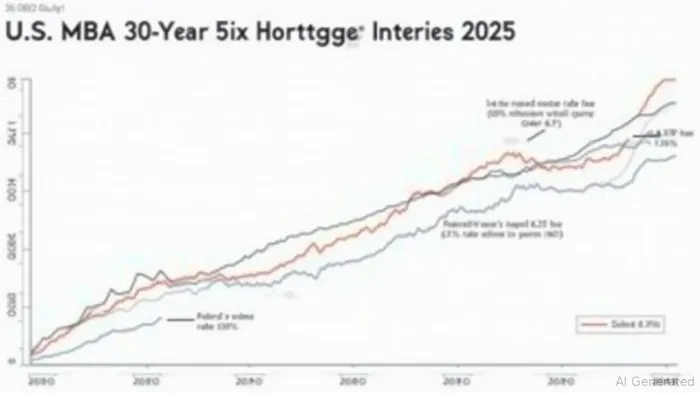
The U.S. MBA 30-Year Fixed Mortgage Rate has become a pivotal barometer for economic health, investor sentiment, and sector-specific performance. As of July 2025, the rate stands at 6.788%, a modest increase from recent months, reflecting a market in flux. This rate, while seemingly stable, masks a complex interplay of inflationary pressures, geopolitical risks, and Federal Reserve policy uncertainty. For investors, understanding how this rate reshapes capital flows and sector dynamics is critical to navigating a landscape where strategic sector rotation and risk management are no longer optional—they are survival strategies.
The Mortgage Rate as a Macroeconomic Signal
The 30-year mortgage rate is more than a borrowing cost; it's a lens through which to view the broader economy. The current rate of 6.788% is underpinned by a decline in 10-year Treasury yields (4.365%) and a surge in oil prices ($69.54 per barrel), which signal mixed economic signals. While lower Treasury yields typically support mortgage rates, rising energy costs introduce inflationary headwinds. Meanwhile, the CNN Business Fear & Greed Index at 68 and Q2 GDP growth of 3% highlight a tug-of-war between cautious optimism and economic resilience.
Sector-Specific Impacts and Strategic Rotation
1. Real Estate Investment Trusts (REITs): Cap Rates and Defensive Plays
REITs have experienced a 139-basis-point expansion in cap rates since 2022, with multifamily and industrial properties leading the charge. This reflects a recalibration of risk premiums in a high-rate environment. Defensive REITs—those with grocery-anchored retail or Sun Belt multifamily exposure—have outperformed the S&P 500 in 2025, while office REITs grapple with 20% vacancy rates. Investors should prioritize REITs with strong balance sheets and low leverage, such as Equity Residential (EQR) or Prologis (PLD).
2. Homebuilders and Materials Suppliers: A Paradox of Demand
Homebuilders like Lennar (LEN) and PulteGroup (PHM) face margin pressures due to elevated mortgage rates and a 4.7% decline in housing starts in 2025. Conversely, materials suppliers such as Vulcan Materials (VMC) and Martin Marietta (MLM) benefit from infrastructure spending and pent-up demand. However, Trump-era tariffs on steel and copper threaten to add 4–10% to construction costs, squeezing margins further. A strategic overweight in construction materials ETFs like the SPDR S&P Homebuilders ETF (XHB) offers exposure to this paradox.
3. Commercial Real Estate: Refinancing Challenges and Private Credit Opportunities
The $3.1 trillion refinancing challenge in commercial real estate has created a $270–570 billion equity gap, with lenders tightening underwriting standards. This has opened the door for private credit funds, now managing $1.4 trillion in assets, to provide mezzanine financing and distressed debt solutions. High-net-worth investors may find value in acquiring undervalued commercial properties in Sun Belt markets, where population growth and rent resilience offset higher cap rates.
4. Automotive and Consumer Spending: Affordability and Leasing Trends
The automotive sector is closely tied to housing trends through household formation and discretionary spending. With mortgage rates at 6.788%, consumer confidence has waned, potentially delaying major purchases like vehicles. Light-truck dominance (81.4% of 2024 sales) continues, but used-vehicle prices remain elevated, pushing demand toward new cars. Investors should monitor automakers like General Motors (GM), which recently announced a $10 billion stock buyback, and consider the rise of leasing as an alternative to ownership.
5. Distribution and Mortgage-Related Services: Liquidity and Prepayment Risks
The distribution sector, including logistics and mortgage-related services, faces volatility due to reduced loan origination volumes. In July 2025, refinance activity rose to 41.1%, but purchase applications fell 12%, creating liquidity challenges for lenders. Investors in mortgage-backed securities (MBS) face heightened prepayment risk, while a shift toward government-backed loans (FHA share at 19.0%) may alter risk profiles.
Risk Management in a Shifting Rate Environment
The current rate environment demands a dual strategy: defensive positioning and opportunistic exposure. Defensive sectors like utilities (XLU) and healthcare (XLV) offer stability, with utilities' dividend yields (3–4%) becoming increasingly attractive as bond yields rise. Conversely, sectors like technology (bifurcated between trade-exposed hardware and domestic AI infrastructure) require careful selection.
Conclusion: Balancing Defense and Growth
The U.S. MBA 30-Year Mortgage Rate is a microcosm of broader macroeconomic forces. As investors navigate this landscape, strategic sector rotation—favoring defensive REITs, construction materials, and utilities—combined with a hedging approach to homebuilders and cyclical sectors, will be essential. The key lies in aligning portfolios with both rate resilience and growth potential, ensuring that volatility becomes an ally rather than an adversary.
In a world where mortgage rates dictate capital flows, adaptability is the ultimate competitive advantage.

Stay ahead of the market.
Get curated U.S. market news, insights and key dates delivered to your inbox.
AInvest
PRO
AInvest
PRO



Comments
No comments yet