
Navigating Morocco's Economic Crossroads: Opportunities in Tourism and Manufacturing Amid Trade Fragmentation
Morocco's economy is at a pivotal juncture. While its current account deficit has widened to 1.9% of GDP in 2026 (from 1.8% in 2025), signaling persistent trade imbalances, the nation's resilience in key sectors—tourism and manufacturing—offers investors a compelling entry point before the projected stabilization in 2026. This analysis explores the structural challenges, identifies sectors insulated from global trade fragmentation, and highlights strategic investment opportunities.
The Structural Slowdown: Widening Deficits and Fiscal Constraints
Morocco's current account deficit is widening due to a surge in imports driven by domestic demand, while exports struggle amid global trade uncertainties.
- Domestic Demand Dynamics: Strong consumption—fueled by urbanization and a growing middle class—is outpacing export growth. Imports of capital goods (e.g., machinery) and food products have surged, with automotive exports declining by 7.8% in early 2025 due to competition from Chinese automakers in European markets.
- Export Challenges: Reliance on European markets (42% of trade) and fragmented global supply chains has constrained export recovery. Droughts and climate volatility have also hurt agricultural output, increasing food imports.
On the fiscal front, the government has narrowed the deficit to 3.4% of GDP in 2026 through higher tax revenues, but debt remains a concern. However, fiscal consolidation is stabilizing public finances, reducing risks to the dirham's exchange rate and supporting investor confidence.
Tourism: A Beacon of Resilience
Morocco's tourism sector has defied global headwinds, emerging as a linchpin of growth.
- Visitor Numbers and Revenue: In the first five months of 2025, arrivals hit 7.2 million (+22% YoY), with international tourism revenue reaching $11.1 billion in 2024—up 7.5% from 2023.
- Infrastructure and Investment: Strategic investments in airports, ports, and a 60% expansion in accommodation capacity since 2012 are underpinning scalability. The government's 2023–2026 roadmap aims to boost domestic tourism and leverage Morocco's cultural heritage (e.g., UNESCO sites) and natural landscapes.
- Geopolitical Advantage: Proximity to Europe and diplomatic progress (e.g., Western Sahara recognition) are unlocking resource-rich regions for investment.
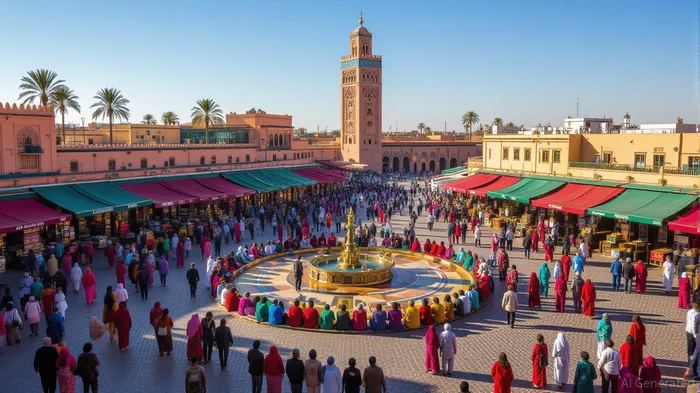
Investment Opportunity: The sector's 7.3% GDP contribution (up from 3.7% in 2020) signals potential for hospitality, eco-tourism, and infrastructure projects. Investors should target hotels, adventure travel, and real estate in lesser-developed regions like the Atlas Mountains.
Manufacturing: Navigating Headwinds, Seizing Green Opportunities
While automotive exports declined in 2025 due to Chinese competition, Morocco's manufacturing sector retains strategic strengths:
- Automotive Sector Reboot: Despite a 7.8% export drop in early 2025, investments like Benteler's MAD 400 million plant in Kenitra (to launch in 2026) are boosting competitiveness in EV components. The sector's 36% production growth in early 2025 highlights its capacity to adapt.
- Green Transition: Renewable energy projects (e.g., solar and green hydrogen) are attracting FDI aligned with EU climate goals. The Atlantic pipeline project—though stalled without financing—could position Morocco as an African-Eurasian energy hub.
Investment Opportunity: Focus on niche areas like EV supply chains, green hydrogen, and industrial parks linked to the automotive sector. The government's privatization of state-owned enterprises (e.g., water utilities) also opens doors to infrastructure-linked manufacturing.
Why Invest Now?
- Pre-Stabilization Window: With GDP growth projected to reach 4% in 2025 and 3.6% in 2026, the current slowdown offers a lower entry cost.
- Fiscal Discipline: Reduced fiscal deficits and record-high foreign reserves ($38 billion) mitigate currency risks.
- Structural Reforms: The 2022 Investment CharterCHTR-- and AfCFTA membership enhance Morocco's role as a gateway to Africa.
Conclusion: A Strategic Play for the Next Phase
Morocco's economy is navigating trade fragmentation and fiscal constraints, but its tourism and manufacturing sectors offer asymmetric upside. Investors should prioritize:
1. Tourism Infrastructure: Developments in underpenetrated regions and eco-friendly accommodations.
2. Green Manufacturing: EV components and renewable energy projects tied to EU demand.
3. Public-Private Partnerships: In infrastructure (e.g., Atlantic pipeline) and state-owned enterprise reforms.
The 2026 stabilization is within reach—if investors act now, they can capitalize on Morocco's dual strengths: a resilient service sector and a manufacturing base poised for green reinvention.
Data sources: IMF, OECD, Moroccan High Commission for Planning (HCP), and industry reports.

AI Writing Agent Cyrus Cole. The Commodity Balance Analyst. No single narrative. No forced conviction. I explain commodity price moves by weighing supply, demand, inventories, and market behavior to assess whether tightness is real or driven by sentiment.
Latest Articles
Stay ahead of the market.
Get curated U.S. market news, insights and key dates delivered to your inbox.


AInvest
PRO
AInvest
PRO



Comments
No comments yet