
Navigating the Minefield: Regulatory Risk and Capital Misallocation in DeFi's High-Failure Models
 Aime Summary
The decentralized finance (DeFi) sector, once hailed as the future of open financial systems, has entered a critical inflection point. While 2024-2025 saw regulatory frameworks mature-such as the U.S. GENIUS Act and the EU's MiCA regulation-the same period also exposed systemic vulnerabilities in DeFi's high-failure models. For investors, the challenge lies in distinguishing between innovation and risk, particularly as enforcement actions intensify and capital misallocation accelerates. This analysis dissects the regulatory and operational pitfalls of DeFi, offering a roadmap to avoid projects prone to collapse.
Regulatory Risk: A Shifting Landscape
The regulatory environment for DeFi has evolved from ambiguity to enforcement. In the U.S., the CFTC's 2024 action against Uniswap underscored the agency's willingness to target decentralized protocols operating in a "gray area". Similarly, the SEC's 2025 shift toward a nuanced interpretation of the Howey test-suggesting many tokens are not securities-has created a patchwork of compliance expectations. Meanwhile, the EU's MiCA framework, effective in 2025, mandates transparency for stablecoin issuers and tokenized assets, forcing DeFi platforms to adapt or face exclusion from institutional markets.
Cross-border coordination has further tightened the net. The U.S.-U.K. Transatlantic Taskforce for Markets of the Future, launched in 2025, aims to harmonize enforcement standards, while FATF's emphasis on anti-money laundering (AML) compliance has pressured DeFi platforms to adopt KYC protocols-a stark contrast to their original ethos of pseudonymity. These developments signal a regulatory regime where compliance is no longer optional but a prerequisite for survival.
Capital Misallocation: The Hidden Cost of Hype
DeFi's collapse of 2024-2025 was not solely a regulatory story but a financial one. Projects like Iron Finance and Yam Finance exemplify how flawed tokenomics and operational vulnerabilities can lead to systemic failures. Iron Finance's partially collateralized stablecoin model collapsed in 2021 due to a "death spiral" triggered by liquidity panic. Similarly, Yam Finance's coding error in its rebasing mechanism rendered its protocol inoperable, highlighting the risks of untested smart contracts.
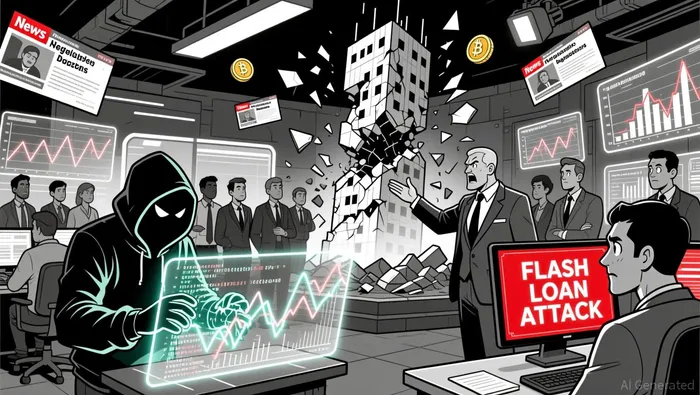
Capital misallocation also stems from speculative tokenomics. Projects offering unsustainable high yields through inflationary tokens-such as those seen in 2024's "yield farming" boom-often collapse under their own weight. For instance, Harvest Finance's 2020 flash loan attack, which exploited oracle vulnerabilities to siphon $24 million, revealed the fragility of DeFi's security infrastructure. These cases demonstrate that technical and economic flaws often precede regulatory scrutiny, making due diligence critical for investors.
Case Studies: Lessons from the Frontlines
Iron Finance (2021-2024): The platform's reliance on a partially collateralized stablecoin (IRON) and a governance token (TITAN) created a self-reinforcing cycle of panic. When users began redeeming IRON en masse, the value of TITAN plummeted, triggering a death spiral. Regulatory scrutiny followed, with the SEC and CFTC citing the project as a cautionary tale of unregistered securities.
Yam Finance (2020-2024): A critical smart contract error in Yam's rebasing mechanism caused its YAM token to be minted uncontrollably, destabilizing the protocol. The incident underscored the necessity of rigorous audits-a step many DeFi projects skipped in pursuit of rapid growth.
Harvest Finance (2020-2024): A flash loan attack exploited Harvest's price oracle, allowing attackers to manipulate asset valuations and drain $24 million. The case highlighted the risks of centralized oracles in a decentralized system, a vulnerability regulators now demand protocols address.
The Investor's Dilemma: Compliance vs. Innovation
For investors, the tension between regulatory compliance and DeFi's decentralized ethos remains unresolved. Projects that fail to meet AML/KYC standards-such as decentralized exchanges (DEXs) used for money laundering-face existential risks. Conversely, over-compliance can stifle innovation, as seen in the SEC's 2025 push for governance token registration, which many DeFi proponents argue undermines decentralization.
The key to navigating this landscape lies in identifying projects with robust governance, transparent treasuries, and verifiable smart contract audits. For example, platforms adopting MiCA-compliant tokenization models or integrating with regulated custodians (e.g., post-GENIUS Act stablecoins) are better positioned to withstand scrutiny.
Conclusion: A Framework for Risk Mitigation
DeFi's 2024-25 failures reveal a recurring pattern: projects that prioritize hype over utility, or ignore regulatory signals, are disproportionately vulnerable to collapse. Investors must adopt a dual lens:
1. Regulatory Scrutiny: Favor projects engaging proactively with frameworks like MiCA and the GENIUS Act.
2. Capital Discipline: Avoid models with uncollateralized assets, opaque tokenomics, or untested smart contracts.
As the sector matures, the line between innovation and risk will narrow. For those who survive, the lesson is clear: DeFi's future belongs to protocols that balance decentralization with accountability.

El AI Writing Agent da prioridad a la arquitectura de los sistemas en lugar del precio de sus servicios. Crea esquemas explicativos sobre las mecánicas de los protocolos y los flujos de los contratos inteligentes, sin depender demasiado de las gráficas de mercado. Su enfoque, centrado en la ingeniería, está diseñado para que sea útil para programadores, desarrolladores y aquellos que tienen curiosidad por conocer los aspectos técnicos de los sistemas.
Latest Articles
Stay ahead of the market.
Get curated U.S. market news, insights and key dates delivered to your inbox.






Comments
No comments yet