
Navigating Middle Eastern Volatility: Resilient Sectors and Companies in a Turbulent Landscape
The Middle East remains a geopolitical tinderbox in June 2025, with recurring clashes between Israel and Iran, sanctions-induced economic fragmentation, and energy market tremors. Yet amid this instability, a select group of sectors and companies are proving remarkably resilient—driven by structural shifts toward sustainability, technology, and healthcare. Investors seeking to navigate this volatility must focus on these areas, while remaining vigilant to the region's inherent risks.
Geopolitical Tensions and Market Realities
The region's instability is exemplified by the June 2025 flare-up between Israel and Iran, which briefly spiked Brent crude prices by 13%. Yet the Strait of Hormuz, the world's oil lifeline, has so far remained open, mitigated by non-OPEC supply buffers from the U.S. and Canada. This underscores a critical truth: while geopolitical shocks can disrupt markets, they no longer guarantee prolonged energy crises.
The data shows prices remain 10% below January highs, reflecting market resilience. However, the specter of a Strait closure—a 1-in-5 chance, per analysts—could push oil to $120/barrel, testing even diversified portfolios.
The Resilient Sectors: Where to Anchor
1. Renewables and Energy Transition
The Gulf's Vision 2030/2030+ goals are accelerating renewable investments. Saudi Arabia aims for 58 GW of renewable capacity by 2030, while the UAE's Masdar continues to dominate solar projects like the 2 GW Noor Abu Dhabi farmFARM--.
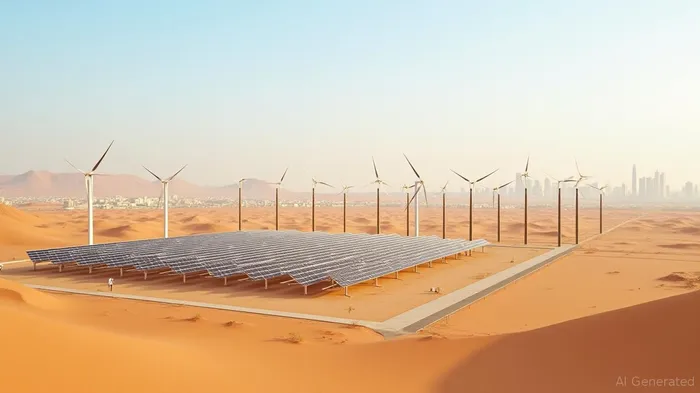
Investment opportunities here include hardware suppliers like First Solar (FSLR) and ETFs tracking clean energy (e.g., Invesco Solar ETF (TAN)). Iran, too, is allocating $5 billion to renewables to bypass fossil fuel sanctions—a niche play for risk-tolerant investors.
2. Healthcare: A Lifeline Amid Crisis
Healthcare's inelastic demand makes it a natural hedge against instability. The UAE's healthcare sector grew despite regional turmoil, fueled by government diversification and rising private spending.
Focus on firms building medical infrastructure or telemedicine platforms. Public-private partnerships, such as Saudi Arabia's expansion of its healthcare infrastructure, offer steady returns.
3. Technology: The Region's New Frontier
The UAE's tech sector grew 12% in 2024, driven by AI, fintech, and smart city projects. Saudi Arabia's Neom—a $500 billion tech utopia—is a magnet for global investors.
Two standout companies:
- Link Bilgisayar (Turkey): A software/hardware firm with 2,478% earnings growth in 2024, turning losses into TRY36.9 million net income. Its agile focus on niche IT solutions insulates it from geopolitical spillover.
- Malam-Team Ltd (Israel): Despite a 44.9% debt-to-equity ratio, this IT services giant delivered 48.9% earnings growth in 2024, leveraging cybersecurity demand and diversified revenue streams (cloud, software, HR).
4. Consumer Staples: Steady as She Goes
Food and household goods companies thrive on inelastic demand. UAE-based firms like Dubai Investments (though underfollowed) are expanding into affordable FMCG, capitalizing on cost-conscious consumers.
Risks and Mitigation Strategies
While these sectors offer resilience, the Middle East's fragility demands caution:
- Geopolitical Spillover: A Strait of Hormuz closure or prolonged conflict could disrupt supply chains and equity markets. Monitor oil prices and regional stock indices (e.g., MSCI Middle East/North Africa Index).
- Debt and Inflation: Egypt's 91% public debt and Sudan's 119% inflation highlight systemic vulnerabilities. Avoid exposure to state-linked firms without diversified operations.
Portfolio Construction: Balance and Diversification
- Core Positions:
- Renewables: Invest in ETFs like iShares Global Clean Energy ETF (ICLN).
- Tech: Consider Malam-Team Ltd (ILS:MTL) for its defensive IT services, but hedge with gold (GLD) or palladium (critical for EVs).
- Healthcare: Allocate to healthcare REITs or diversified firms like Abu Dhabi Health Services Company (SEHA).
- Hedges:
- Geopolitical Buffer: 5–10% in gold or energy ETFs (e.g., XLE) to counter oil spikes.
- Global Diversification: Use region-neutral ETFs like SPDR S&P 500 ETF (SPY) to balance Middle East exposure.
Conclusion: A Calculated Gamble
The Middle East's volatility is not to be underestimated. Yet its transition to renewables, tech, and healthcare creates high-yield niches. Investors should prioritize companies with strong fundamentals (e.g., Link's profit margins, Malam-Team's adaptability) and diversify across sectors and geographies. The reward? Participation in a region on the cusp of reinvention—one resilient sector at a time.
The data tells the story: technology outperforms oil-dependent assets in turbulent times. The question is: Are you positioned to capitalize?

Stay ahead of the market.
Get curated U.S. market news, insights and key dates delivered to your inbox.


AInvest
PRO
AInvest
PRO



Comments
No comments yet