
**Navigating the Mexican Peso's Volatility: A Playbook for Emerging Market Investors**
 Aime Summary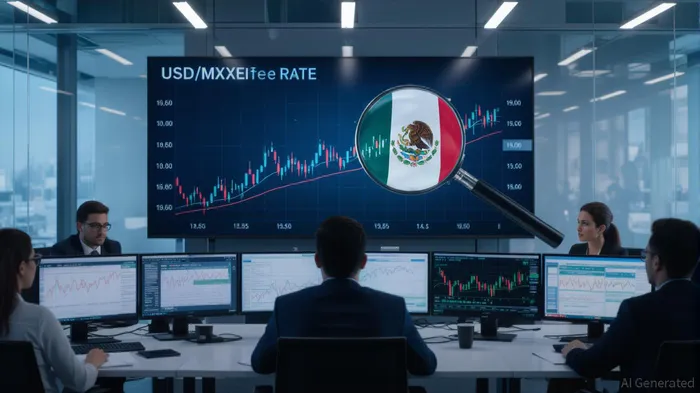
The Mexican Peso (MXN) has been a rollercoaster ride for investors in 2025. After a 20% surge in 2023 driven by high real interest rates and a carry trade boom, the peso has now depreciated over 12% against the U.S. Dollar (USD) in the past six months. As of July 19, 2025, the USD/MXN rate sits at 18.74, near a 15-month low of 18.75. This volatility isn't just a Mexican story—it's a microcosm of broader Latin American market dynamics, where trade deficits, inflation, and U.S. Federal Reserve uncertainty collide. For investors, this chaos hides both risks and golden opportunities. Let's break it down.
The Peso's Pain: Trade Deficits, Inflation, and Fed Signals
Mexico's recent struggles are textbook emerging market fare. A 5.7% year-on-year drop in exports—the steepest in 46 months—and a widening trade deficit have starved the peso of demand. Meanwhile, inflation, though easing to 5.61% in July, remains stubbornly above the Bank of Mexico's 3% target. The central bank's dovish pivot, including a 150-basis-point rate cut, has exacerbated the peso's weakness.
But the real wild card is the U.S. Federal Reserve. With Jerome Powell's term expiring in May 2026 and Donald Trump pushing for a dovish successor, market participants are pricing in aggressive rate cuts. A Fed pivot to easier policy would weaken the USD, potentially boosting the peso. However, Trump's protectionist tariffs on Mexican imports and the political tug-of-war over the Fed's independence have created a paradox: a weaker USD could hurt Mexican exporters while attracting capital to Mexican equities and commodities.
Latin America's Fragile Equilibrium
Mexico isn't alone in its turbulence. Across Latin America, emerging markets are grappling with U.S. policy uncertainty, from Brazil's real to Argentina's peso. The region's reliance on U.S. trade and capital flows makes it particularly vulnerable to Fed shifts. For instance, a dovish Fed could trigger a “carry trade rally,” where investors borrow in low-yielding USD and invest in higher-yielding emerging market assets. But this same scenario could backfire if U.S. tariffs or a Trump-driven trade war disrupt supply chains.
The key for investors is to balance exposure. Mexico's fiscal discipline and close U.S. ties offer a buffer. Remittances from the U.S. hit $55.9 billion in 2022, and nearshoring initiatives are attracting manufacturing investment. Yet, the peso's volatility—driven by a mix of domestic weakness and external shocks—means hedging is non-negotiable.
Opportunities in a Volatile Peso
For those with a stomach for risk, the peso's weakness has created a golden opportunity in Mexican equities. The Mexican stock market trades at a 15-year low in P/E multiples, making it one of the cheapest emerging markets. Companies in the automotive, logistics, and construction sectors—shielded by USMCA tariffs—could benefit from nearshoring and infrastructure spending under the 41 Poles of Development initiative. Startups like Klar (a fintech enabling USD virtual accounts) and Kavak (a pre-owned car marketplace) are also attracting global capital.
However, exposure to the peso itself requires caution. A sudden rebound could erase gains in equities if the Fed's dovish pivot falters. Here's where hedged strategies shine:
1. Currency Derivatives: Use forward contracts or options to lock in exchange rates for equity investments.
2. Dollar-Earning Assets: Invest in Mexican companies with strong U.S. dollar revenue streams, such as automotive exporters or remittance processors.
3. Fintech Solutions: Platforms like Klar allow investors to hold USD without a U.S. presence, reducing currency conversion risk.
The Powell Exit: A Game of Musical Chairs
The Fed's leadership transition is the ultimate wildcard. A dovish chair like Scott Bessent could trigger a USD sell-off, boosting the peso and Mexican equities. A hawkish Kevin Warsh, on the other hand, might prolong high rates, keeping the peso under pressure. Investors should monitor the Senate's confirmation process and Trump's political moves—both could sway the Fed's direction.
Final Take: Ride the Wave, But Secure the Life Vest
The Mexican Peso's volatility is a double-edged sword. For investors, it's a chance to buy undervalued equities and dollar-earning assets at a discount—but only if you hedge against currency swings. Diversify across sectors, use derivatives to manage risk, and keep a close eye on U.S. policy shifts. In emerging markets, the key to success isn't avoiding the storm but learning to dance in the rain.
Action Plan:
- Buy: Mexican equities (e.g., automakers, fintechs) with hedged currency exposure.
- Sell: Short-term peso bets unless you're confident in a Fed dovish pivot.
- Watch: Trump's tariff negotiations and the Fed's September meeting for clues on policy direction.
In a world of uncertainty, the Mexican Peso isn't just a currency—it's a barometer of global risk. Play it smart, and the rewards could be substantial.

Delivering real-time insights and analysis on emerging financial trends and market movements.
Latest Articles
Stay ahead of the market.
Get curated U.S. market news, insights and key dates delivered to your inbox.


AInvest
PRO
AInvest
PRO



Comments
No comments yet