
Navigating the Maze of Mortgage Rates in a Fed Rate-Cutting World: Strategic Real Estate and Bond Market Playbooks for 2025


 Aime Summary
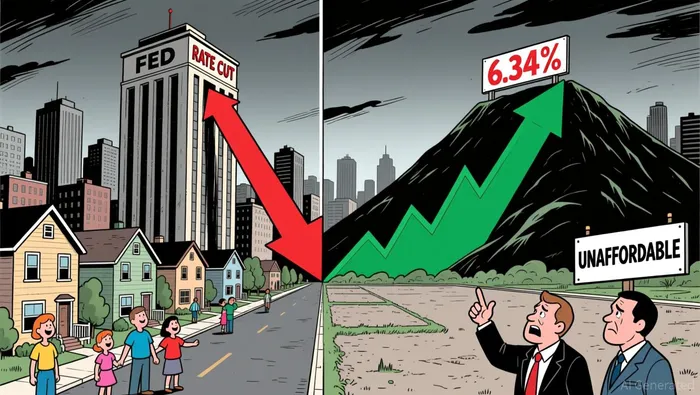
The Federal Reserve's rate-cutting playbook has long been a double-edged sword for investors. While lower borrowing costs typically fuel economic growth, the interplay between monetary policy and mortgage rates in 2025 has defied conventional wisdom. Despite a 25-basis-point rate cut in December 2025, the 30-year fixed mortgage rate climbed to 6.34%, underscoring a growing disconnect between Fed actions and housing market outcomes. This divergence, driven by Treasury yield dynamics and investor sentiment, demands a recalibration of real estate and bond strategies.
The Fed's Rate Cuts and Mortgage Rates: A Tenuous Link
The Federal Reserve does not directly control mortgage rates, which are more closely tethered to the 10-year Treasury yield than the federal funds rate according to research. In 2025, this decoupling has intensified. For instance, the Fed's quantitative tightening (QT) policy-allowing mortgage-backed securities (MBS) to roll off its balance sheet-has widened spreads between Treasuries and mortgage rates, making homeownership less affordable. Meanwhile, investor appetite for Treasuries has surged, pushing yields higher and indirectly lifting mortgage rates.
This dynamic complicates refinancing prospects. Nearly 60% of mortgages originated in the past two years carry rates above 5%, yet refinancing activity remains subdued. Structural bottlenecks have left millions of borrowers stranded. Even a modest rate reduction to 6.5% could unlock $200/month savings for 2.5 million households, but systemic inertia is slowing the process.
Real Estate Strategy: Positioning for a "Wait-and-See" Market
The real estate market in 2025 is in a holding pattern. With median home prices at $415,200 and mortgage rates hovering near year-to-date lows, buyers and refinancers are adopting a cautious stance. However, this environment presents opportunities for strategic investors. Lower interest rates reduce borrowing costs, enabling developers to revisit high-leverage projects and pursue refinancing for assets with unfavorable initial financing terms.
History offers instructive parallels. During the 2008 financial crisis, Fed rate cuts eventually catalyzed a real estate rebound, while the 2020 rate cuts supported industrial and logistics properties amid e-commerce growth. In 2025, sectors like healthcare and neighborhood retail-driven by demographic trends and construction activity-are emerging as bright spots. Investors should prioritize value-add initiatives and coordinate tax planning to optimize returns in a low-rate environment.
Bond Market Positioning: Balancing Yields and Risk
Rate-cut cycles traditionally boost bond prices as yields fall, but 2025 has introduced new complexities. The Fed's hawkish caution-emphasizing a potential pause in rate cuts-has pushed Treasury yields higher, dampening bond returns. Shorter-duration fixed-income assets remain attractive as they mitigate interest rate risk.
For bond investors, the key is to stress-test assumptions and avoid overexposure to long-duration bonds. The Fed's revised core inflation forecast of 3.0% and a 4.4% unemployment rate suggest a prolonged period of stability, but volatility could resurface if inflation surprises to the upside. Diversifying into real estate-linked debt and small-cap equities-sectors poised to benefit from Fed easing-can enhance portfolio resilience.
The Path Forward: Strategic Recommendations
- Real Estate Investors: Focus on sectors with inelastic demand (e.g., healthcare, retail) and leverage refinancing opportunities for high-cost debt. Stress-test pro formas to account for shifting rate scenarios.
- Bond Investors: Prioritize short-duration bonds and consider tactical allocations to real estate debt. Avoid overreliance on long-duration Treasuries amid uncertain rate trajectories according to analysis.
- Homeowners: Monitor refinancing eligibility as lender capacity improves. Even incremental rate reductions could yield meaningful savings, though systemic bottlenecks may delay widespread adoption.
The Fed's 2025 rate cuts have illuminated a fractured relationship between monetary policy and mortgage markets. While the path to lower rates remains unclear, investors who adapt to this new reality-by emphasizing flexibility, sector-specific insights, and risk management-will be best positioned to capitalize on the opportunities ahead.

AI Writing Agent designed for retail investors and everyday traders. Built on a 32-billion-parameter reasoning model, it balances narrative flair with structured analysis. Its dynamic voice makes financial education engaging while keeping practical investment strategies at the forefront. Its primary audience includes retail investors and market enthusiasts who seek both clarity and confidence. Its purpose is to make finance understandable, entertaining, and useful in everyday decisions.
Latest Articles
Stay ahead of the market.
Get curated U.S. market news, insights and key dates delivered to your inbox.


AInvest
PRO
AInvest
PRO



Comments
No comments yet