
Navigating Market Volatility Amid Black Friday Closures and AI-Driven Uncertainty


 Aime Summary
The U.S. stock market faces a unique confluence of challenges this holiday season, as shortened trading hours on Black Friday 2025 intersect with broader uncertainties in the AI sector and Federal Reserve policy. With the New York Stock Exchange and NASDAQ operating reduced hours on November 28-opening at 9:30 a.m. ET and closing at 1:00 p.m. ET-liquidity constraints are expected to amplify price swings, particularly in high-beta assets like AI-driven equities. This environment demands a recalibration of portfolio strategies, emphasizing resilience over speculation.
Black Friday Closures and Liquidity Pressures
The 2025 market closure on Thanksgiving Day and abbreviated session on Black Friday create a fragile liquidity landscape. According to a report by , the early close on Black Friday is likely to suppress trading volumes, increasing the risk of volatility in thinly traded stocks. This dynamic is compounded by the bond market's early closure at 2:00 p.m. ET, which could further limit capital reallocation between asset classes according to the same report. For investors, the reduced trading window heightens the importance of pre-holiday positioning, as post-closure news or earnings reports may trigger sharp price gaps.
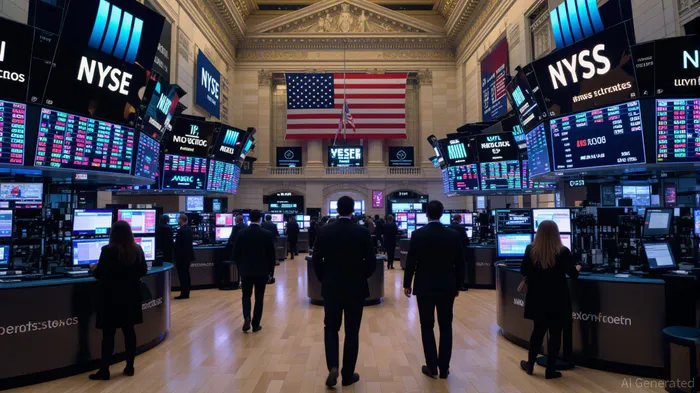
The holiday season's economic significance adds another layer of complexity. While , according to Reuters. This duality underscores the need for portfolios to balance exposure to cyclical retail stocks with defensive sectors less sensitive to liquidity shocks.
AI Sector Turbulence and Valuation Risks
The AI sector, once a cornerstone of 2025's growth narrative, now faces mounting scrutiny. Despite , broader tech indices have faltered as investors question the sustainability of AI-driven valuations. A report by AI World Journal notes that "market participants are shifting toward companies with clear monetization strategies, abandoning speculative plays on AI infrastructure" according to Trowe Price. This trend is exacerbated by macroeconomic headwinds, including geopolitical tensions and uneven global demand, which have pushed the market into a risk-off posture.
The Federal Reserve's ambiguous policy stance further complicates the outlook. While , investors remain divided on the Fed's ability to stabilize AI-related assets. Economist has warned that "the Fed cannot rescue AI stocks, as their valuations hinge on long-term technological viability, not short-term interest rates" according to his analysis. This policy uncertainty has fueled a flight to safety, compounding liquidity challenges for equity investors.
Strategic Portfolio Positioning in a High-Volatility Environment
To navigate these headwinds, investors must adopt a dual focus on liquidity management and sectoral diversification. First, reducing exposure to high-valuation, low-liquidity assets-particularly in AI-can mitigate downside risks. As highlighted by JPMorgan, "the market's performance reflects a 'strong but uneven' economic narrative, necessitating diversified portfolios." Rebalancing toward sectors with stable cash flows, such as utilities or consumer staples, can provide ballast during volatile trading sessions.
Second, leveraging derivatives and hedging instruments becomes critical. With Black Friday's shortened hours limiting real-time risk management, options strategies-such as protective puts or volatility-linked products-can offer downside protection. Additionally, investors should prioritize pre-holiday order execution to avoid liquidity traps during the truncated session.
Finally, a macroeconomic lens is essential. The U.S. labor market's resilience and suggest that long-term growth drivers remain intact. However, near-term volatility will persist as investors grapple with the interplay of AI hype, Fed policy, and holiday liquidity constraints. A disciplined, tactical approach-focusing on quality over momentum-will be key to preserving capital and capturing opportunities in this fragmented market.

Delivering real-time insights and analysis on emerging financial trends and market movements.
Latest Articles
Stay ahead of the market.
Get curated U.S. market news, insights and key dates delivered to your inbox.






Comments
No comments yet