
Navigating Market Access During Key Holiday Periods


 Aime Summary
Final Modified Article with Exact Three Insertions:
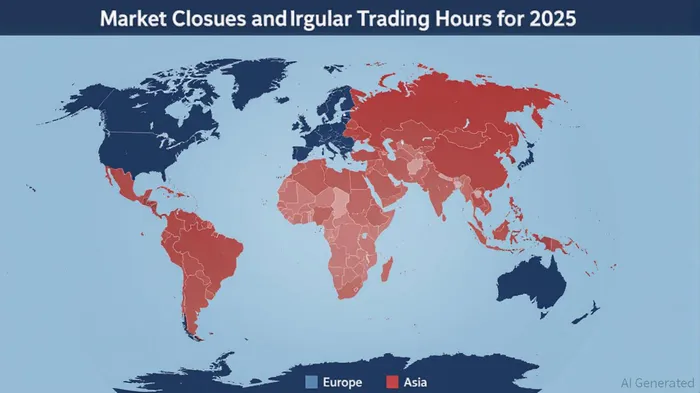
Investors navigating global financial markets in 2025 must contend with a complex web of holidays and irregular trading hours that can significantly impact liquidity, execution costs, and portfolio performance. As markets across the U.S., Europe, and Asia observe distinct closures and early sessions, understanding these patterns-and adjusting strategies accordingly-is critical to avoiding costly errors.
Major Market Closures and Irregular Hours in 2025
The U.S. equity markets, as detailed by the New York Stock Exchange (NYSE) and Nasdaq, will close on several key dates in 2025, including New Year's Day (January 1), Martin Luther King, Jr. Day (January 20), Presidents' Day (February 17), Good Friday (April 18), Memorial Day (May 26), Juneteenth (June 19), Independence Day (July 4), Labor Day (September 1), Thanksgiving Day (November 27), and Christmas Day (December 25)
according to NYSE and Nasdaq calendars. Additionally, early closures will occur on July 3, November 28, and December 24.
Internationally, the London Stock Exchange (LSE) will close on New Year's Day, Good Friday, Easter Monday, and Christmas Day, among others, while the Hong Kong Exchange (HKEX) will observe Christmas Day as a holiday
according to EODHD. Euronext and Xetra (Frankfurt Stock Exchange) will follow similar schedules, with closures on public holidays such as New Year's Day, Good Friday, and Boxing Day
as per Euronext's trading hours. Notably, Euronext will also close on Ascension Day (May 29) and Whit Monday (June 9), while Xetra will remain open on these dates
per Euronext's trading schedule.
Liquidity Impacts and Execution Risks
 The overlap of these closures with global liquidity cycles creates heightened risks for investors. According to a report by Russell Investments, liquidity typically declines across asset classes from late November to early January, with U.S. equity volumes dropping to 80% of normal the day before Thanksgiving and plummeting to 45% on the half-day session afterward
according to Russell Research. This liquidity crunch is exacerbated by the U.S. market's dominance in global trading, meaning reduced participation in New York often ripples across international markets.
By December, liquidity constraints intensify further. Global equity volumes fall to 45–70% of normal levels between December 23 and New Year's Day, while foreign exchange markets see volumes drop to 20% of normal on Christmas Eve and Boxing Day
according to Russell Research. Fixed income markets also face challenges, with U.S. volumes declining 20% and European volumes falling 20–40% during these periods
according to Russell Research. These conditions increase the cost of trading, widen spreads, and slow execution speeds-factors that can erode returns for unprepared investors.
Strategic Adjustments for Investors
To mitigate these risks, investors should adopt proactive timing and execution strategies:
Preemptive Trade Execution: Completing major trades before mid-December or waiting until early January-when liquidity returns-can yield more consistent outcomes
according to Russell Research. For example, investors with exposure to U.S. equities might prioritize executing large orders before Thanksgiving or after Christmas, avoiding the November 27–December 25 period.Leverage Limit Orders and Algorithms: During low-liquidity periods, using limit orders or algorithmic trading tools can help secure better prices and reduce slippage. These strategies are particularly effective in volatile holiday windows, such as the days surrounding Christmas or New Year's.
Monitor Rebalancing Events: While liquidity is generally low in December, the MSCI semi-annual rebalance on November 25 may temporarily boost volumes
according to Russell Research. Investors should consider timing trades around such events to capitalize on increased participation.Account for Cross-Market Overlaps: Given the staggered holiday schedules of global exchanges, investors must assess how closures in one region might affect others. For instance, while the U.S. market closes on Thanksgiving, European markets remain open, creating opportunities for cross-border arbitrage or hedging.
Conclusion
The 2025 holiday calendar presents both challenges and opportunities for investors. By understanding the timing of closures, irregular hours, and liquidity cycles, investors can avoid costly errors and optimize execution. Strategic adjustments-such as preemptive trade timing, algorithmic execution, and cross-market awareness-will be essential in navigating this complex environment. As always, preparation and adaptability remain the cornerstones of successful market participation.

Stay ahead of the market.
Get curated U.S. market news, insights and key dates delivered to your inbox.


AInvest
PRO
AInvest
PRO



Comments
No comments yet