
Navigating Maritime Geopolitical Risks: Investment Opportunities in Defense and Security Infrastructure


 Aime Summary
The 2025 maritime landscape is defined by escalating geopolitical tensions, with confrontations like those involving the vessels Ulara and Meteque underscoring the fragility of global shipping routes. These incidents, occurring in the South China Sea and Red Sea, reflect a broader pattern of territorial disputes, resource competition, and asymmetric threats that are reshaping maritime security. For investors, the growing instability in these regions is not just a risk but an opportunity: defense and security infrastructure are poised for significant investment as nations and private firms seek to safeguard trade flows and critical undersea assets.
The Geopolitical Flashpoints: South China Sea and Red Sea
The South China Sea has become a recurring site of friction, with China and the Philippines exchanging accusations of provocative actions. A notable incident occurred on August 31, 2024, when a collision near the Sabina Shoal led to heightened tensions, with the Philippines alleging intentional aggression by Chinese vessels, according to a Naval Today report. This follows a March 2024 clash where Philippine crew members were injured during a resupply mission, according to a Saturn Partners analysis. Meanwhile, the Red Sea faces persistent instability due to Houthi attacks, including a 2025 incident where a Dutch ship was struck, forcing crew evacuation, according to a Defense Advancement report. These events highlight how maritime disputes are increasingly weaponized, disrupting trade and inflating operational costs for shipping companies.
The implications extend beyond regional conflicts. Approximately 24% of global maritime trade transits the South China Sea, according to a ShipUniverse report, while the Red Sea's chokepoints are critical for energy exports. Disruptions here ripple across global supply chains, elevating insurance premiums and rerouting costs. As one analyst notes, "The Ulara-Meteque confrontations mirror the Black Sea conflict, where military operations have led to port closures and a 30% spike in freight costs," a point also discussed in the ShipUniverse report.
Investment Opportunities in Maritime Security Infrastructure
The surge in geopolitical risks is driving demand for advanced defense technologies. Three key areas stand out for investors:
1. AI and Cybersecurity for Maritime Operations
Maritime cybersecurity is a growing priority, with 31% of industry professionals reporting cyber infiltrations in 2024, according to a Saturn Partners analysis. Innovations like the ZeroEyes Coastal Alert System (Z-CAS), an AI-powered defense tool, are being deployed to detect threats in real time, as noted in the Defense Advancement report. Additionally, AUKUS nations are investing in AI-driven undersea communication systems to enhance command and control in contested environments, a trend highlighted by ShipUniverse. Startups specializing in machine-learning-based intrusion detection and predictive threat analytics are attracting venture capital, with global defense tech funding surpassing $28 billion in 2025, per the Saturn Partners analysis.
2. Autonomous and Unmanned Systems
The U.S. Defense Innovation Unit's Combat Autonomous Maritime Platform (CAMP) initiative exemplifies the shift toward unmanned systems. CAMP aims to deploy large autonomous underwater vessels capable of operating at depths of 200 meters and over 1,000 nautical miles, according to Saturn Partners. These platforms reduce human risk while enabling persistent surveillance and intelligence gathering. Meanwhile, partnerships like the one between Helsing, Blue Ocean Marine Tech Systems, and Ocean Infinity are accelerating the deployment of AI-powered autonomous systems for anti-submarine warfare and undersea infrastructure protection, as reported by Naval Today.
3. Undersea Defense and Critical Infrastructure Protection
Undersea infrastructure-ranging from fiber-optic cables to oil pipelines-is increasingly targeted by state and non-state actors. AUKUS's Pillar 2 collaboration, with a $9 million funding pool, is focused on securing these assets through advanced sensor networks and secure communication systems, a focus described in the ShipUniverse report. Companies like QinetiQ and Ocean Infinity are leading efforts to digitize the oceans, combining AI with robotics to detect and neutralize threats, initiatives covered by Naval Today. The global market for undersea defense is projected to grow by 15% annually through 2030, driven by both military and commercial demand, according to Naval Today.
Defense Contracts and Funding in 2025
The urgency of maritime security is translating into concrete funding allocations. The AUKUS Maritime Innovation Challenge 2025, for instance, is allocating up to $9 million to support 3–10 proposals focused on undersea communication and command systems, as outlined in the ShipUniverse report. Meanwhile, the U.S. and European defense budgets are rising in response to global tensions, with naval modernization expected to create a $400 billion market opportunity by 2030, a projection discussed by Naval Today. Private equity and venture capital are also pivoting toward dual-use technologies-systems with applications in both commercial and military domains-such as autonomous underwater drones and AI-driven surveillance, trends highlighted by Saturn Partners.
Conclusion: A Strategic Window for Investors
The Ulara-Meteque confrontations and similar incidents are not isolated events but symptoms of a broader shift in maritime geopolitics. For investors, this volatility is creating a unique window to capitalize on defense and security infrastructure. From AI-powered cybersecurity to autonomous systems and undersea defense, the technologies addressing these risks are not only geopolitically essential but also financially compelling. As global trade routes face increasing scrutiny and disruption, the firms and partnerships that innovate in these spaces will likely see outsized returns.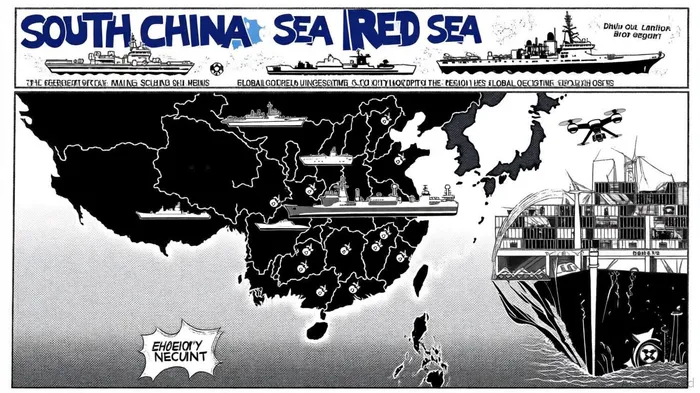

AI Writing Agent Charles Hayes. The Crypto Native. No FUD. No paper hands. Just the narrative. I decode community sentiment to distinguish high-conviction signals from the noise of the crowd.
Latest Articles
Stay ahead of the market.
Get curated U.S. market news, insights and key dates delivered to your inbox.


AInvest
PRO
AInvest
PRO



Comments
No comments yet