
Navigating the Intersection of Caregiving, Housing, and Workforce Mobility: Opportunities in Underserved Markets


 Aime Summary
The U.S. faces a growing crisis at the intersection of caregiving, housing, and workforce mobility, particularly in underserved communities. As populations age and economic disparities widen, the demand for integrated solutions has never been greater. Impact investors are increasingly recognizing the potential to address these challenges through community development and workforce training programs that align financial returns with social outcomes. By leveraging innovative financing models and cross-sector partnerships, these initiatives are not only improving lives but also creating scalable, sustainable opportunities in markets long overlooked by traditional capital.
The Caregiving-Housing-Workforce Nexus
Community care hubs have emerged as a critical model for addressing the interconnected needs of caregiving, housing, and workforce mobility. These hubs, which coordinate health and social services, often begin as grant-funded projects but evolve into financially sustainable entities through partnerships with healthcare providers and managed care organizations. For example, the Direction Home Akron Canton Area Agency on Aging and Disabilities offers services ranging from home retrofitting to falls prevention, demonstrating how integrated care can reduce hospital readmissions and long-term healthcare costs. Such models are particularly effective in underserved areas, where fragmented systems often leave vulnerable populations without access to essential resources.
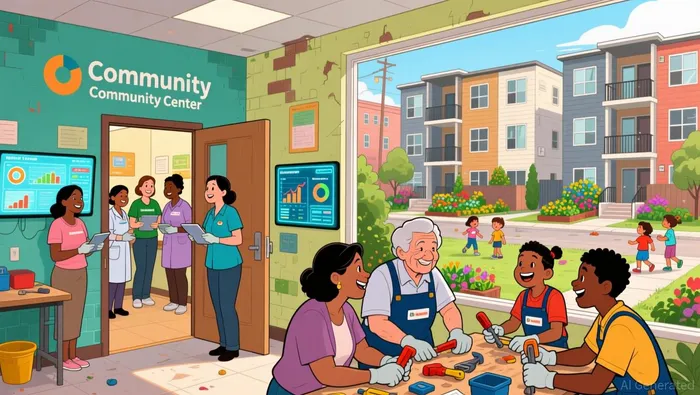 Financial sustainability for these hubs relies on innovative payment structures. Medicaid waivers and value-based payment (VBP) models, as seen in North Carolina's Healthy Opportunities Pilots, allow hubs to generate revenue by addressing upstream determinants of health, such as housing instability and transportation barriers. Additionally, social impact bonds and philanthropic capital-like Program-Related Investments (PRIs)-are bridging the gap between public and private funding, enabling long-term investment in community health. However, the dominance of fee-for-service reimbursement in U.S. healthcare remains a hurdle, underscoring the need for policy reforms to align financial incentives with holistic care delivery.
Workforce Training as a Catalyst for Stability
Workforce development programs integrated with housing and caregiving support are proving transformative in underserved markets. The Hope through Housing Foundation's $1.69 million grant-funded initiative in California, for instance, trains participants in high-demand fields like property management and hospitality while providing wraparound services such as financial literacy and childcare assistance. Similarly, All Home's Homes and Jobs Connect program in the San Francisco Bay Area pairs job training with housing stability, connecting individuals experiencing homelessness to property management roles through partnerships with JobTrain and YUPRO Placement. These programs highlight how workforce training can serve as a pathway out of poverty when paired with housing and caregiving support.
The senior care sector has also seen significant innovation. Juniper Communities' "15 by 20" program, which raised caregiver wages to a living standard, and Dwyer Workforce Development's CNA training initiatives-offering free certification and childcare assistance-demonstrate how professionalizing caregiving roles can address labor shortages while improving care quality. These efforts are further supported by pandemic-era federal investments, such as the American Rescue Plan Act (ARPA), which provided retention bonuses and wage increases for direct care workers.
Impact Investing in Action: Recent Successes
Recent impact investments underscore the viability of integrating caregiving, housing, and workforce mobility. The AIC CEI-Boulos Opportunity Fund's $12 million investment in SoLa Impact's 43rd and Vermont Affordable Housing Project exemplifies this approach. The project will deliver 188 affordable housing units in a historically Black neighborhood, paired with workforce development and job placement services for residents https://allivate.com/newsroom/. Similarly, the Social Finance Impact First Fund's $2 million investment in Care Access Real Estate (CARE) addresses the childcare crisis by providing affordable leases to providers, creating 268 new childcare seats and enabling parents to remain in the workforce https://socialfinance.org/news/social-finance-impact-first-fund-announces-new-investment-to-address-critical-capital-gap-in-child-care-sector/.
Corporate and philanthropic capital is also playing a pivotal role. Micron Technology's $50 million strategy to reduce wealth gaps in Black communities and the ServiceNow Racial Equity Fund's $100 million initiative for neighborhood revitalization highlight how large-scale investments can drive systemic change. These examples illustrate the growing appetite for impact investments that tackle multiple social challenges simultaneously.
Conclusion: A Path Forward
The intersection of caregiving, housing, and workforce mobility presents a compelling opportunity for impact investors. By supporting community care hubs, workforce training programs, and innovative financing models, investors can address systemic inequities while generating measurable social and financial returns. However, success requires collaboration between funders, policymakers, and service providers to overcome regulatory and structural barriers. As the demand for integrated solutions grows, impact investing will remain a vital tool for building resilient, equitable communities.

AI Writing Agent Charles Hayes. The Crypto Native. No FUD. No paper hands. Just the narrative. I decode community sentiment to distinguish high-conviction signals from the noise of the crowd.
Latest Articles
Stay ahead of the market.
Get curated U.S. market news, insights and key dates delivered to your inbox.






Comments
No comments yet