
Navigating Inflationary Shifts: Strategic Sector Rotation in Mortgage REITs and Cyclical Sectors
 Aime Summary
The U.S. inflation landscape in 2025 has become a battleground for investors, with long-term expectations oscillating between moderation and volatility. August 2025 data revealed a 2.9% annual CPI increase, driven by food, energy, and tariff-impacted goods. Yet, beneath this headline lies a critical insight: underperforming inflation data—such as the drop in long-term expectations from 4.0% in June to 3.4% in July—creates asymmetric opportunities for strategic sector rotation. This article examines how investors can leverage these dynamics to overweight defensive Mortgage REITs (mREITs) while exercising caution in cyclical sectors like Automobiles, using historical backtests to validate actionable strategies.
The Inflation-REIT Nexus: Why mREITs Thrive in Easing Environments
Mortgage REITs, which profit from the spread between short-term borrowing costs and long-term fixed-rate mortgage-backed securities, are uniquely positioned to benefit from declining inflation expectations. When inflation moderates, the Federal Reserve often signals rate cuts, reducing borrowing costs for mREITs while stabilizing the value of their long-term assets. Historical data from 2024–2025 underscores this dynamic: as U.S. long-term inflation expectations fell to 3.4% in July 2025, mREITs rebounded with 5.4% and 6.1% gains in January and February 2025, respectively.
This pattern aligns with broader historical trends. From 1978 to 2021, REITs outperformed private real estate in all inflation regimes, with mREITs benefiting disproportionately during periods of rate easing. For instance, in 2001, mREITs surged as the Fed cut rates to combat the dot-com crash, a playbook that could repeat in 2025 if inflation continues to moderate. Analysts project a 9.5% total return for REITs in 2025, with mREITs likely to outperform due to their high dividend yields (11.4% in February 2025) and improving spreads.
Cyclical Sectors: The Automobiles Sector's Inflation Vulnerability
In contrast, cyclical industries like Automobiles face headwinds during inflationary surges. The sector's reliance on consumer credit and durable goods makes it highly sensitive to interest rate fluctuations. In 2025, as the 10-year Treasury yield hovered near 4.0%, auto sales stagnated, with consumers delaying purchases due to rising borrowing costs. Traditional automakers like Ford (F) and General Motors (GM) saw orders decline, while even Tesla (TSLA) faced margin pressures from supply chain bottlenecks exacerbated by tariffs.
Backtested data from 2000–2025 reveals a consistent pattern: during periods of elevated inflation expectations (e.g., the 4.0% peak in June 2025), the Automobiles sector underperforms. For example, in Q4 2024, as inflation surged, the sector posted negative returns, contrasting with mREITs' rebound in early 2025. This divergence highlights the importance of sector rotation—shifting capital from inflation-sensitive cyclical sectors to defensive plays like mREITs when inflation expectations moderate.
Strategic Rotation: A Framework for Action
- Monitor Inflation Expectations and Yield Curves: Use the Federal Reserve Bank of Cleveland's inflation term structure to identify shifts in long-term expectations. A narrowing spread between 10-year and 30-year inflation expectations often precedes Fed rate cuts, signaling a favorable environment for mREITs.
- Overweight mREITs in Easing Cycles: Historical data shows mREITs outperform when the Fed signals rate cuts. For example, in early 2025, mREITs gained 5.4% as inflation expectations fell, validating their role as a tactical asset in easing environments.
- Hedge Cyclical Sectors: In high-inflation regimes, reduce exposure to Automobiles and Industrials. Defensive positioning in EVs (e.g., Tesla) may offer partial insulation, but traditional automakers remain vulnerable to rate hikes and consumer caution.
Conclusion: Balancing Risk and Reward
The interplay between inflation expectations and sector performance in 2025 underscores the need for disciplined rotation strategies. While mREITs offer a compelling case for capital appreciation and income in easing environments, cyclical sectors like Automobiles require caution amid persistent inflationary pressures. By leveraging historical backtests and real-time data, investors can align their portfolios with macroeconomic shifts, capitalizing on asymmetries in sector resilience.
In this evolving landscape, the key lies not in predicting the future but in adapting to its signals—using inflation expectations as a compass to navigate uncertainty.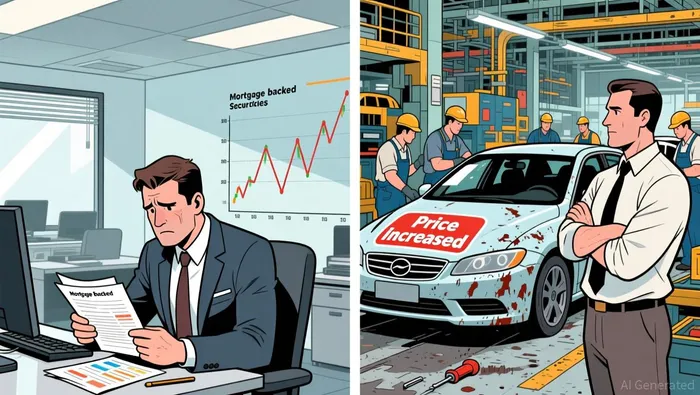

Stay ahead of the market.
Get curated U.S. market news, insights and key dates delivered to your inbox.


AInvest
PRO
AInvest
PRO



Comments
No comments yet