
Navigating the New Inflationary Landscape: Sector-Specific Opportunities and Risks in U.S. Import Price Inflation
 Aime Summary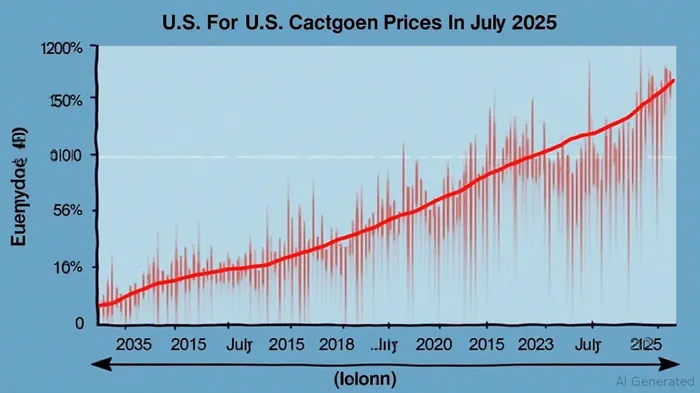
The U.S. import price inflation landscape in 2025 is a tapestry of contradictions. While overall import prices edged up 0.4 percent in July, masking a 12-month decline of 0.2 percent, the underlying dynamics reveal a fractured picture. Fuel imports, for instance, surged 2.7 percent in July—the largest monthly gain since January 2025—driven by a 4.7 percent jump in natural gas prices. Meanwhile, nonfuel industrial supplies and materials rose 1.0 percent, the largest increase since February 2024. These divergences highlight a critical truth: in a world of fragmented supply chains and geopolitical headwinds, inflation is no longer a monolithic force. It is a mosaic of sector-specific pressures, and investors must navigate it with precision.
The Energy Sector: A Tale of Two Fuels
The energy sector sits at the crossroads of these trends. Natural gas import prices have skyrocketed 62.2 percent over the past year, while petroleum imports have fallen 13.7 percent. This dichotomy reflects the dual forces of policy and market fundamentals. The Trump-era tariffs, which have pushed the average effective U.S. tariff rate to 22.5 percent—the highest since 1909—have exacerbated costs for energy infrastructure. For example, copper, a critical input for renewable energy systems, now faces a 25 percent tariff, inflating costs for solar and wind projects.
Yet, the sector is not without opportunity. Natural gas prices, buoyed by geopolitical tensions and a shift away from coal, have created a tailwind for domestic producers. Companies like Caterpillar Inc. (CAT), which reported $1.5 billion in tariff-related costs in 2025, are now pivoting to localize supply chains and hedge against price volatility. Investors might consider energy ETFs like XLE (Energy Select Sector SPDR Fund), which tracks oil and gas producers, or ICLN (iShares Global Clean Energy ETF), which benefits from the green energy transition. However, the risks are clear: a prolonged soft patch in oil prices or a reversal in natural gas demand could erode margins.
Industrial Supplies and Machinery: The Cost of Resilience
The industrial machinery sector is grappling with a "Great Equipment Squeeze." Tariffs on hydraulic components, sensors, and steel have driven up costs by 18–26 percent for manufacturers like CNH Industrial (CNHI) and Deere & Co. (DE). These companies are now forced to reengineer supply chains, shifting production to India, Turkey, and Latin America. While this diversification reduces exposure to China, it also introduces new risks, such as currency volatility and political instability.
For investors, the key is to distinguish between companies that can pass on costs and those that cannot. XLI (Industrial Select Sector SPDR Fund), which includes heavyweights like 3M (MMM) and United Technologies (UTX), offers exposure to firms with pricing power. However, smaller players in the ETF may struggle with margin compression. A hedging strategy—such as shorting the INDU (Dow Jones Industrial Average) during periods of tariff uncertainty—could mitigate downside risks.

Manufacturing: The Aluminum and Steel Paradox
The manufacturing sector, particularly primary metal production, is another battleground. Steel and aluminum prices have surged due to tariffs and reduced imports from China. While this benefits domestic producers like Nucor (NUE) and Alcoa (AA), it also raises costs for downstream industries, from automotive to construction. The XLB (Materials Select Sector SPDR Fund), which includes these metals, has seen a 10.0 percent increase in its price index over the past year.
However, the sector's long-term outlook is clouded by the shift toward electric vehicles (EVs) and green steel. Investors must weigh the short-term gains from tariffs against the long-term risks of obsolescence. A diversified approach—allocating to both traditional metals and EV-related materials like lithium and cobalt—could balance these dynamics.
The Road Ahead: Hedging and Adaptation
The 2025 inflation environment is not a temporary blip but a structural shift. Tariffs, energy transitions, and supply chain reconfigurations will continue to rippleXRP-- through markets. For investors, the playbook must evolve:
- Sector Rotation: Overweight energy and industrial ETFs while underweighting sectors like consumer staples, which face margin pressures from higher input costs.
- Geographic Diversification: Invest in companies with localized supply chains to mitigate tariff risks.
- Hedging: Use futures and options to hedge against commodity price swings, particularly in natural gas and copper.
- Active Management: Favor active ETFs and mutual funds that can pivot quickly in response to trade policy changes.
In conclusion, the U.S. import price inflation of 2025 is a double-edged sword. It creates headwinds for cost-sensitive industries but opens doors for those that can adapt. The key is to identify the sectors and companies best positioned to navigate this new normal—those that can turn inflationary pressures into competitive advantages. For the discerning investor, the challenge is not to fear inflation but to harness it.

Stay ahead of the market.
Get curated U.S. market news, insights and key dates delivered to your inbox.
AInvest
PRO
AInvest
PRO



Comments
No comments yet