
Navigating Inflation and Trade Turbulence: Strategic Investments in Consumer Staples and Food Innovation
 Aime Summary
In the shadow of 2025's volatile tariff landscape and surging grocery costs, the consumer staples sector has emerged as a paradox: a defensive haven and a fertile ground for innovation. While global trade disruptions have squeezed margins for many, a select group of companies has leveraged pricing power, localized supply chains, and technological agility to outperform. For investors, this presents a unique opportunity to identify undervalued stocks that are not only weathering the storm but positioning themselves for long-term growth.
The Resilience of Core Staples: Procter & Gamble and Church & Dwight
Procter & Gamble (PG) exemplifies the power of operational discipline. Amid a 1% decline in foreign exchange-driven sales, the company maintained flat net sales of $84.3 billion in FY 2025 while boosting organic sales by 2%. Its 20.2x P/E ratio—a 15% discount to its 5-year average—reflects undervaluation despite robust free cash flow productivity of 87%. PG's localized production hubs in the U.S. and its $16 billion shareholder return program make it a compelling core holding.
Church & Dwight (CHD), meanwhile, has turned tariffs into tailwinds. By reshoring production and automating processes, the company expanded margins by 14% in 2024, even as its P/E ratio rose to 24.5x. Its portfolio of essential household products—baking soda, Arm & Hammer, and OxiClean—ensures steady demand, making it a defensive play in a fragmented market. CHD's 22% stock price surge in 2024 underscores its ability to balance innovation with margin preservation.
Supply Chain Agility: Sysco's AI-Driven Edge
Sysco (SYY) is a case study in technological adaptation. The food distributor's AI-powered inventory systems reduced logistics costs by 20%, allowing it to maintain a 16.3x P/E ratio despite tariff headwinds. By optimizing delivery routes and inventory turnover, SYY has preserved service levels while trimming waste—a critical differentiator in an industry where margins are razor-thin.
Beyond Staples: Food Innovation in the Inflationary Era
The rise of food innovation is redefining resilience. Precision fermentation and cell-based meats, once niche, are now gaining traction. Perfect Day (annual revenue: $90.3 million) and Geltor ($18.1 billion in revenue) are leading the charge with animal-free dairy and collagen alternatives. These companies are not only addressing sustainability but also capitalizing on consumer demand for clean-label ingredients.
Meanwhile, UPSIDE Foods and Good Meat are pioneering cultivated meat for niche markets, with Tyson FoodsTSN-- and Beyond MeatBYND-- investing heavily in their ecosystems. While scalability remains a hurdle, regulatory progress in 2025—led by Singapore and the EU—signals a path to mainstream adoption.
Strategic Diversification: Balancing Defense and Growth
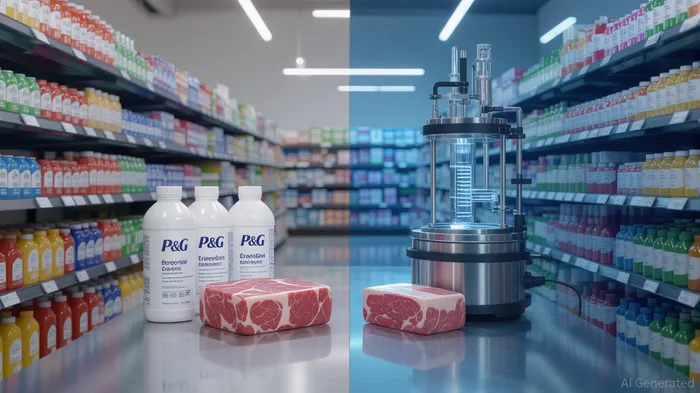
For investors, the key lies in diversifying across defensive staples and high-growth innovators. Procter & Gamble and Church & Dwight offer stability and income, with PG's 2.9% dividend yield providing a buffer against inflation. Sysco's undervaluation and AI-driven logistics make it a value play with upside potential. In the innovation space, companies like Perfect Day and UPSIDE Foods represent the future of food, albeit with higher volatility.
The Road Ahead: Navigating Uncertainty with Discipline
As tariffs and inflation persist, the consumer staples sector's resilience will hinge on three pillars: localization, technological integration, and sustainability. Companies that master these will outperform, while those clinging to outdated supply chains will falter. Investors should prioritize stocks with strong balance sheets, pricing power, and a clear path to innovation—whether through AI, regenerative agriculture, or next-gen proteins.
The market's current volatility is a buying opportunity for those who recognize that the future of food is not just about survival but transformation. By anchoring portfolios in undervalued staples while allocating to disruptive innovators, investors can navigate the storm and position for long-term gains.

Stay ahead of the market.
Get curated U.S. market news, insights and key dates delivered to your inbox.


AInvest
PRO
AInvest
PRO



Comments
No comments yet