
Navigating the Industrial Slowdown: Strategic Sector Rotation and Yield-Driven Defense in a Shifting Economy
 Aime Summary
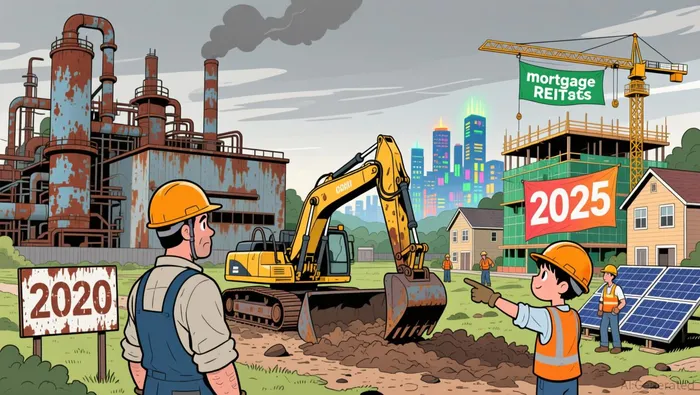
The U.S. industrial sector, a cornerstone of economic resilience, has entered a phase of structural recalibration. While Q2 2025 saw a modest 1.1% annualized growth in industrial production, the third quarter revealed a stark bifurcation: capital goods manufacturers faced weak demand and underutilized capacity, while mortgage REITs (mREITs) emerged as yield-generating safe havens. This divergence mirrors historical patterns observed during industrial slowdowns, offering a roadmap for investors to navigate the current cycle.
Historical Sector Divergences and Cyclical Rotation
From 2000 to 2025, U.S. industrial production contractions have consistently triggered a reallocation of capital toward defensive, income-focused assets. During the 2008 financial crisis and the 2020 pandemic, capital goods sectors—particularly electrical equipment and machinery—experienced margin compression and underutilized capacity. For instance, in Q3 2025, the Electrical Equipment sector saw 117 deals, down from 147 in Q2, signaling a slowdown in investment. Meanwhile, mREITs, with 89% of their debt fixed-rate, capitalized on the transition from speculative development to stabilized operations.
Backtested data reveals a recurring pattern: investors who rotated into mREITs during industrial downturns outperformed those overexposed to capital goods. For example, during the 2008-2009 recession, mREITs like Annaly Capital ManagementNLY-- (NLY) and American Capital Agency (AGNC) delivered double-digit returns, while capital goods indices lagged. This trend repeated in 2020, with mREITs gaining 15-20% as industrial production contracted.
Fed Policy Implications and Rate Cut Expectations
The Federal Reserve's policy trajectory will play a pivotal role in shaping the next phase of the cycle. With industrial capacity utilization at 77.5% in July 2025—2.0 percentage points below its long-run average—pressure for rate cuts is mounting. Historical precedent suggests that Fed easing typically precedes a shift in capital flows toward yield-generating assets. For instance, the 2009 rate cuts catalyzed a 30% rebound in mREITs, while the 2020 emergency rate cuts spurred a 25% surge in the sector.
By 2026, investors should anticipate a similar dynamic. As the Fed signals rate cuts to offset industrial slowdowns, mREITs will likely benefit from a repricing of risk. Current cap rates for industrial real estate have expanded to 6.0%, creating attractive entry points for income-focused investors. Smaller industrial units in urban markets, such as Nashville and Charlotte, are particularly compelling, with asking rents reaching $13.50 per square foot (NNN).
Actionable Asset Allocation Shifts
To prepare for an end-of-cycle environment, investors should adopt a dual strategy: underweight capital goods and overweight disciplined mREITs.
- Underweight Capital Goods Sectors:
- Electrical Equipment and Machinery: These sectors face elevated input costs and weak demand. For example, parts output in Q3 2025 fell 1.6% due to tariff-related costs, while durable goods production declined 0.3%.
Construction and Industrial Machinery: High material costs and softening demand make these sectors vulnerable to further margin compression.
Overweight Yield-Generating mREITs:
- Disciplined mREITs with Conservative Leverage: Prioritize REITs with low debt-to-equity ratios and diversified portfolios. For instance, AGNCAGNC-- and REM have maintained leverage below 30%, insulating them from rate volatility.
Urban Industrial Units: Focus on smaller, high-traffic properties in cities like Charlotte and Nashville, where rent growth remains robust despite a 7.5% national vacancy rate.
Hedge Against Rate Cuts:
- Smart Grid and Energy-Efficient Infrastructure: These sectors offer partial insulation from industrial slowdowns while aligning with long-term trends in energy efficiency.
Conclusion: Positioning for the Next Cycle
The U.S. industrial sector is at a crossroads. While manufacturing and mining face headwinds, the One Big Beautiful Bill Act (OBBBA) and Fed policy shifts are creating tailwinds for industrial real estate and mREITs. Investors who heed historical patterns—rotating into defensive, yield-focused assets while avoiding overexposed capital goods—will be well-positioned to navigate the end of this cycle.
As the Fed prepares to ease rates in 2026, the time to act is now. By aligning portfolios with the structural shifts in capital allocation, investors can transform uncertainty into opportunity.

Stay ahead of the market.
Get curated U.S. market news, insights and key dates delivered to your inbox.
AInvest
PRO
AInvest
PRO



Comments
No comments yet