
Navigating the Impact of Trump's 25% Tariffs on India's Markets
 Aime Summary
The imposition of 25% tariffs by the Trump administration on Indian exports has sent shockwaves through global markets, testing the resilience of India's economy and its strategic positioning in the emerging world order. While the short-term volatility has been pronounced, the long-term implications reveal a more nuanced story of adaptation and recalibration. For investors, understanding the interplay between immediate market reactions and structural shifts is critical to navigating the evolving landscape of emerging market equities and commodities.
Short-Term Volatility: A Market Under Pressure
The announcement of Trump's tariffs triggered an immediate sell-off in India's equity markets. The Nifty 50 and BSE Sensex both fell by approximately 0.6% on the day of the announcement, reflecting investor anxiety over the potential erosion of export margins in sectors like textiles, pharmaceuticals, and marine productsMPX--. The Indian rupee depreciated to a five-month low of 87.74 against the U.S. dollar, amplifying concerns about inflationary pressures and the competitiveness of Indian exports. Foreign institutional investors (FIIs) accelerated outflows, withdrawing roughly Rs 25,000 crore over eight consecutive days, as capital shifted to perceived safer havens such as Hong Kong and South Korea.
The MSCIMSCI-- India Index, a barometer of the country's equity market, was on track for its weakest month since February 2025, underscoring the fragility of investor sentiment. While the market initially absorbed the shock—partly due to prior pricing of tariff risks—the uncertainty surrounding trade negotiations and the possibility of retaliatory measures from India or its partners kept volatility elevated.
Long-Term Strategic Shifts: Resilience in a Multipolar World
Despite the short-term turbulence, India's strategic approach to trade negotiations has demonstrated a commitment to long-term stability. Unlike other nations that have accepted hasty, rough-cut agreements, India has insisted on a comprehensive deal that balances its economic interests with geopolitical realities. This patience is rooted in a recognition that the U.S. tariff regime is part of a broader, pre-deal negotiation strategy. Analysts anticipate that the final tariff rate could settle in the 15–20% range, with the Indian government signaling its willingness to engage constructively while safeguarding domestic industries.
India's trade strategy has also evolved to mitigate vulnerabilities. The country has accelerated diversification of its export markets, reducing reliance on the U.S. and expanding trade ties with Southeast Asia, the Middle East, and Africa. This shift is not merely reactive but reflects a deliberate effort to hedge against future disruptions. For instance, India's exports to the U.S. account for only 2.5% of its GDP, a relatively low exposure compared to China or Vietnam, which face higher tariffs but benefit from more established supply chains.
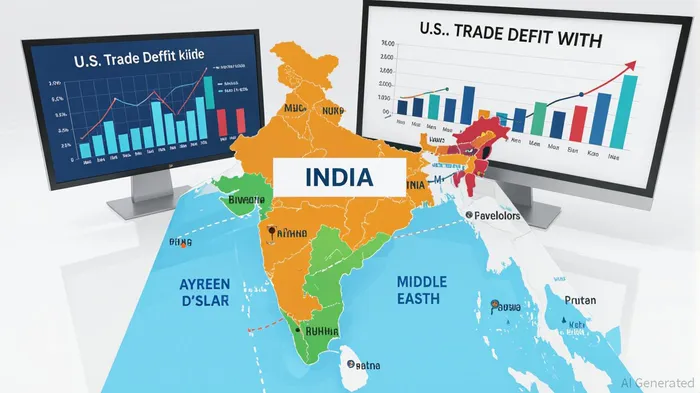
Commodity Markets and Trade Balances: A Comparative Lens
The impact on commodity markets has been mixed. While sectors like textiles and pharmaceuticals face margin pressures, others, such as energy and agriculture, may benefit from India's pivot to alternative markets. For example, India's purchase of Russian oil—a move that has drawn U.S. ire—has insulated its energy costs from global volatility, a critical advantage in a period of geopolitical uncertainty.
Comparatively, India's position stands in stark contrast to China and Vietnam. China, despite facing its own U.S. tariffs, has managed to secure reduced rates through negotiations, maintaining its dominance in global manufacturing. Vietnam, meanwhile, has struck a 20% tariff deal with the U.S., further cementing its role as a production hub. India's higher tariffs, though a short-term headwind, have not yet derailed its long-term growth trajectory, as the country leverages its demographic dividend and digital transformation to attract investment in sectors like technology and services.
Investment Implications: Navigating the New Normal
For investors, the key lies in discerning between sectors that are resilient to trade pressures and those that will face headwinds. Equities in export-dependent industries such as textiles and pharmaceuticals remain volatile, but opportunities exist in domestic consumption-driven sectors like private banking, telecom, and infrastructure. These sectors are less exposed to U.S. tariffs and benefit from India's robust domestic demand, which accounts for over 70% of its GDP.
Commodity investors should monitor the rupee's trajectory, as its depreciation could offset some of the margin pressures on exporters. However, the risk of a sharper depreciation—should the U.S. impose additional penalties on India's trade with Russia—remains a concern. Gold and dollar-denominated assets may offer safe-haven appeal in such scenarios.
Strategically, India's trade negotiations with the U.S. present a unique opportunity. A resolution that lowers tariffs to 15–20% would likely trigger a rebound in equities and commodities, particularly in sectors like automobiles and marine products. Investors with a medium-term horizon should closely watch the August U.S. trade delegation visit to India, as it could signal the path forward.
Conclusion: A Test of Resilience
Trump's tariffs on India are a test of the country's ability to balance immediate challenges with long-term strategic goals. While the short-term market reactions have been painful, India's measured approach to trade negotiations and its focus on diversification suggest a path toward resilience. For investors, the lesson is clear: volatility is inevitable, but strategic foresight and diversification are the keys to navigating the uncertainties of a multipolar world.

Delivering real-time insights and analysis on emerging financial trends and market movements.
Latest Articles
Stay ahead of the market.
Get curated U.S. market news, insights and key dates delivered to your inbox.




Comments
No comments yet