
Navigating the Impact of Southwest Airlines' Policy Shifts on Airline Sector Valuations
 Aime Summary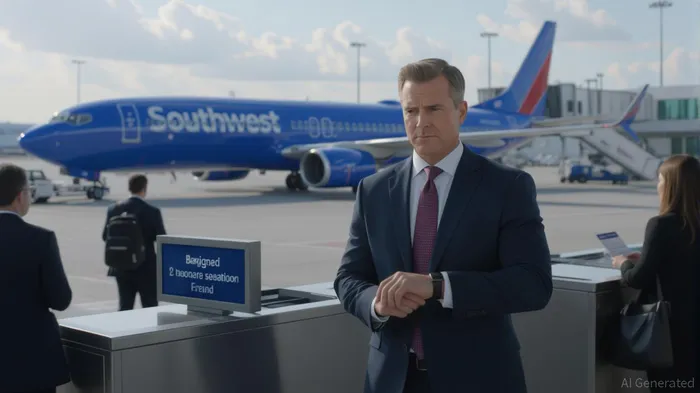
Southwest Airlines' 2025 policy overhaul—spanning seating, baggage fees, and fare structures—has ignited a firestorm of debate among investors, analysts, and travelers. At first glance, these changes appear to align with industry trends, where airlines like DeltaDAL-- and United have long monetized ancillary services. Yet Southwest's departure from its “Bags Fly Free” ethos and open-seating model has raised critical questions: Are these moves a strategic evolution or a brand-eroding gamble? And how might they reshape the broader airline sector's valuation dynamics?
Strategic Shifts and Operational Realities
Southwest's new fare tiers—Basic, Choice, Choice Preferred, and Choice Extra—introduce a tiered pricing model designed to maximize revenue per passenger. The Basic fare, for instance, strips away flexibility (nonrefundable, no changes) and requires paid seat selection, while the top-tier Choice Extra offers perks like extra-legroom seats and early boarding. This segmentation mirrors strategies used by legacy carriers but marks a stark departure for SouthwestLUV--, which built its brand on simplicity and customer-friendly policies.
The shift to assigned seating, effective January 2026, is particularly contentious. While the airline argues it enhances predictability for passengers, critics view it as a betrayal of Southwest's identity. The backlash is palpable: social media campaigns and customer surveys highlight frustration over losing the spontaneity of choosing a seat. However, the airline projects these changes will generate $1.5 billion in annual seat revenue and contribute to a $4.3 billion operating profit boost by 2026.
From a cost perspective, Southwest's bag fee rollout (initially $35 for the first checked bag) has already exceeded financial expectations without operational hiccups. The company's fleet modernization—retiring older aircraft and adopting fuel-efficient BoeingBA-- 737-8s—has also improved efficiency, with a 2.9% year-over-year fuel efficiency gain. These moves suggest a disciplined approach to cost management, even as they risk alienating price-sensitive travelers.
Investor Sentiment and Stock Performance
The market's reaction has been mixed. Southwest's stock (LUV) closed at $30.75 as of August 12, 2025, up 0.10% from the prior session, but has underperformed the broader airline sector. Over the past year, the stock returned 20.85%, lagging the US Airlines industry's 89.1% gain. Analysts remain divided: UBSUBS-- upgraded its price target to $34.00, while CitigroupC-- cut its target to $23.00. The average 12-month price target of $31.20 reflects cautious optimism, but the wide range ($23–$40) underscores uncertainty.
Southwest's financials tell a nuanced story. While the company returned $1.6 billion to shareholders via buybacks and dividends in Q2 2025 and authorized a new $2.0 billion repurchase program, its net margin remains negative at -2.32%. The payout ratio of 106% has also raised concerns about dividend sustainability. Yet, the airline's liquidity—$3.8 billion in cash and a $1.0 billion credit line—provides a buffer against volatility.
Competitive Positioning and Sector Implications
Southwest's policy shifts aim to close the gapGAP-- with legacy carriers in ancillary revenue. The airline now projects $1.8 billion in EBIT from these initiatives in 2025, with $4.3 billion expected in 2026. However, this strategy risks diluting its unique value proposition. Competitors like Spirit and FrontierULCC-- have already weaponized low fares and aggressive ancillary pricing, while Southwest's new Basic fare could cannibalize its own customer base.
The broader sector may face a ripple effect. If Southwest's model proves profitable, other airlines could follow suit, accelerating the commoditization of air travel. Conversely, if customer dissatisfaction persists, it could signal the limits of profit-driven policy shifts. The key question is whether Southwest can balance revenue growth with brand integrity—a challenge that will define its long-term success.
Investment Considerations
For investors, the calculus hinges on two factors: execution risk and sector dynamics. Southwest's ability to implement these changes without operational hiccups (e.g., seating chaos, customer attrition) is critical. The airline's recent cost-cutting progress and fleet modernization are positives, but its negative net margin and high payout ratio remain red flags.
In the short term, Southwest's stock appears range-bound, with technical indicators suggesting limited upside unless the company demonstrates clear margin expansion. For long-term investors, the airline's transformational plan—assuming it delivers on $4.3 billion in EBIT by 2026—could justify a premium valuation. However, the risks of customer backlash and competitive erosion cannot be ignored.
Conclusion: A Tipping Point for the Sector
Southwest's policy shifts are a microcosm of the airline industry's broader struggle: balancing profitability with customer loyalty. While the changes may boost short-term revenue, their long-term success depends on whether travelers are willing to pay for convenience and whether the airline can maintain its cost discipline. For investors, the lesson is clear: airline valuations are increasingly tied to operational agility and brand resilience. Southwest's journey will be a litmus test for whether the sector can evolve without losing its soul.
Investment Advice: Consider a cautious, time-distributed approach to Southwest's stock. Monitor key metrics like EBIT growth, customer satisfaction scores, and ancillary revenue trends. For a diversified portfolio, pairing Southwest with more stable, high-margin carriers like Delta or American AirlinesAAL-- could hedge against sector-specific risks.

Delivering real-time insights and analysis on emerging financial trends and market movements.
Latest Articles
Stay ahead of the market.
Get curated U.S. market news, insights and key dates delivered to your inbox.
AInvest
PRO
AInvest
PRO



Comments
No comments yet