
Navigating the Housing Slowdown: Sector-Specific Investment Strategies in a Cooling Market
 Aime Summary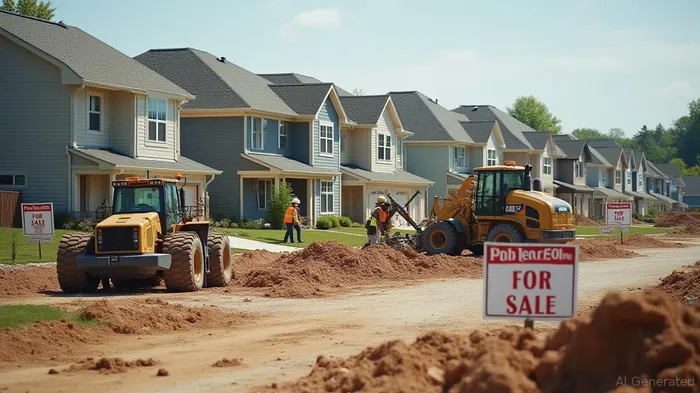
The U.S. housing market is at a crossroads. In May 2025, the Federal Housing Finance Agency (FHFA) reported that the U.S. House Price Index (MoM) fell by 0.2%, exceeding expectations of a 0.1% decline and marking the third consecutive month of softening. This data point, coupled with a year-over-year growth rate of 2.8% (down from 3.4% in April), underscores a broader cooling trend. For investors, this is not merely a blip but a signal to recalibrate strategies across construction, housing, and related industries.
Sector-Specific Impacts and Market Implications
The housing slowdown is reshaping dynamics across key sectors:
- Construction and Homebuilding
High mortgage rates (averaging 6.7% in Q2 2025) have created a "lock-in" effect, where homeowners are reluctant to sell due to being significantly out-of-the-money on their mortgages. This has starved the market of inventory, with single-family existing homes for sale remaining near record lows. For homebuilders like KB HomeKBH-- (KBH) and LennarLEN-- (LEN), the result is a strategic pivot: 37% of builders cut prices in June 2025, while 62% offered incentives—a shift toward margin protection over volume.
Construction activity is also slowing. Total housing starts fell 9.8% in May 2025, with single-family permits declining 2.7%. Builders are prioritizing efficiency, as seen in Lennar's reduced construction cycle times and Toll Brothers' focus on luxury homes. For investors, this signals a need to avoid speculative bets on speculative land plays and instead focus on builders with strong balance sheets and regional specialization.
Real Estate Investment Trusts (REITs) and Property Markets
Regional disparities are critical. The Middle Atlantic division saw 5.9% year-on-year price growth in May, while the Pacific division lagged at 0.6%. Investors in real estate platforms like Arrived note that single-family residential properties in midwestern cities (e.g., Detroit, Cleveland) offer more affordable entry points, with average annualized dividends of 3.7%. The launch of the Seattle City Fund in Q2 2025 highlights opportunities in high-growth markets, though investors must balance growth potential with affordability risks.Digital and Renewable Infrastructure
While housing construction slows, digital infrastructure is surging. Data centers, driven by AI demand, accounted for 25% of sector-specific capital raised in Q1 2025. This trend is outperforming traditional infrastructure by 300 basis points, per the Infrastructure Quarterly report. Conversely, U.S. clean energy manufacturing faces headwinds as policy uncertainty (e.g., accelerated IRA incentive expiration) dampens project pipelines. Investors should prioritize digital infrastructure over renewables unless policy clarity emerges.
Policy and Consumer Behavior Shifts
The housing market's trajectory is also shaped by policy and consumer behavior. President Trump's proposed zoning reforms and federal land allocation for housing could alleviate supply constraints, but his immigration stance risks worsening labor shortages—a critical concern for a construction sector already reliant on immigrant labor (30% of workers).
Consumer behavior reflects caution. With mortgage rates near 7%, buyer demand remains muted. The National Association of Home Builders (NAHB) reports builder confidence at a 10-year low (32 in June 2025), as affordability challenges persist. This "wait-and-see" attitude is pushing buyers toward rentals, with Zillow forecasting a 4% rise in single-family rents in 2025.
Actionable Investment Strategies
For investors navigating this landscape, the following strategies emerge:
Regional Diversification
Allocate capital to markets with stable or rising prices and strong fundamentals. Midwestern and Northeastern cities with inventory growth (e.g., Cleveland, Dayton) offer better affordability and long-term value. Avoid overvalued West Coast markets, where Pacific division growth is stagnant.Homebuilder Exposure with Caution
Prioritize builders with strong cash flow and regional focus. KB Home and D.R. Horton (DHI) are better positioned than speculative plays like Lennar, which faces margin compression. Monitor mortgage rate trends—any drop below 6.5% could trigger a short-term price surge.Digital Infrastructure Over Renewables
Invest in data center REITs or tech-focused infrastructure funds. These assets are insulated from housing market volatility and align with AI-driven demand. Avoid clean energy projects until policy clarity emerges.Short-Term Rental Opportunities
Vacation rental platforms like AirbnbABNB-- continue to outperform in a high-rate environment. Arrived's vacation rental portfolio, with 94% stabilized occupancy, offers a 2.4% annualized yield—ideal for income-focused investors.
Conclusion
The U.S. housing market is transitioning from a high-price, low-inventory phase to a more localized, selective environment. While a full-blown crash is unlikely, investors must adapt to slower growth, affordability challenges, and policy-driven shifts. By focusing on regional diversification, digital infrastructure, and defensive homebuilders, portfolios can weather the cooling market and capitalize on emerging opportunities. The key lies in balancing long-term value with agility in a rapidly evolving sector.


Stay ahead of the market.
Get curated U.S. market news, insights and key dates delivered to your inbox.
AInvest
PRO
AInvest
PRO



Comments
No comments yet